
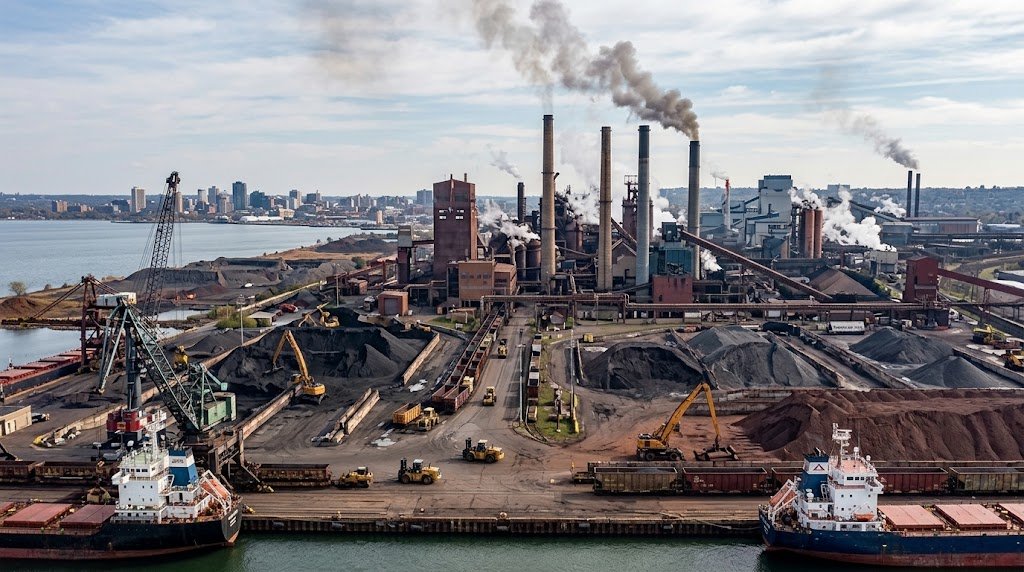
Industry Minister Mélanie Joly says the Hamilton steelmaker’s U.S. owner has breached promises made when it bought the company. Stelco says it has not, and the layoffs are going ahead.
Stelco job commitments are now the centre of a legal and political standoff between the Canadian government and the American company that owns the Hamilton steelmaker. On Friday 16 October 2026, Industry Minister Mélanie Joly told a Toronto audience that Cleveland-Cliffs “must uphold its commitments, full stop”. She also warned that the company could be forced to sell its Canadian assets. Ottawa says the plan to idle part of Stelco’s Hamilton operations breaks promises tied to the 2024 takeover. The company, however, says it is acting within the terms it agreed to.
How the Dispute Began
Stelco announced on 28 September that it would indefinitely idle its Hamilton Works finishing lines, which produce cold-rolled and coated steel. Production will be concentrated at its Lake Erie Works plant in Nanticoke, Ontario. The company said up to 500 workers across the two sites could be affected, although the United Steelworkers’ local has estimated the number of layoffs at about 350. The wind-down was reported to begin on 9 October.
Cleveland-Cliffs, an Ohio-based steelmaker, bought Stelco in 2024 in a deal reported at $3.4 billion. Ottawa approved the purchase under the Investment Canada Act, which governs foreign takeovers. The approval came with conditions, including that the new owner keep at least as many unionized workers as Stelco had when the deal was announced, and the vast majority of its non-union staff, for five years. The government has put the workforce covered by those commitments at more than 1,500 people.
Why Ottawa Says Stelco Job Commitments Were Broken
On Monday 5 October, Joly wrote to Stelco president Paul Simon and gave the company five business days to submit a plan showing how it would meet all of its obligations. She said the commitments do not stop applying because market conditions have changed. She also said Ottawa was ready to seek a court ruling to enforce them. On 7 October she told reporters that no response had arrived and that the government would use “the full force of the law” if the company did not comply.
Her 16 October speech went further. Joly said it is the government’s position that Stelco has breached its commitments more than once, and that the Investment Canada Act offers options through a court process. She added that Ottawa has hired lawyers to review its next steps. She also pointed to the company’s chief executive, Lourenco Goncalves, who has publicly supported American steel tariffs, and argued that the company cannot treat the trade measures as an event beyond its control. Her remarks stopped short of saying Ottawa would take an ownership stake in the company.
The Company’s Position
Stelco replied to Ottawa in a letter around 10 October. It said it is not in violation of the Stelco job commitments and is proceeding with the Hamilton idling as planned. The company also said the government’s offers of financial assistance did not address the root cause of the decision. It added that laid-off workers can apply for openings at Lake Erie Works, but the local union says only 46 positions are available there.
Goncalves has described the move as a business decision to concentrate production. He has argued that the ability to sell steel freely into the United States was an underlying condition of the deal. He has also said he would not have bought Stelco had he known how relations between the two countries would change. Meanwhile, Prime Minister Mark Carney has said federal money has been put on the table to keep workers employed, without disclosing the amount or terms. Cleveland-Cliffs’ chief executive has said no amount of money would have changed the decision.
What the Law Allows
According to industry reporting, a superior court could order the company to meet its obligations, impose monetary penalties or order a sale of the business if the government applies. Not everyone agrees on how far the remedies go. A McMaster University economist told the Hamilton Spectator that fines might be the only available recourse, and that they could be appealed. There is also a precedent. In 2009, Ottawa took U.S. Steel to court over employment and production promises it made when it bought Stelco in 2007.
What It Means for Workers
For the steelworkers affected, the legal fight moves more slowly than their bills arrive. Employment Insurance pays 55 per cent of average insurable weekly earnings, up to a maximum of $729 a week in 2026, and those benefits are taxable. Workers who are asked to sign anything affecting their recall or severance rights should speak to their union or an employment lawyer first. It also remains unclear how many of the laid-off workers will be offered jobs at Lake Erie Works, since the two sides give different pictures of how many positions exist.
What Happens Next
The next move is Ottawa’s. The government has said it believes there have been multiple breaches, and it must now decide whether to apply to a court under the Investment Canada Act. No court filing had been reported at the time of writing, and the company has not changed course. The first major test of the conditions attached to this foreign takeover will show how enforceable the Stelco job commitments really are. It will also show whether similar promises in other deals carry real weight. For more reporting on stories that affect workers and communities, visit Human Crisis News. For the government’s initial five-day ultimatum, see CBC News’ report on the letter to Stelco.