
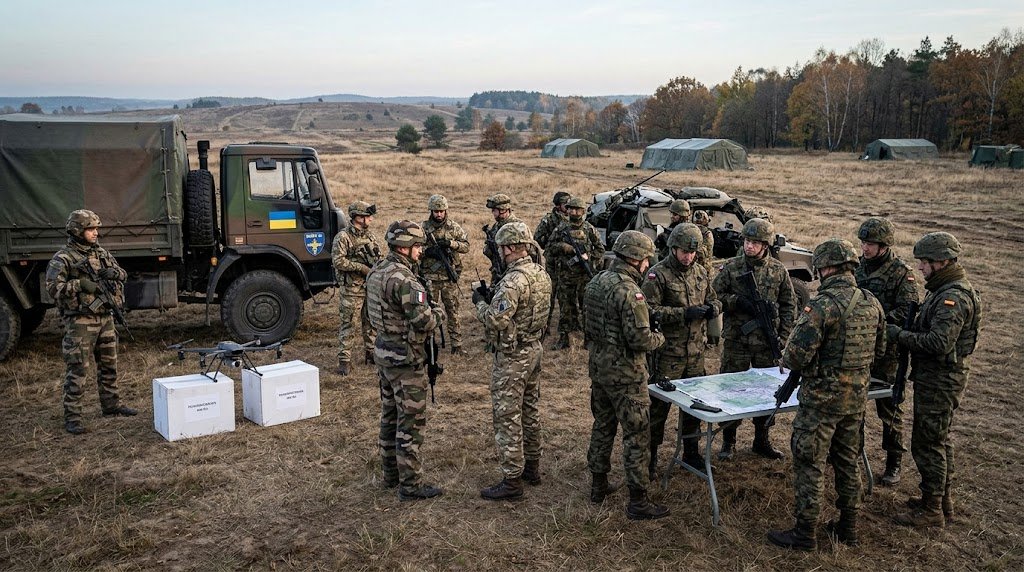
The Multinational Force Ukraine, a coalition led by France and the United Kingdom, will hold its first exercise in southeastern Poland from November 9 to 22, the two governments announced on Tuesday, November 3. Around 2,800 troops from 10 European countries are due to take part in the drill, which is named Koalicja, the Polish word for “coalition.” The force exists to support Ukraine after a ceasefire, and no such ceasefire has been agreed.
What the Multinational Force Ukraine exercise will test
According to a joint statement released by the French defense ministry, the exercise is meant to measure the speed and efficiency with which several nations can deploy forces on land, sea and air once hostilities have ended. Britain’s Lt. Gen. Tom Bateman, who will co-lead the drill with France’s Gen. Armel Dirou, said it will test coordination arrangements, the movement of personnel, equipment and supplies, and whether the national components can operate together as one force. Dirou called the exercise “a key milestone” and said it will show the force’s ability to deploy as soon as the fighting stops.
The equipment on the ground in Poland will be light. Reports on the joint statement say participants will use items such as drones for anti-drone and self-defense training, rather than heavy weapons. Because the aim is rehearsal rather than combat, much of the work will be logistical, such as moving people and supplies quickly and checking that different national systems fit together.
Who is taking part
France and the UK lead the effort, and Poland is hosting and will contribute its own troops. The joint statement also names Belgium, Estonia, Germany, Lithuania, the Netherlands, Spain and Sweden for the land and air portion, which makes 10 countries in total. Ukraine is not among the 10 listed participants in the reports reviewed by HCN, although the force is designed to support it. Turkish troops will not take part in the land exercise in Poland.
What the Multinational Force Ukraine is, and what it is not
The force was set up in 2025 and already has an operational headquarters in Paris. It is not a NATO operation, and U.S. involvement is limited. Its stated tasks are to support Ukraine’s armed forces, help secure Ukrainian skies and allow economic activity to resume in the Black Sea. Officials have stressed that it has no offensive mission, and Bateman said it is not a peacekeeping or ceasefire monitoring mission. The UK defense minister, Wes Streeting, said in the British statement that the force is meant to reassure Ukraine, help rebuild its military and strengthen its ability to deter future Russian aggression.
The phrase “post-ceasefire” can therefore be misleading. The exercise rehearses what would happen after a ceasefire, but it does not mean one exists. A limited truce linked to an aid mission in the Russian-occupied city of Oleshky ended just days ago, and Ukrainian officials reported a deadly Russian strike on an aid distribution center in the Zaporizhzhia region on Monday. Moscow has said it does not target civilians.
Russia’s likely view and the political backdrop
AFP noted that the size and length of the drill risk antagonizing Russia, which has shown little appetite for a peace settlement. HCN did not find a Russian government response to the announcement in the reports reviewed. For its part, Bateman said the drill is not a show of force. Whether Moscow accepts that description is unknown, and any Russian reaction will shape how the exercise is seen politically.
What the Multinational Force Ukraine exercise means for civilians and what to watch
The reports reviewed describe no direct impact on civilians, either in Poland or in Ukraine, and they do not say whether residents of the exercise area should expect disruption. The value of the drill is therefore mostly strategic, because it shows how prepared Ukraine’s backers are to act if a ceasefire is reached. The key questions are whether the exercise proceeds as planned, how Russia responds and whether peace talks produce a ceasefire that would put the force to use. Readers can follow updates on Human Crisis News, and the France 24 report on the announcement carries the joint statement’s main details.