
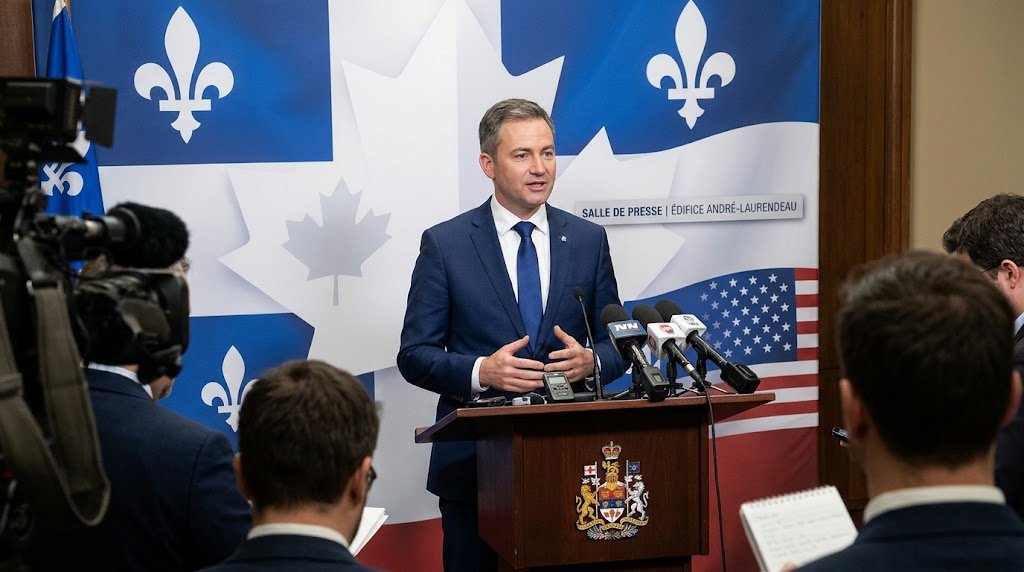
Quebec diplomatic offensive plans were announced on Wednesday, November 4, when Premier Paul St-Pierre Plamondon said his government will prepare outreach to American officials, one day after U.S. midterm elections handed both chambers of Congress to the Democrats. Speaking to reporters in Quebec City, the leader of the Parti Québécois said the result changes the political picture around the long-running trade dispute between Canada and the United States. The reports reviewed by HCN did not include a schedule for the outreach or a list of the American officials Quebec intends to approach.
Quebec diplomatic offensive: key facts at a glance
- Who: Quebec Premier Paul St-Pierre Plamondon of the Parti Québécois, which formed a minority government after the provincial election on October 5.
- What: A plan to open discussions with U.S. counterparts to look for a solution to the tariff dispute. The premier said Quebec does not plan to negotiate trade directly with Washington for now.
- When: Announced on Wednesday, November 4, 2026, the day after the U.S. midterm elections.
- Why now: Democrats won control of both the House and the Senate, according to Canadian reporting, and the trade war with Canada was an issue in close races in Maine and Michigan.
- What is still unknown: Which officials Quebec will approach, and when the outreach will begin.
What the premier said about the Quebec diplomatic offensive
St-Pierre Plamondon told reporters that Quebec is in a better position to look for a solution now that “Americans have spoken.” He described the plan as an effort to open discussions with U.S. counterparts and see whether the tariff dispute can be eased. He also made clear what the Quebec diplomatic offensive is not, at least for now: his government does not plan to negotiate trade terms directly with Washington. The first step, he said, is to open channels of discussion before taking any position on direct talks.
That restraint reflects how trade works in Canada. Negotiating trade agreements with other countries is led by the federal government in Ottawa, while provinces such as Quebec can lobby, build relationships and make their economic case to legislators, governors and business leaders. Ontario Premier Doug Ford has signalled a similar approach, saying he will send ministers to Washington to meet newly elected members of Congress once they take office.
Why the midterms changed the calculation
According to CBC reporting, Democrats flipped Republican-held Senate seats in Texas, Kansas and South Carolina while holding battleground seats in Georgia and Michigan. The same reporting said the trade war with Canada became a ballot-box issue in close contests in Maine and Michigan, where Democrats defeated their Republican rivals. Democratic leaders have signalled that they want to end the tariffs, which is the opening the Quebec diplomatic offensive is designed to use.
Canadian officials, however, are urging caution. Canada-U.S. Trade Minister Dominic LeBlanc said Ottawa’s focus has not changed and noted that the current Congress remains in office until January, so Canada must keep working with the lawmakers who hold power today. Justice Minister Sean Fraser called it dangerous to assume what will happen before sitting down with U.S. partners. Ford said it would be wrong to think the trade war is over, because the president still holds the power to impose tariffs. A National Bank Financial analysis published in September made a related point: even a Democratic Congress cannot easily override a presidential veto, which would take a two-thirds vote in both chambers.
What is at stake for Quebec’s economy
The United States is by far Quebec’s largest trading partner. CBC reported earlier that the province exported just over 87 billion dollars in goods to the U.S. in 2023, according to the Institut de la statistique du Québec. The current U.S. tariffs target softwood lumber, aluminum and a range of manufactured goods, which makes Quebec one of the provinces hit hardest. A 2025 Canadian Press report found that the Saguenay–Lac-Saint-Jean region produces about one-third of Canada’s aluminum and sends around 85 per cent of it to the United States, which shows how directly the tariffs reach workers and towns outside the big cities.
The wider dispute has deepened since talks between Ottawa and Washington collapsed in August, which was followed by broader U.S. tariffs on Canadian goods. Canada responded with counter-tariffs of between 15 and 50 per cent on roughly 27.6 billion dollars’ worth of U.S. imports, according to Global News. Prime Minister Mark Carney said on Tuesday that “more intense” negotiations with Washington had begun after a weekend phone call with President Donald Trump.
Tension between Quebec City and Ottawa
The Quebec diplomatic offensive arrives while the relationship between the premier and the prime minister is still strained. St-Pierre Plamondon did not attend last week’s Canada-European Union summit in Montreal after Ottawa declined to give him official speaking rights. He has accepted an invitation to meet Carney but insists that the meeting take place in Quebec City. The two have spoken by phone but have not formally met since the provincial election, and they could cross paths at the Francophonie summit in Cambodia later this month.
The Parti Québécois is a sovereigntist party, which means it supports Quebec becoming an independent country. Reports have said the premier ruled out holding an independence referendum while Trump remains in office. It is not yet clear whether Quebec’s outreach and the federal government’s own talks will reinforce each other or create friction, since neither side has described how they would coordinate.
HCN analysis: what the Quebec diplomatic offensive can and cannot achieve
The evidence available so far describes an intention, not a result. No contacts, dates or meetings have been announced, so it is too early to judge whether the Quebec diplomatic offensive will change anything on the ground. What the reporting does show is that the premier chose a deliberately limited first step. He ruled out direct negotiations, and the federal officials quoted all stressed that Ottawa leads the talks. On that evidence, Quebec’s realistic role is persuasion: building relationships with American lawmakers and business leaders who may have reasons of their own to want lower tariffs.
Timing also matters. The current Congress stays in place until January, and Ford’s own plan is to travel to Washington once new members are sworn in. Starting conversations now could mean Quebec has contacts ready when the new Congress arrives, though that is HCN’s reading of the sequence, not something the premier has said. The main risk visible in the reporting is the open dispute between Quebec City and Ottawa. If the two governments send different messages, the Quebec diplomatic offensive could dilute rather than strengthen Canada’s case. These points are HCN’s assessment of the available facts and are separate from the reported statements above.
Why the Quebec diplomatic offensive matters beyond Canada
For readers outside Canada, the story shows how a trade dispute between two close partners now runs through domestic politics on both sides of the border. Conservative Leader Pierre Poilievre argued after the vote that Americans dislike the tariffs and that a tariff on Canada is a tax on Americans, a view that reflects his position rather than an established finding. Canada has also been widening its trade ties elsewhere, with recent trips to China and India and an associate membership with the European Union, according to Global News. A provincial government reaching out directly to U.S. political figures adds a third channel alongside Ottawa’s talks and those wider efforts.
What to watch after the Quebec diplomatic offensive announcement
The first signs will be practical ones: whether Quebec names the U.S. contacts it plans to approach, whether a date is set for the meeting between the premier and the prime minister, and how the federal negotiations with Washington develop. The new Congress is due to be sworn in in early January, which is when Democratic lawmakers can begin to act on any plan to challenge the tariffs. For more coverage of trade and politics, see the latest news on Human Crisis News, and for the full range of Canadian reactions to the midterms, Global News has a detailed report.