
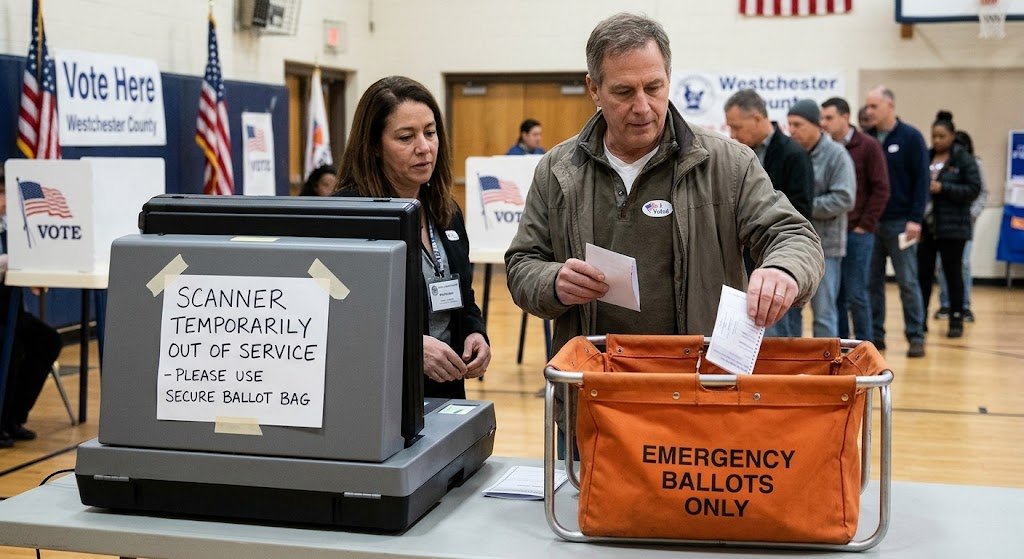
A ballot scanner failure left voters across Westchester County, New York, unable to feed their ballots into machines shortly after polls opened on Tuesday, November 3. Election workers instead collected completed ballots in orange emergency bags, which are secured and counted later under state election law. County and state officials said every ballot would be counted. Still, the breakdown happened in one of the most closely watched House battlegrounds in the country, which means part of the county’s Election Day vote will be tabulated later than planned.
What caused the ballot scanner failure in Westchester?
The Westchester County Board of Elections first told voters that some ballots appeared to be too thick for the scanners to accept. A later statement dropped that explanation without replacing it. Gothamist later reported, citing a statement from the New York State Board of Elections, that the problem traced back to updated election programming that had not been properly deployed to the scanners. According to that report, officials worked through the day to bring one working scanner back online at each polling place. Because the public explanations have changed, the exact cause of the ballot scanner failure should be treated as not yet fully established.
Voters were urged to stay in line and complete their ballots, which poll workers placed in the emergency bags to be monitored and counted later. New York Attorney General Letitia James said her office was in touch with state and local boards of elections and told Westchester voters that their votes would count. The county board said it was in constant contact with state officials, the county government and poll workers to keep voting going with as little disruption as possible.
Why the Westchester ballot scanner failure matters
Westchester County, just north of New York City, sits at the centre of the congressional race between Republican Rep. Mike Lawler and Democratic challenger Cait Conley, which Gothamist described as a marquee contest. The county could also be an important swing area in other races on the ballot. Gothamist reported that results in the congressional contest could be delayed. A delay is not the same as a lost vote, but in a close race, every extra hour or day before the count is complete extends the period of uncertainty for candidates, campaigns and voters alike.
How emergency ballot bins work when a scanner fails
Most places that use paper ballots and optical scanners keep a locked emergency compartment for moments when a machine cannot accept ballots. Oklahoma’s State Election Board, for example, explains that ballots placed in its emergency bin are counted by poll workers once the problem is fixed or after the polls close. Rules differ by state and county, but the principle is the same: the ballot stays on paper and is counted later, instead of being lost or turned away.
The trade-off is that voters lose the immediate feedback a working scanner can provide. Researchers who study election administration have noted that scanners can warn a voter who has marked too many choices in a race, giving them the chance to correct the ballot, and that warning is not available when a ballot goes straight into a bag. For voters, a ballot scanner failure also asks for more trust: instead of watching a machine accept the ballot, they hand it over and rely on the chain of custody that follows.
Rumours moved faster than the explanation
The scanner problem spread online within hours. CyberScoop reported that equipment failures like this occur in a small number of precincts in every election cycle and that there is no evidence of foul play. It also cited University of Washington professor Kate Starbird, who studies election-related rumours, as finding that posts about the Westchester failure on X reached as many as 100 a minute, with some accounts framing it as proof of election malfeasance.
A machine failure is not evidence of manipulation, and emergency procedures exist precisely so that ballots stay on paper when technology breaks down. At the same time, a shifting official explanation leaves a gap that rumours can fill, which is why a clear public account of what went wrong matters after any ballot scanner failure.
Other ballot scanner failure reports across the United States
North Carolina’s State Board of Elections described minor delays at some precincts, blaming printer jams, power problems and longer lines, according to reporting on its statements. It scheduled a meeting to consider extending voting hours at affected sites only, as state law limits any extension to the length of the interruption. In Georgia, Fulton County officials said two scanners failed during early voting, leaving 1,069 ballots to be recovered or rescanned, a step that required approval from the county elections board, according to CBS Atlanta. That problem occurred before Election Day.
HCN did not find confirmed accounts from election officials of Election Day scanner failures in Iowa, Oklahoma or Wisconsin at the time of writing, and unverified social media posts are not treated here as evidence of failures.
What to watch after the ballot scanner failure
The key questions are how many Westchester ballots ended up in emergency bags, when they will be counted, and whether state or county officials publish a clear technical explanation. Local audits and the county canvass, the formal review and certification of results, will show whether the count matches the number of ballots cast. More politics and election coverage is available on Human Crisis News.