
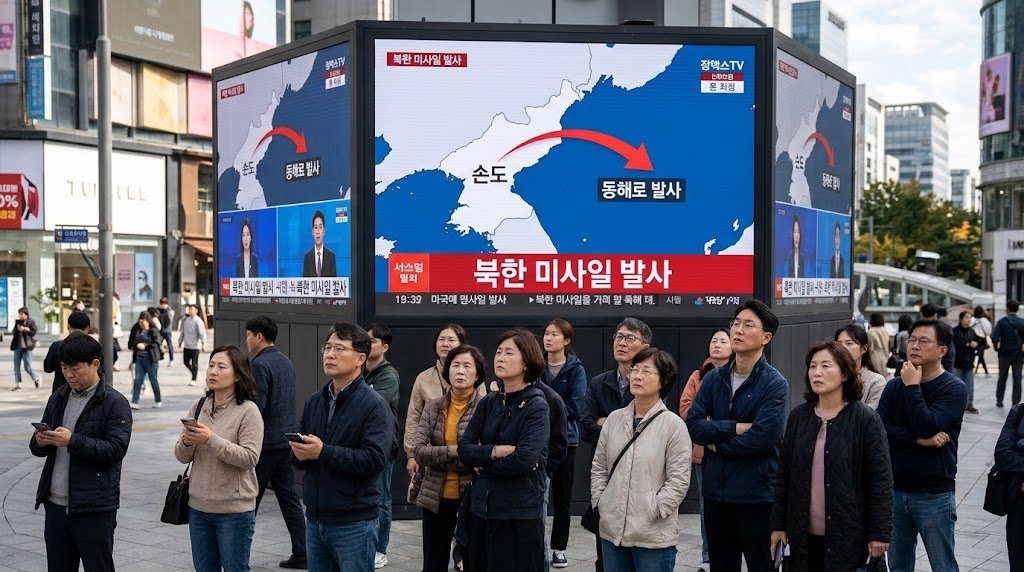
North Korea missile launch reports from Seoul on Wednesday, November 4, said the North fired multiple missiles from the Sondok area of South Hamgyong Province toward the East Sea, also known as the Sea of Japan. South Korea’s Joint Chiefs of Staff (JCS) said the missiles are believed to have flown less than 300 kilometres and that South Korean and U.S. officials are analysing what type they were.
Pyongyang’s state media later described the activity as a test of a new air defence missile system and a cruise missile strike drill. That leaves a gap between the two accounts that has not yet been resolved.
North Korea missile launch: key facts at a glance
- When and where: Early Wednesday, November 4 (Korean time), from the Sondok area in South Hamgyong Province on North Korea’s east coast.
- What Seoul says: Multiple missiles, flying less than 300 km, possibly including a close-range ballistic missile. The type has not been officially confirmed.
- What Pyongyang says: State media reported on Thursday a test of a new air defence missile system and a strike drill with a long-range strategic cruise missile against a virtual airport target.
- Pattern: Yonhap counted it as the North’s fourth weapons test in a week.
- What is unknown: The exact number and types of missiles, and any official reaction from Washington or Tokyo, which HCN did not find.
What South Korea’s military says about the North Korea missile launch
The JCS said it detected the launches from the Sondok area and that further analysis of the missiles’ specifications was under way together with the United States. In a notice to reporters, it said South Korean and U.S. forces had watched the launch from its preparation stage and tracked the missiles from lift-off, and that the military is ready to “respond overwhelmingly to any provocations.”
The JCS assessed that the missiles flew under 300 km and did not rule out that they included a close-range ballistic missile. A ballistic launch would breach UN Security Council resolutions that bar North Korea from such tests, resolutions Pyongyang rejects.
An outside expert, Shin Jong-woo of the Korea Defense and Security Forum, told Yonhap the weapon appeared to be the Hwasong-11 Ra, a short-range tactical ballistic missile. That is an expert’s reading, not an official identification.
Yonhap noted that if the launch is confirmed as ballistic, it would be the third ballistic launch by the North in a week. The reports reviewed by HCN did not mention damage, casualties or any missile landing in Japanese waters.
What Pyongyang says about the missile test
According to Korea’s state news agency KCNA, as relayed by Yonhap, the Missile Administration tested a newly designed air defence missile system to confirm its technical capabilities, including its guidance modes and its ability to identify and track targets. KCNA also said that a unit of the long-range strategic cruise missile force in the east carried out a strike drill the same day against a virtual airport target.
These claims have not been independently verified. An air defence system is a defensive weapon, so the description does not obviously match a ballistic missile, and the JCS has not said which of its detections correspond to which of North Korea’s stated tests.
Until South Korea and the U.S. finish their analysis, the safest reading is that Seoul detected multiple launches and that Pyongyang is describing at least some of them as air defence and cruise missile tests.
Why the North Korea missile launch comes now
The launch is the latest in a run of weapons tests that began last Thursday with about a dozen short-range ballistic missiles fired from Wonsan, followed by a cluster bomb test on Saturday and a warhead test for a cruise missile on Monday, according to Yonhap. Experts told the agency the tests appear aimed at responding to Freedom Flag, the ongoing South Korea-U.S. air drills, which a member of North Korea’s Central Military Commission, Kim Jong-sik, had earlier criticised.
Other tensions are running at the same time. Kim Yo-jong, the sister of leader Kim Jong-un, issued two statements this week rejecting a U.S. investigation that blamed North Korea for the theft of more than six billion dollars in cryptocurrency from the Binance exchange. She said the North remains open to dialogue with Washington as an option but does not need it.
On the border, South Korea proposed military talks on October 23 to confirm the Military Demarcation Line and prevent accidental clashes, after a mine explosion on September 21 wounded three South Korean soldiers. Pyongyang has not accepted the proposal, and the October 29 salvo was widely read as a rebuff.
The latest launch also coincided with the U.S. midterm elections, which Yonhap described as widely seen as a referendum on President Donald Trump.
The security and human impact of the North Korea missile launch
No harm to people was reported from this North Korea missile launch, but repeated tests keep pressure on those who live closest to the border. South Korean officials held an emergency security meeting after the October 29 salvo, and residents near the Demilitarized Zone live with the possibility of accidental clashes, which was the stated reason for Seoul’s talks offer.
Each launch also forces South Korea, Japan and the United States to divert surveillance and defence resources. It adds to the uncertainty facing the region’s commercial air and sea traffic, though HCN found no report of disruption this time.
HCN analysis: reading the North Korea missile launch
The evidence supports several overlapping explanations, but none can be proven from the public record. The timing fits the allied exercises, which is the explanation experts gave. It also follows the refusal to talk to Seoul and the dispute with Washington over the Binance theft, and it came on U.S. election day, when attention in Washington was elsewhere.
Pyongyang’s leaders have said for years that they will keep expanding their nuclear and missile forces, so a test needs no single trigger. HCN’s assessment is that this North Korea missile launch is best read as part of a sustained testing campaign, not a response to one event, but that is an inference.
What would change that picture is the allied analysis. If the missiles prove to be ballistic, the North would again be breaching UN resolutions it rejects. If they are air defence and cruise missiles, as Pyongyang says, the signal is about improving its defences and strike options, which still matters to its neighbours but is a different kind of message.
What to watch after the North Korea missile launch
Watch for the JCS and U.S. assessment of the missile types, any statement from Washington, Tokyo or the UN, and whether KCNA releases photographs or details. Watch also whether North Korea responds to Seoul’s offer of military talks and how it reacts as Freedom Flag continues.
For more reporting on security and world affairs, see Human Crisis News, and for the full Yonhap account of North Korea’s claims, see this Korea Times report.
Frequently asked questions
What was the North Korea missile launch on November 4?
South Korea’s military said North Korea fired multiple missiles from Sondok toward the East Sea early on Wednesday. They flew less than 300 km, and their exact type is still being analysed.
Did the North Korea missile launch hit anything?
The reports reviewed by HCN did not mention any damage or casualties, or any landing in Japanese waters. The missiles appear to have fallen in the sea off North Korea’s east coast.
What does North Korea say it tested?
State media said it tested a new air defence missile system and ran a strike drill with a long-range strategic cruise missile. South Korea has not confirmed that description.