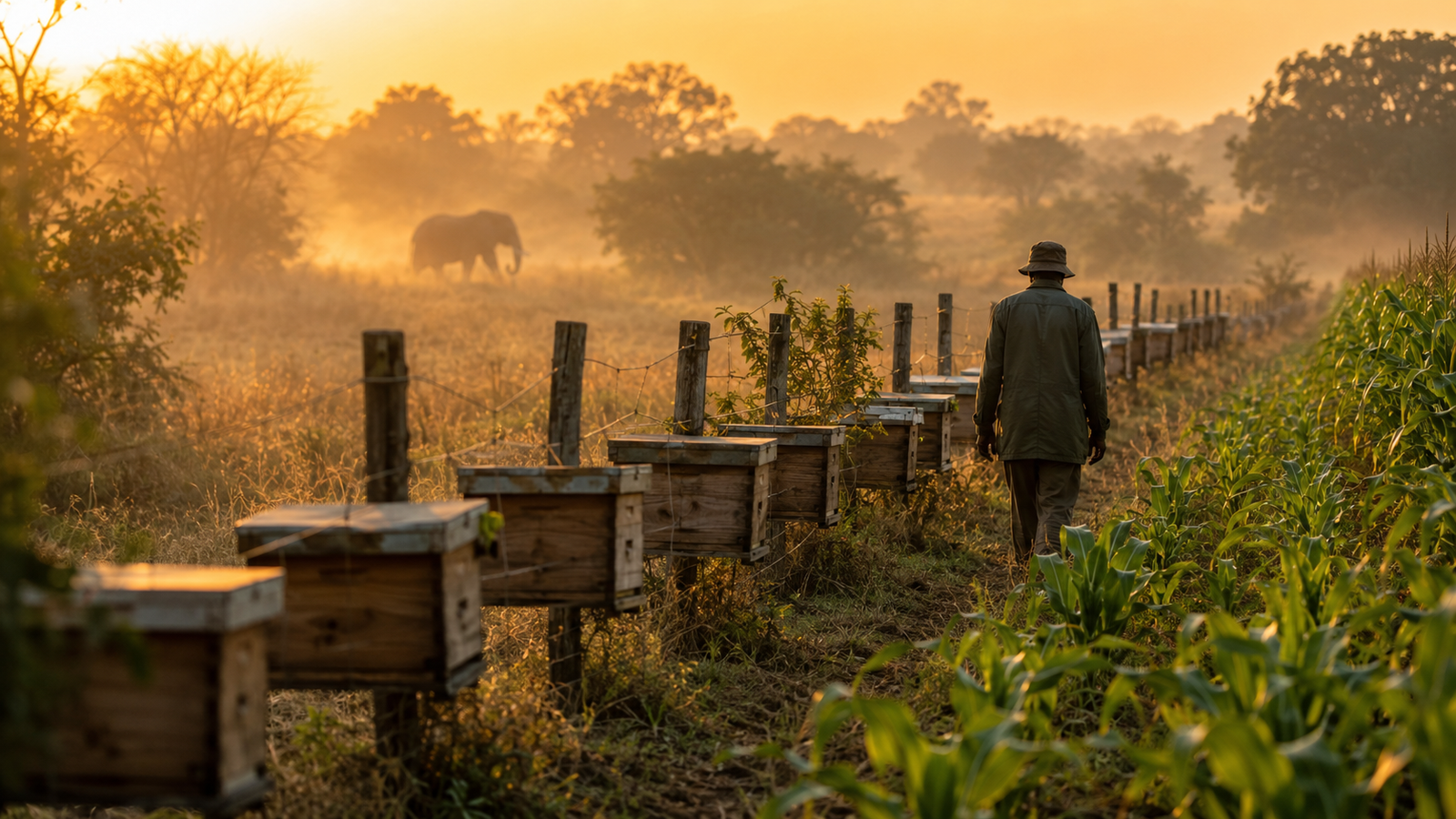
A beehive fence is the reason Halima can still farm this land without fear. Before sunrise in Sagalla, a small farming community pressed against the boundary of Tsavo East National Park, she walks a quiet line along her family’s mealie field – not checking for elephant tracks, but checking the row of wooden hive boxes strung together on wire between her fence posts. Somewhere past the tree line, a herd may already be moving toward the smell of ripening maize. Whether they turn back tonight depends on whether these hives are full, and whether the bees inside are awake.
This isn’t a folk remedy. It’s one of the most rigorously tested wildlife coexistence tools in Africa today.
What Is a Beehive Fence, and Why Does It Work?
A beehive fence is a simple structure: a line of beehives connected by wire, hung around the edge of a farm. If an elephant brushes the wire, the hives shake, the bees swarm, and the herd retreats. Elephants have thick skin, but disturbed bees target the sensitive areas – eyes, mouth, and trunk – where stings cause real pain. When an African bee stings, it can release a pheromone that signals other bees to target the same animal, turning one sting into a coordinated response elephants have learned to avoid entirely.
The idea came from Dr. Lucy King, a researcher who founded the, a collaboration between Save the Elephants, Oxford University, and Kenya’s Wildlife Research and Training Institute. Farmers had long noticed that elephants avoided trees with wild beehives in them – King’s project turned that observation into an engineered solution.
Nine Years of Data Behind the Beehive Fence
This isn’t a small pilot project. Researchers from, Save the Elephants, and Kenya Wildlife Service tracked beehive fences across farms next to Tsavo East National Park for nine years – one of the longest studies of its kind for any human-wildlife conflict tool.
The results, published in the journal Conservation Science and Practice, found that elephants avoided beehive fences up to 86% of the time during peak crop seasons. Across the full nine-year study, out of 3,999 elephants that approached the protected farms, only 1,007 – about 25% – broke through the fence and entered the fields. The remaining 2,649 either stayed outside the boundary entirely or were deterred at control sites.
The project has since expanded well beyond Sagalla. More than 14,000 beehives have now been hung as elephant deterrents across 97 sites in Africa and Asia, according to ScienceDaily’s coverage of the Oxford study. Similar coexistence projects have also worked in Tanzania, near the Udzungwa Mountains and Kijereshi Game Reserve, and along the Selous-Niassa wildlife corridor.
More Than a Fence – A Livelihood
What makes a beehive fence different from an electric fence or a trench isn’t just that it works – it’s that it pays for itself. The same hives that keep elephants out also produce what the project calls “Elephant-Friendly Honey,” a product farmers can harvest and sell, turning a defensive barrier into an income source.
Traditional deterrents – electric fences, thorn barriers, loud noises, fire, even gunshots – are expensive to maintain, and elephants often learn to work around them over time. In the worst cases, these confrontations turn deadly for people and elephants alike. A beehive fence offers something rarer in conservation: a solution that reduces harm to both sides without requiring either to lose.
Where a Beehive Fence Doesn’t Work as Well
No solution is universal, and researchers are careful not to oversell this one. A beehive fence project in Tanzania’s Ngorongoro Conservation Area found no significant reduction in crop raiding compared to chili-based fences – though researchers noted the sample size was small and bee occupancy in the hives was low, which may explain the weaker result.
There’s also a longer-term pressure building underneath the good news: Kenya’s human population grew by 59.4% between 2000 and 2020, steadily shrinking the land available for elephant habitats and increasing the number of places where farms and migration routes now overlap. A beehive fence can reduce conflict on the ground – but it doesn’t solve the deeper math of shrinking space and growing population pressure. This same tension – communities squeezed between poverty and shrinking land – echoes what we’ve reported in our coverage of child poverty in South Africa, where economic pressure and resource scarcity intersect in similar ways.
A Note on South Africa
While the strongest long-term data for the beehive fence method comes from Kenya, similar community-led coexistence approaches have been explored in other parts of Southern Africa, where rural communities face the same core tension: living beside animals large enough to destroy an entire season’s food supply overnight. The underlying idea travels well, even if the honey doesn’t come from the same hives.
Beehive Fence FAQ
What is a beehive fence made of?
A beehive fence is made of a series of wooden or wire beehives connected by cable or wire, strung around a farm’s perimeter at chest height, positioned so a disturbed hive shakes when an animal touches the connecting wire.
Does a beehive fence hurt the elephants?
No – a beehive fence relies on discomfort and avoidance, not injury. Elephants are stung, similar to any wild bee encounter, but the goal is deterrence, not harm.
Can a beehive fence work outside Africa?
Yes. Evidence is building that beehive fences are also effective against Asian elephants (Elephus maximus), suggesting the method isn’t limited to African elephant species.
The Quiet Kind of Solution
There’s no dramatic rescue in this story – no airlift, no emergency appeal, no crisis unfolding in real time. Just a woman checking a line of hives before the heat sets in, in a place where, for one more season, the maize might make it to harvest, and the elephants might make it home without a single shot fired.
A beehive fence won’t end human-wildlife conflict everywhere. But in Sagalla, it’s already changed what one more season looks like – for the farmers, and for the elephants.