
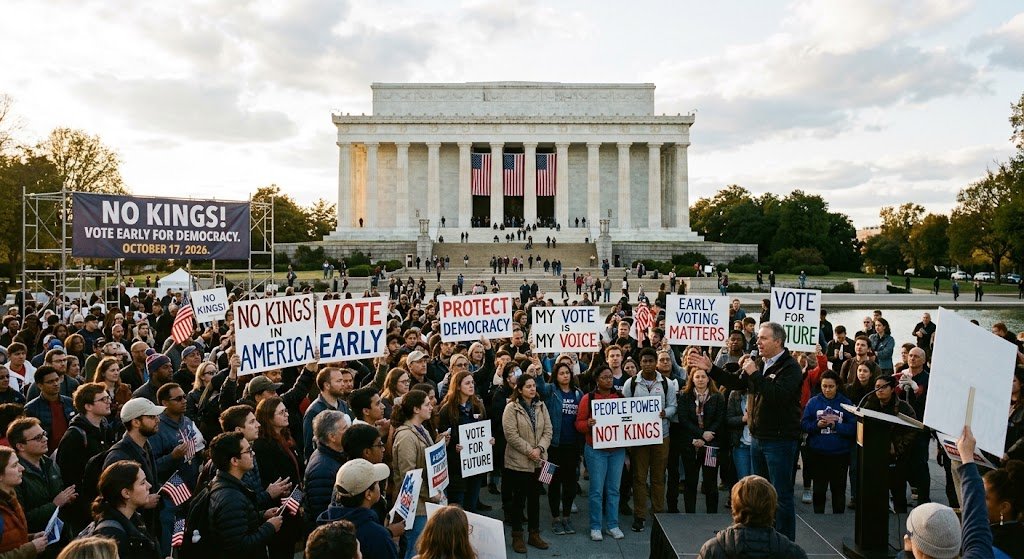
No Kings early voting rallies took place in cities and towns across the United States on Saturday, October 17, as the movement behind the large anti-Trump marches turned its attention to getting people to cast ballots in the midterm elections. Organizers billed the day as nonpartisan. Early voting is already open in many states, and Election Day is November 3.
Counts of No Kings early voting events differ between outlets. NPR and The Hill described thousands of gatherings, while the Associated Press referred to hundreds of planned events, and no independent national total had been published in the reports reviewed. Crowd sizes also varied. The AP saw what appeared to be a few hundred people at the Lincoln Memorial in chilly weather, and a Louisiana public radio report counted roughly 200 in Baton Rouge.
Why No Kings early voting marks a shift
The first three No Kings days, held in June 2025, October 2025 and March 2026, were built around public opposition to the president. This No Kings early voting day asked people to make a voting plan. Ezra Levin, a co-founder of Indivisible, one of the coalition’s main groups, told NPR that earlier events were meant to send a message and that organizers were done with that. The coalition includes hundreds of partner groups, among them the American Civil Liberties Union and Black Voters Matter.
No Kings early voting events looked very different from town to town. Some were marches or rallies with signs aimed at the Trump administration, while many were block parties, cookouts and information tables. Colorado organizers invited people to bring dogs on a “Paws to the Polls” walk, and a Washington state group planned a concert. In Salt Lake City, marchers walked from the Utah Capitol to the main library to turn in their ballots together.
What organizers say they are worried about
Levin said the No Kings early voting effort responds to several developments he sees as threats to election integrity, including a failed bill that would have required proof of citizenship to register, concerns about federal immigration officers near polling places, and the president’s efforts to restrict mail voting. These are his views, and the administration has not been quoted responding to them in the reports reviewed. Some groups also used the day to train volunteer poll watchers and to prepare for disputes after voting ends.
The AP noted that Trump has long distrusted mail voting and has claimed without evidence that fraud cost him the 2020 election. This week his administration sued California election officials, asking a judge to bar the state from counting mail ballots from people the federal government calls “likely” noncitizens until their status is confirmed. The Justice Department also warned local officials on Friday that processing such ballots could expose them to criminal investigation. Three Democratic senators wrote to the attorney general asking for a commitment not to seize ballots before the results are certified.
How nonpartisan was it?
Levin said the day’s events shared rules against political endorsements and against inviting current candidates to speak. Yet the AP noted that the events grew out of nearly two years of marches by people unhappy with Trump’s presidency. A local event page on Indivisible’s site called the president a “wannabe-king” bent on sabotaging the midterms, and an Al Jazeera photo caption identifies a Democratic US Senate candidate speaking at the Portland, Maine, event. It is unclear whether that appearance was part of the official program.
What it could mean for voters
The practical effect on turnout is unknown, and the reports reviewed offered no data on whether rallies of this kind change how many people vote. What they did show was local, hands-on outreach. In Frisco, Texas, where early voting opens on October 19, one organizer and her neighbors prepared 500 goody bags with QR codes linking to voting information. In Washington, D.C., a small group gathered around an official drop box and cheered as each person slid a ballot inside.
Earlier worries about policing and traffic have so far not materialized in what has been published. The reports reviewed did not mention arrests or major disruptions, although they also did not offer systematic data on road closures or police activity. Activists in San Antonio held banners at highway intersections to reach drivers, which is the kind of activity local authorities typically monitor.
What to watch next
Early voting begins in Texas on Monday, and election officials in many states will see turnout figures in the coming days. The California lawsuit over mail ballots and the Justice Department’s warning are likely to draw further legal and political responses before November 3. For more of our coverage of how public decisions reach daily life, visit the Human Crisis News homepage. The Associated Press has more on the day in its report on the No Kings rallies. This story is based on published reporting, HCN did not report from the scene, and it will be updated as new information emerges.