
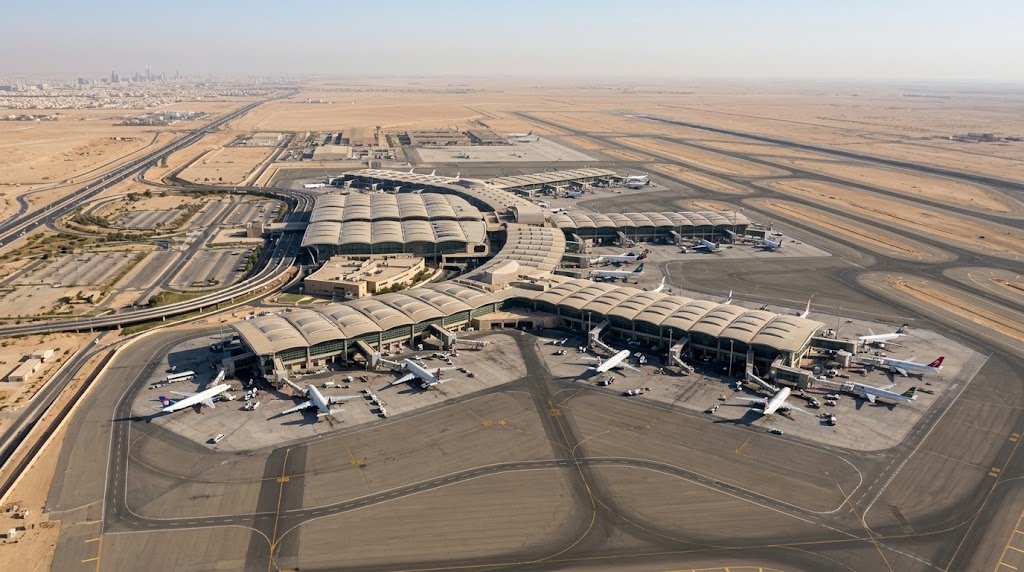
A new Canada travel advisory tells Canadians in Saudi Arabia to avoid King Khalid International Airport in Riyadh after a strike on the airport complex on Saturday killed at least 12 people and wounded more than 300, according to Saudi authorities. The airport remained closed on Sunday, and flights were being diverted elsewhere.
What the Canada travel advisory says
The Embassy of Canada in Saudi Arabia updated its travel advice on Saturday, citing military activity that was affecting operations at the airport. It urged Canadians to avoid all travel to the airport because of the security situation. Prime Minister Mark Carney also condemned the attacks, calling them abhorrent and saying that no political or military objective can justify deliberately targeting civilians. He extended Canada’s condolences to the families of those killed.
The Government of Canada’s wider guidance for Saudi Arabia advises Canadians to avoid non-essential travel because of the volatile security situation in the region, and to avoid all travel near the border with Yemen. That country-wide level appears to predate this attack, because Government of Canada material published in April already referred to an advisory being in place. The sources reviewed did not make clear whether the level was changed after Saturday’s strike.
The practical advice for people already in the country is straightforward. Canadians are told to follow the instructions of local authorities, including any order to shelter in place, and to verify their travel plans before heading to the airport. Government of Canada guidance also warns that many travel insurance policies do not cover trips to regions under an advisory to avoid non-essential travel, so travellers should check their own policy.
What is confirmed about the strike
Saudi authorities said the dead included four Saudi citizens, two Bangladeshi nationals and one person each from Egypt, Jordan, Sudan and Syria, as well as a Palestinian and a U.S. citizen. They said 309 people were injured and were being treated in several hospitals, some of them seriously. Egyptian state television identified one of the dead as Azza Ramzy, a 28-year-old Egyptian flight attendant who worked for the Saudi airline Flynas. None of the reports reviewed by HCN mentioned Canadian casualties.
A regional official, speaking on condition of anonymity because they were not authorised to brief the media, said the strike hit the complex that houses terminals 3 and 4, which handle domestic flights. An injured traveller said they saw something cross the sky outside the airport before part of the ceiling near a departure gate collapsed. The airport has no military facilities, according to news agency reporting, and media reports described the attack as the deadliest on Saudi soil in more than a decade.
Responsibility has been presented with some care. Saudi Arabia and the Saudi-led coalition have described the attack as a Houthi one, but the Yemeni group had not immediately claimed Saturday’s strike. The Houthis had earlier claimed attacks that week on the same airport, which killed three Saudis, including a pilot. On Sunday, the coalition said a projectile struck a passenger terminal at King Khalid International Airport again. No details of casualties from that second strike had been released.
The Houthi threat and the wider conflict
Houthi military spokesman Yahya Saree then warned that Saudi airports and airspace were exposed to targeting and described them as a theatre of operations for Houthi forces. He said the threat excluded the holy sites of Mecca and Medina and urged passengers not to travel. The Houthis also said on Sunday that the airport in the Yemeni capital, Sanaa, which they control, had been struck again. They blamed Saudi Arabia but gave no details. Saudi Arabia moved Riyadh schools online in response to the latest threat.
The attacks come about a week after the Saudi-led coalition launched a major military offensive against the Houthis. Saudi Arabia entered the Yemen war in 2015 at the head of an Arab coalition, aiming to force the Houthis out of Sanaa, which the group had seized the year before. The Houthis are widely described as Iran-backed, and the strike has further complicated efforts to end the separate war between the United States and Iran.
International reaction
Canada was not alone in issuing warnings. The U.S. mission in Saudi Arabia urged American citizens to avoid the airport and surrounding areas. Britain, Germany and Australia issued similar advice, and the Irish embassy also told its nationals about a serious incident at the airport.
Condemnation came from several governments and bodies. The United Nations and the European Commission president, Ursula von der Leyen, criticised the attacks, with von der Leyen warning that they were pushing the region towards a spiral of violence. U.S. Secretary of State Marco Rubio condemned the strike and noted that an American was among the dead. President Donald Trump said he was considering joining Saudi strikes on the Houthis. Qatar called the attack a direct threat to regional security, while Egypt, Jordan and Oman expressed solidarity with Saudi Arabia.
What remains unclear
Several important questions are still open. The full toll from Saturday’s strike may change, and no figures have been given for the second strike. Responsibility for Saturday’s attack has not been claimed, and the airport’s reopening date has not been announced. It is also unclear whether Canada will revise its country-wide advice if attacks on Saudi airports continue.