
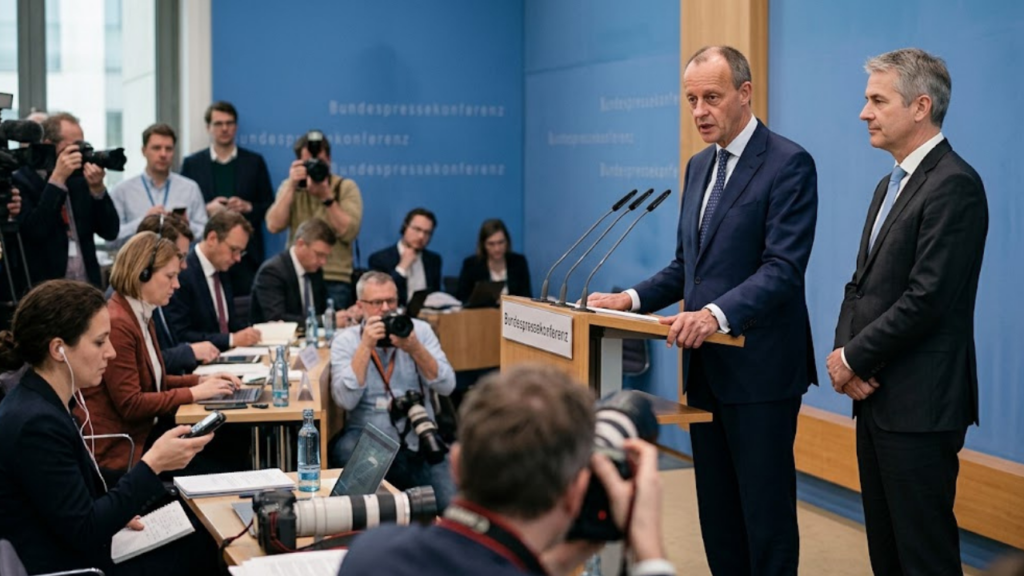
Russia sanctions will stay in place in Germany after the United States temporarily eased restrictions on Russian diesel, the German government said on Saturday, 10 October 2026. Chancellor Friedrich Merz’s spokesman, Stefan Kornelius, said Berlin had taken note of the US decision, while its position and that of its European partners remained clear.
What Washington changed
The move followed a phone call on Friday between President Donald Trump and Russian President Vladimir Putin. Trump announced that Russia would supply large quantities of diesel to the US and global markets, and the Kremlin confirmed the deal. According to Austrian broadcaster ORF’s account of his remarks, Trump put the first batch at more than 300,000 tonnes, with a further 500,000 in November and another million shortly afterwards. These are Trump’s own figures, and nothing seen so far shows how much Russia can actually deliver.
ORF also reported that the US Treasury issued a temporary licence authorising the sale, delivery, unloading and import of Russian diesel until 7 April 2027. HCN has not yet reviewed the licence text itself. Diesel matters well beyond the fuel pump because it powers trucks, farm machinery and factory equipment, so changes in its price tend to feed into the cost of transport and goods.
Berlin’s stance on Russia sanctions
A spokeswoman for Economy Minister Katherina Reiche said Germany “stands unconditionally by the sanction packages”. She added that Germany no longer imports oil or petroleum products from Russia. Kornelius said the government is working with European partners on further sanctions. He also said Germany’s support for Ukraine was unchanged and that diplomatic efforts would continue.
Merz visited Kyiv last weekend and has repeatedly said that Germany, Ukraine’s largest European donor, will not reduce its support for the Ukrainian government. The wording of the latest statements is cautious. Berlin acknowledges the US decision without criticising it, and it stresses that German policy has not changed.
How the EU rules differ from the US licence
Reuters described the US step as a temporary lifting of sanctions on Russian fuel, while ORF described it as a time-limited licence. The two descriptions are not identical, and the licence text will determine exactly what is permitted and for how long.
The European Union’s position is different. It banned imports of Russian diesel and other refined oil products in February 2023, and set a price cap of $100 a barrel for diesel and similar products traded elsewhere, according to the Associated Press at the time. Russia had once supplied around 10% of Europe’s diesel. Nothing in the US licence changes those European rules, which Brussels and national governments would have to amend themselves.
A history of targeted US exceptions
The diesel decision is not the first time Washington has adjusted its Russia sanctions case by case. In March 2026, days after Merz met Trump at the White House, the US exempted Rosneft Deutschland and its related entities from sanctions on the Russian oil company, with no end date, according to the news outlet EUalive. The unit has been under German trusteeship since 2022 and holds stakes in refineries including PCK Schwedt, which supplies the Berlin region. Germany’s Economy Ministry welcomed that decision.
EUalive reported that analysts saw the exemption as a pragmatic concession rather than a weakening of the overall regime, while critics warned that open-ended carve-outs could erode the credibility of Western sanctions. The Rosneft case involved German-based assets, so it is not the same as Russian diesel shipments to the US. Both, however, show that US sanctions policy has included targeted exceptions.
Doubts over supply and prices
Poland’s foreign minister, Radosław Sikorski, has questioned whether Russia has any diesel surplus to spare. ORF reported that specialists doubt the shipments would bring a lasting fall in prices. It said Russia normally exports far more diesel when its refineries are not under attack. It also noted that US diesel and other distillate consumption averages about 3.77 million barrels a day, according to the US Energy Information Administration, roughly 500,000 tonnes, so 300,000 tonnes would cover only about 14 hours of demand.
Fuel markets are already under pressure from fighting elsewhere. In its reporting on the Houthi-claimed attacks on Riyadh airport, HCN noted that the conflict has kept oil prices and financial markets volatile. Trump is also under domestic pressure over rising fuel prices ahead of next month’s US midterm elections.
What remains unconfirmed
Several points are still open. The text and scope of the Treasury licence have not been independently reviewed by HCN. It is not yet clear whether the shipments Trump described will happen on the schedule he gave, or at what volume. Beyond Germany, other EU governments have not yet set out how they will respond, and the timing and content of the further European sanctions Berlin says it is preparing have not been announced.