
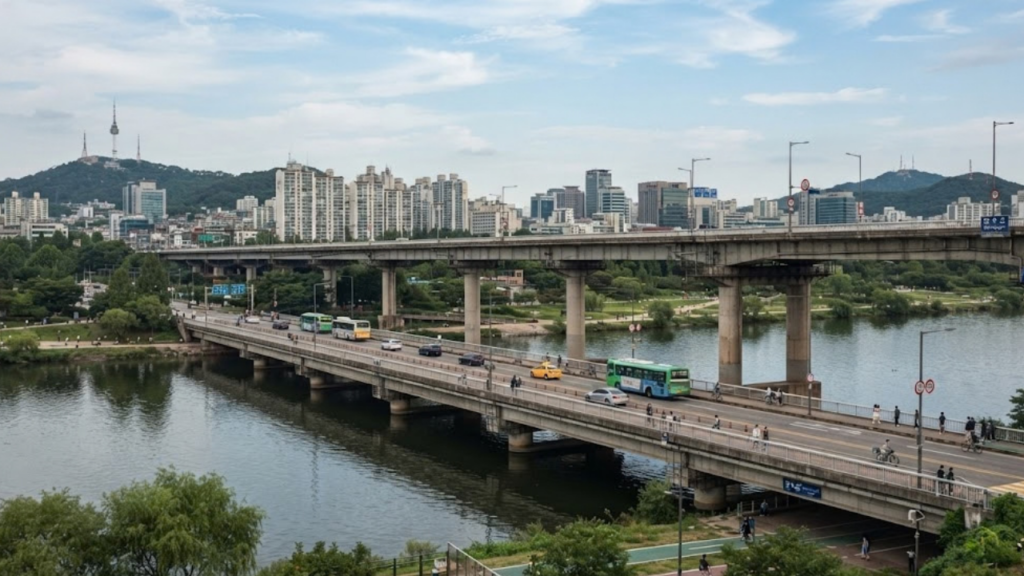
Seoul will bar all vehicles from Jamsugyo Bridge from midnight on Oct. 26. This ends car traffic on one of the Han River’s best-known crossings and begins construction of what the city calls its first pedestrian-only bridge over the river. The Seoul Metropolitan Government announced the plan on Oct. 8. The start date follows the last Sunday of this year’s car-free festival on the bridge, which runs until Oct. 25.
What Changes for Drivers and Bus Riders
The ban applies to the bridge and to the underpass at its northern end in Yongsan, which will also lose its roadway. From Oct. 26, drivers who used Jamsugyo will have to cross on Banpo Bridge or other nearby bridges. Bus routes 740 and 405, which ran over Jamsugyo, will be diverted to Banpo Bridge in both directions. Two stops at Banpo Hangang Park and Sebitseom, near the bridge’s southern end, will close. Passengers are directed to the Banpo Bridge South End and Hangang Citizens’ Park Entrance stops.
The city expects limited disruption. Its traffic impact analysis concluded that rerouting vehicles onto Banpo Bridge would reduce travel speeds only slightly. Insight, a Korean news outlet, reported that Jamsugyo carried about 20,252 vehicles a day last year. That is roughly a fifth of the 100,000-plus on other Han River bridges. The outlet also said daily traffic has fallen since the car-free festival began in 2022, after rising to about 22,887 vehicles in 2021. It noted that some rush-hour congestion remains possible as those vehicles spread onto surrounding roads. HCN has not independently verified these traffic figures.
What the City Plans to Build
According to the city, the project will add 22 viewing spaces along the bridge. At two points where ships pass beneath, “transparent decks” will let visitors look down at the water. Jamsugyo sits much closer to the surface than other Han River bridges, so visitors can get close to the river and to the Banpo Bridge Moonlight Rainbow Fountain. Officials say they want to use that to make it a place to stay, not only to cross.
The northern underpass will become pedestrian space. Reports on the plan say the aim is to improve the route from the Yongsan and Itaewon areas to the river, where narrow walkways, vehicle noise and exhaust have made walking unpleasant. After construction, the city intends to hold outdoor festivals, street performances and flea markets on the bridge.
Pedestrians and cyclists can keep using the bridge during construction, except during road paving from May to August next year, when access will be fully closed. Im Chun-geun, head of the city’s Urban Infrastructure Headquarters, said the city would prioritise pedestrian safety and traffic management during the work to keep inconvenience to a minimum.
A Bridge Built for Cars, Gradually Handed to Walkers
Jamsugyo opened in 1976 as a vehicle crossing, as part of the city’s drive to develop the Gangnam area. Korean press accounts say it was built about 2.7 metres above the water, partly so it could slow the river’s flow when flooded and partly so armoured units could cross quickly in wartime. Banpo Bridge was built above it in 1982, giving the site its unusual two-level form.
The shift towards pedestrians began in 2008, when the city converted two of the bridge’s four lanes for walkers and cyclists. Since 2022, Seoul has closed the bridge to cars on selected Sundays for the Car-Free Jamsugyo Bridge Festival. The city says the festival has drawn about 6.47 million visitors, including 1.17 million in the first half of 2026. This autumn’s edition runs on Sundays from Sept. 6 to Oct. 25.
From Festival to Permanent Change
The conversion is part of Mayor Oh Se-hoon’s Great Han River Project. The city launched an international design contest for it in 2023. In early 2024, it said it aimed to make the bridge car-free by 2026. Construction now begins in October 2026, with completion reported for later, so the timetable has moved. Park Jin-young, head of the city’s Future Hangang Office, has said the city would use the conversion to create a new way for residents to experience the river. Officials plan to present a new version of the festival once the bridge is fully pedestrian.
Flooding, Which the Reports Do Not Address
Jamsugyo is a submersible bridge, and heavy rain has repeatedly forced closures. In 2020, Seoul restricted pedestrians when the river passed 5.5 metres and vehicles at 6.2 metres. That year, the vehicle ban lasted 11 days. The reports on the new plan reviewed by HCN do not explain how flood closures will work once the bridge is pedestrian-only.
What Is Not Yet Clear
Reports differ on the finish date. Several Korean outlets say work will run to August next year, and one gives a different timeline. A construction cost was not found in the reports reviewed. Seoul has also not said what form the festival will take after this season. HCN also follows other international developments affecting public life around the world.