
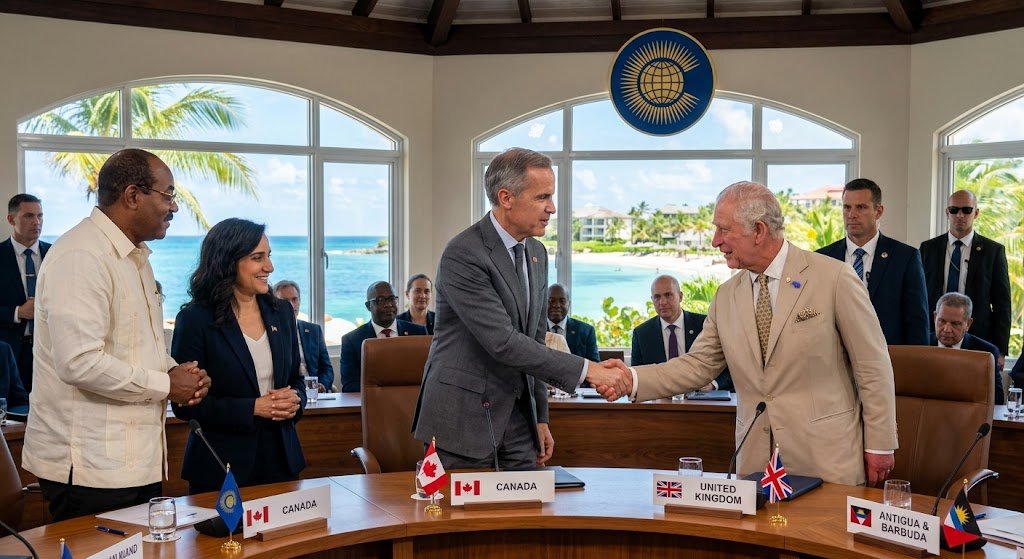
The Carney Commonwealth meeting began for Canada on Monday, November 2, 2026, when Prime Minister Mark Carney arrived in Antigua and Barbuda for the Commonwealth Heads of Government Meeting (CHOGM). It is his first appearance at the biennial summit, which brings together leaders from the 56-member Commonwealth, and King Charles is attending as head of the organization. Officials say Carney will spend only one day at the gathering, Tuesday, November 3, before flying back to Ottawa that night. No agreements had been announced at the time of writing.
Three priorities behind the Carney Commonwealth meeting
The Prime Minister’s Office says Canada is deepening its Commonwealth partnerships around three areas: trade and investment, climate resilience and renewable energy, and collective security. Carney said in a statement that Canada is “drawing closer to our Commonwealth partners.” This year’s summit theme is “Accelerating Partnerships and Investment for a Prosperous Commonwealth.”
Canadian officials told reporters that Canada already does more than $100 billion in trade with Commonwealth countries. Foreign Affairs Minister Anita Anand, who is traveling with Carney, said the group has an “ambitious” target of lifting trade among members to $2 trillion by 2030. Those figures come from officials, and a target is not a commitment that members have signed.
What Carney is doing at the Commonwealth meeting
According to reporting from The Canadian Press, Carney’s day begins with a meeting with Antigua and Barbuda Prime Minister Gaston Browne. He will then host a working breakfast for Caribbean leaders, where officials say the topics will include trade, investment, climate action and regional security. After that, he is scheduled to take part in two executive sessions and hold one-on-one meetings with the leaders of Australia, Guyana and Ghana.
The evening is largely ceremonial. Carney has been invited to a lunch the King is hosting for new Commonwealth leaders and to a formal dinner, also hosted by the King. The summit itself runs through Wednesday, November 4, but Carney’s role at the Carney Commonwealth meeting is limited to this single day on the ground.
Why trade leads the Carney Commonwealth meeting agenda
Commonwealth Secretary-General Shirley Botchwey told CBC she expects about 30 leaders to attend and described Carney’s presence as a “vote of confidence” in the group’s investment agenda. She argued that cutting trade barriers among members fits with the Carney government’s efforts to depend less on the U.S. market. Canadian officials framed the Commonwealth’s diversity as a way to build “strategic autonomy,” and the summit coincides with U.S. midterm elections on Tuesday.
Before the meeting, the Commonwealth Secretariat also unveiled an investment platform listing more than 60 projects put forward by 20 developing member countries that are seeking funding. For smaller economies, that kind of platform could matter more than a communique, because it is meant to connect specific projects with investors. Whether any of those projects secure money will only become clear in the months after the summit.
King Charles, the legacy of slavery and climate pressures
King Charles is expected to open the summit on Tuesday and, according to Canadian Press and Global News, to address the legacy of slavery. Officials did not say directly whether Carney will take part in any discussions on that subject. The King’s remarks will be closely watched in Antigua and Barbuda and across the Caribbean, where the history of slavery remains a live political question.
Climate is the other issue tied closely to the people who live in smaller member states. Canadian officials said the meeting will focus on resilience and adaptation, a priority for island nations already dealing with rising seas. Retired Canadian diplomat Patricia Fortier told The Canadian Press the summit gives Canada a chance to build ties with countries it might not otherwise deal with day to day.
What to watch after the Carney Commonwealth meeting
The outcomes of the Carney Commonwealth meeting are not yet known. Key questions include whether Canada announces any new trade or investment commitments with Caribbean, African or Pacific partners, and whether the leaders’ final statement includes concrete steps on trade barriers. It also remains to be seen how the King’s address is received and whether Commonwealth governments move toward any shared approach on the legacy of slavery.
For now, the visit is best read as a diplomatic and economic outreach effort whose results will depend on follow-up deals, not on the meetings themselves. For more reporting on global diplomacy and trade, visit the Human Crisis News homepage.