
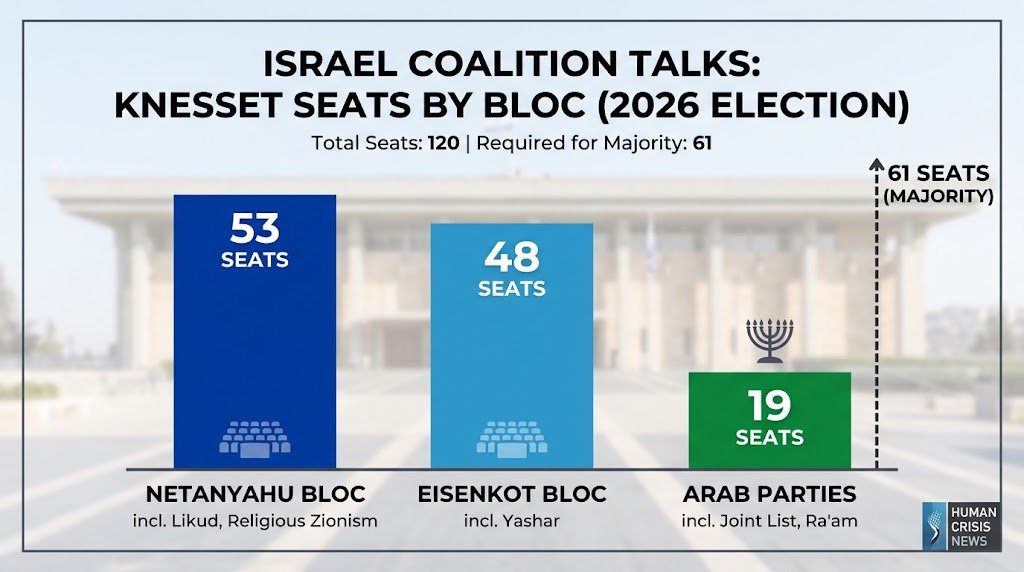
Israel coalition talks are set to begin on Wednesday, November 4, after the country’s October 27 election produced no governing majority. Prime Minister Benjamin Netanyahu’s bloc won 53 of the Knesset’s 120 seats, while the bloc led by Gadi Eisenkot won 48. According to final figures from the Central Elections Committee, Arab-led parties took the remaining 19 seats, the highest total they have ever won. A government needs at least 61 seats, so neither side can govern alone.
President Isaac Herzog will open consultations with the parties at the presidential residence in Jerusalem once the committee formally presents him with the official results. The meetings will decide who gets the first chance to build a government, and the answer is far from settled.
How the Israel Coalition Talks Work
Each party recommends a candidate to the president, and Herzog then assigns the task to the lawmaker he believes has the best chance of assembling a coalition. The mandate does not automatically go to the leader of the largest party. The chosen candidate has 28 days to form a government, with a possible 14-day extension. If repeated attempts fail, Israel could face another election early next year, a scenario Herzog has said he will do everything in his power to avoid.
The new Knesset is expected to be sworn in on November 10. That date matters because, once parliament convenes, Eisenkot’s bloc could join forces with the Arab parties to elect a new Knesset speaker. Doing so would give them control of the parliamentary agenda and could let them advance legislation before any government is formed.
Where the Numbers Stand
Likud remains the largest single party with 27 seats, followed by Eisenkot’s Yashar party with 21. Among the Arab-led parties, the Joint List won 11 seats and Ra’am won eight. Netanyahu’s bloc is now well below the 68 seats his coalition controlled in the previous Knesset, and its 53 seats leave it eight short of a majority.
The arithmetic offers no easy answer for either side. Eisenkot’s 48 seats combined with the 19 held by Arab parties would total 67 on paper, but both Netanyahu and Eisenkot ruled out a government with Arab parties before the vote. That promise is now under pressure, and the choices each leader makes in the coming days will shape everything that follows.
Eisenkot’s Conditions and Netanyahu’s Response
Eisenkot, a former military chief of staff, has said he wants to form the broadest possible government and that any lawmaker who accepts four principles could be a partner. Reports say those principles include recognizing Israel as a Jewish and democratic state, upholding its Declaration of Independence, supporting mandatory military or civilian service, and recognizing Hamas as a terrorist organization. He has also pledged to repeal legislation linked to the previous government’s judicial overhaul.
The Arab parties are not a single bloc in their approach. Joint List figure Ahmad Tibi has said his party would support replacing the Knesset speaker but would not join a government. Israeli media have reported that both the Joint List and Ra’am are expected to recommend Eisenkot to the president, which would give him roughly 60 recommendations against about 46 for Netanyahu. Those figures are projections rather than confirmed endorsements. Netanyahu, for his part, has warned against any cooperation with Arab parties, and people close to him have reportedly floated a unity government with Eisenkot, an idea Eisenkot’s bloc rejects.
Fraud Claims and What Authorities Found
In the hours before final results were released, Netanyahu and his Likud party amplified unsubstantiated claims that Arab-led parties had stolen the election, possibly with foreign assistance. Israeli police said no investigative or intelligence evidence supports allegations of widespread fraud, and the Central Elections Committee described claims of systematic violations as baseless. Its chairman, Justice Noam Sohlberg, said he could not verify suspicions of foreign interference but asked the Shin Bet security agency to investigate, with findings expected within about a week. Qatar, which Israeli media reports had named, rejected the allegation.
President Herzog said the claims must be investigated, but he also warned against casting suspicion on an entire community. The warning carries weight because Arab citizens make up about 20% of Israel’s population and turned out in record numbers this year. How the allegations are handled may affect how that community, and the outcome itself, are perceived.
What Is at Stake
For Netanyahu, the stakes are personal as well as political. If he loses office, he would be weakened while facing an ongoing corruption trial, and an official inquiry into the security failures before the October 7, 2023 attack would almost certainly follow, according to the Associated Press. Centrist leader Yair Lapid has said the truly hard part of the process is only now beginning.
The first concrete signal will come this week, when parties tell the president whom they back. For a fuller account of the election results and the negotiations ahead, read the Associated Press report on PBS NewsHour, and follow more world coverage on Human Crisis News.