
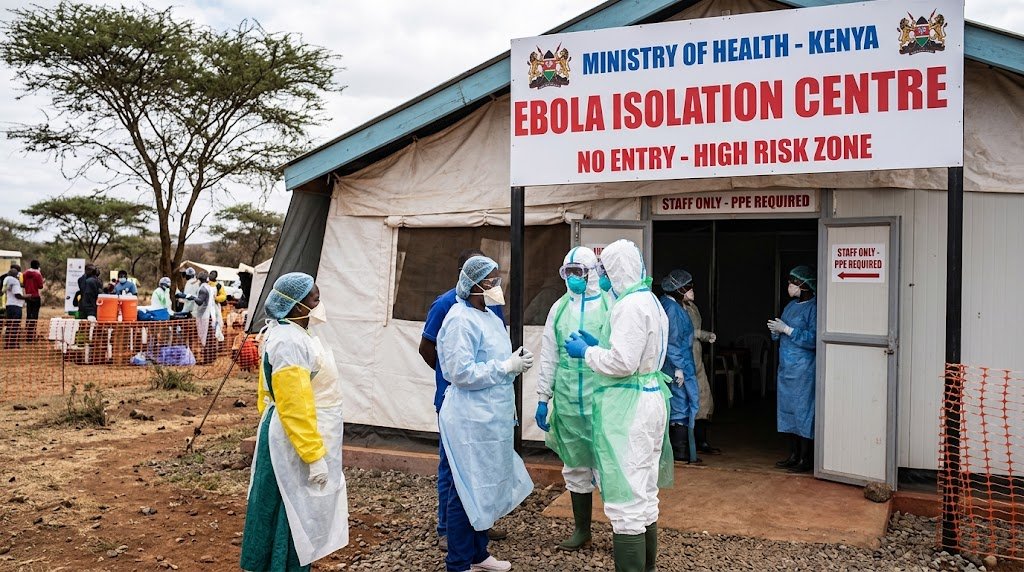
Two relatives of the first patient fell ill while already in quarantine. Officials say there is no sign of spread in the wider community. Kenya Ebola cases have risen to three, including one death, the Ministry of Health said on 16 October 2026. The latest patient is a 65-year-old woman who was already in quarantine as a close contact of the first case.
All three infections trace back to one man who returned from the Democratic Republic of the Congo (DRC) and died in Nairobi on 5 October, according to the World Health Organization (WHO). It was the first Ebola case ever recorded in Kenya. For more developing world and health coverage, visit Human Crisis News.
Kenya Ebola cases at a glance
The three confirmed patients are all linked to a single imported infection, and one of them has died. The virus is Bundibugyo, a rarer form of Ebola with no licensed vaccine or specific treatment. Of 130 listed contacts, 127 are in quarantine, and the ministry says it has found no community spread. Kenya remains open, with no restrictions on travel, trade or public gatherings.
How the three Kenya Ebola cases are linked
The first patient was a Kenyan man who had been living in the DRC. He travelled by road to Kampala, Uganda, and then flew to Nairobi on 3 October. He tested positive and died on 5 October. The second case, a 39-year-old man and a close relative, was confirmed on 14 October. He developed symptoms on 13 October while under daily monitoring, so he was isolated at once.
The third case is the 65-year-old woman, who has been in quarantine since 6 October. She developed fever, sore throat and malaise before testing positive.
Both patients are receiving supportive care in designated treatment units. The ministry says the man is stable and responding well. It also says the woman was diagnosed early, which improves her chances of recovery.
Contacts are checked daily for 21 days, the longest it can take for symptoms to appear. However, the ministry warns that more cases among quarantined contacts are possible until monitoring ends. “This is the response working as designed,” Director General for Health Dr Patrick Amoth said, according to WHO.
What Kenya Ebola cases mean for people
For most Kenyans, the risk remains low, according to the ministry. Ebola is not airborne. It spreads through direct contact with the blood or body fluids of a person who is sick or has died, or through contaminated objects. People are also not infectious before symptoms begin. The burden falls mainly on a few hundred people. Contacts face three weeks of quarantine with daily checks. Health workers who treated the first patient are among those being monitored. Kenya says nearly 5,000 health workers have been trained since May with WHO support.
Early symptoms can look like malaria or other common illnesses. They include fever, tiredness, muscle or joint pain, headache and sore throat. Because of this, early testing matters. Bleeding is less common than many people assume and usually appears late. Not every alert has proved real. A suspected case in Wajir County tested negative on 8 October, according to the county governor.
The larger outbreak behind the cases
The Congolese Health Ministry reported 9,066 confirmed cases and 4,381 deaths on 13 October, according to AP. It is the largest Ebola outbreak in the DRC’s history. Globally, only the 2014–2016 West Africa epidemic was bigger. Reuters reported on 16 October that two cases were confirmed in North Ubangi province, which would be the eighth province affected. Congolese authorities had not yet officially announced it.
Meanwhile, responders face community mistrust and conflict in the east, AP reports. A local politician who defended the response on the radio was beaten to death in September, according to his party. Candidate vaccines are in early trials, and WHO says a vaccine efficacy trial is being prepared in the DRC.
A dispute over response funding
Africa CDC says financial information from aid groups suggests more than $700 million of donor money is unaccounted for. Director General Dr Jean Kaseya told Reuters that donors sent about $962 million to implementing organisations. Those groups reported receiving $228 million, of which $127 million had been spent.
Kaseya said it was too early to speak of embezzlement. Congolese Health Minister Samuel Roger Kamba warned aid groups to disclose their funding or risk being barred. HCN has not seen the underlying data or obtained a response from the aid groups.
What to watch after the Kenya Ebola cases
The key date for Kenya is the end of the 21-day monitoring period for remaining contacts. Ebola outbreaks are typically declared over after 42 days without new cases. New cases among monitored contacts would not by themselves signal community spread. Cases outside that group would. In the DRC, watch for official confirmation of North Ubangi, the start of the vaccine trial and the outcome of the funding dispute.