
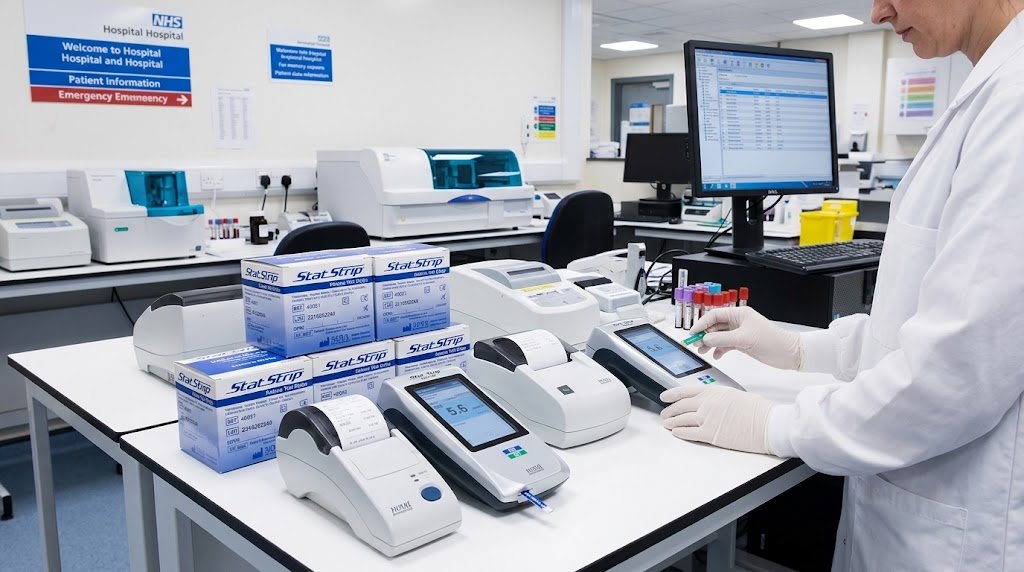
UK regulators say the recall could disrupt blood ketone testing across the NHS. Hospitals have been told to protect testing for the highest-risk patients. StatStrip ketone test strips made by Nova Biomedical are being recalled in the UK after repeated quality-control failures, and the medicines regulator has warned the recall could cause a growing shortage of blood ketone testing across the NHS. The Medicines and Healthcare products Regulatory Agency issued its device safety notice on 9 October 2026.
The notice is addressed to healthcare professionals and the organisations that use the strips. It is not a general consumer recall. This article reports the regulator’s advice and is not medical advice.
What the StatStrip ketone test strips recall covers
According to the MHRA, Nova Biomedical found quality problems in specified lots of StatStrip ketone test strips. Those lots were linked to repeated failures in quality-control (QC) testing, the routine check that confirms a strip gives accurate results before it is used on a patient. The company has recalled the affected lots, paused their distribution and advised that no one should use them.
Nova Biomedical has also said any further lots that fail QC testing should be withdrawn. For that reason, the regulator describes the risk as a shortage that could grow over time rather than a single, fixed loss of stock. The MHRA says the company is unable to replenish UK stock for about four weeks. Community Pharmacy England, cited by trade publication The Pharmacist, reports that Nova expects new product to ship to the UK during the week of 26 October 2026.
Why blood ketone testing matters
Blood ketone tests help clinicians diagnose and monitor diabetic ketoacidosis (DKA), a serious complication of diabetes that can be life-threatening. The MHRA notice says the NHS advises that blood ketone levels above 3 mmol/L may indicate DKA and need emergency assessment. NICE guidance builds blood ketone measurement into its DKA pathways.
The tests are used widely. They are found in emergency departments, acute wards, children’s services, ambulance teams, community hospitals, primary care, district nursing and hospital-at-home services. For children and young people, NICE recommends a near-patient blood ketone test when DKA is suspected. If one is not available, it recommends immediate transfer to a hospital with acute paediatric facilities.
What a shortage of StatStrip ketone test strips could mean
The MHRA says the greatest risk arises when a patient is acutely unwell, DKA is suspected or being treated, and no validated alternative test is available straight away. In those cases, losing access to StatStrip ketone test strips could delay recognition of DKA, escalation, hospital transfer or treatment decisions. It could also make it harder to track whether treatment is working. The regulator warns that such delays may contribute to severe illness, permanent harm or death.
The effect is also expected to fall unevenly. Children’s, community and pre-hospital services may be hit hardest where hospital laboratory testing is not immediately at hand. The notice asks organisations to make sure local workarounds do not leave people with suspected DKA in settings that cannot assess or monitor ketones.
What health services have been told to do
The MHRA tells organisations that use StatStrips to find out which lots they hold and stop using recalled ones. If a lot that is not recalled fails QC twice in a row, staff should remove it and switch to another lot or another method. Services are also advised not to assume current stock will last, to work out how long supplies will hold, and to identify validated alternatives such as other point-of-care devices or laboratory testing.
Where supply is tight, testing should go first to those at greatest risk. These include people with suspected or confirmed DKA, children, acutely unwell patients with type 1 diabetes and patients who need repeated ketone checks during DKA treatment. Meanwhile, the Department of Health and Social Care issued a national patient safety alert on Tuesday 13 October, according to The Pharmacist. It requires affected organisations to complete certain actions by 20 October. NHS England has published interim guidance on prioritising blood ketone testing during the disruption, and the MHRA says further clinical guidance will follow.
What patients are being told
The MHRA says patients can be reassured that their healthcare team will act to protect their care, and that anyone with concerns should contact them. People with diabetes should keep following their prescribed sick-day and insulin plans unless a clinician says otherwise, and should not stop insulin on their own. Those with a glucose meter or continuous glucose monitor should keep checking glucose often and report high readings that persist or worsen.
The regulator also lists warning signs that need urgent medical care because they may indicate DKA. These are vomiting, abdominal pain, deep or rapid breathing, fruity or pear-smelling breath, marked drowsiness or confusion, severe thirst or dehydration, or becoming steadily more unwell.
What to watch next
Three questions will matter most in the coming weeks: how many lots end up withdrawn, how quickly hospitals arrange alternative testing, and whether replacement StatStrip ketone test strips arrive on the timeline Nova Biomedical has given. The MHRA says further communications are expected. Healthcare professionals can report problems through the Yellow Card scheme in England, Wales and Northern Ireland, and through the Incident Reporting and Investigation Centre in Scotland. For more health reporting, see the Health section on Human Crisis News.