
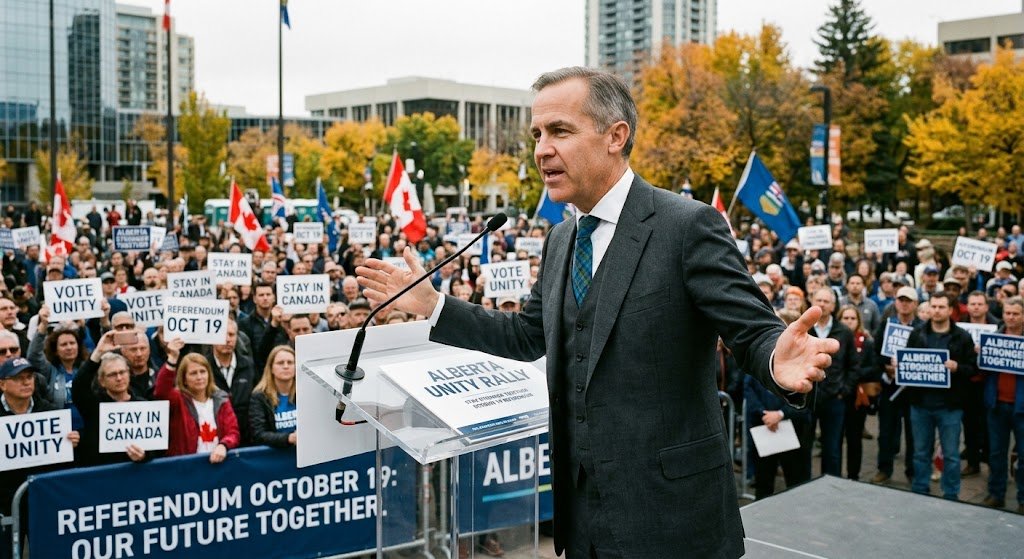
Albertans vote on Monday, October 19, 2026, in a provincial referendum that has pulled Canada’s prime minister, its Conservative opposition leader and Alberta’s own premier into a national unity campaign. The Alberta referendum is not a direct vote on independence. Voters will answer 10 separate questions, and the most closely watched one asks whether Alberta should remain a province of Canada or whether its government should begin the legal process toward a future, binding referendum on separating. Results were not known at the time of writing.
What Is Actually on the Ballot
The Alberta referendum has two parts. Questions 1 to 9 are yes-or-no questions on immigration and constitutional change, and Question 10 is a choice between two options. According to the Calgary Chamber of Commerce’s explainer, the first five questions cover immigration-related issues such as eligibility for provincially funded programs, residency requirements, fees for health care and education, and proof of citizenship to vote in provincial elections.
Questions 6 to 9 ask whether Alberta should work with other willing provinces to seek changes to the Canadian Constitution, according to the Otipemisiwak Métis Government’s guide. The topics are how judges are appointed, abolishing the Senate, letting provinces opt out of federal programs without losing the funding, and giving provincial laws priority over federal laws in some areas. Each question appears on its own ballot, so a voter can answer them differently.
What the Independence Question Does and Does Not Do
Question 10 offers two choices. Option 1 is that Alberta should remain a province of Canada. Option 2 is that the Alberta government should begin the legal process required under the Constitution to hold a binding referendum on separation. Neither option separates Alberta, and The Associated Press has stressed that Monday’s vote is not a direct referendum on independence.
A vote for Option 2 would, however, instruct the government to start the process toward a second vote. Premier Danielle Smith has said she does not want a second referendum, according to CBC, though CBC’s analysis noted that the decision might not be entirely hers. Smith called the vote while opposing independence herself, and she recently cited a poll showing 22% of Albertans support separation, a figure she said was still too high. The referendum came about after her government lowered the threshold for citizen-led referendums, which separatists then used, according to CBC.
What the Leaders Are Saying
Prime Minister Mark Carney spent two days campaigning in Calgary, Red Deer and Edmonton, and told a rally that “a vote against Canada is a dangerous bluff.” He also warned that the referendum comes at the “worst possible time,” with the United States waging a trade war and threatening Canada’s sovereignty, and urged Albertans not to treat the result as decided. For the first time, Carney also urged voters to reject the other nine questions, using the slogan “no to the nine.” He warned against treating the vote as a way to “send a message” to Ottawa.
Conservative Leader Pierre Poilievre also appealed to Albertans in Calgary to stay in Canada. He told them not to leave fellow Canadians behind and said, in remarks reported by CBC, that Albertans “don’t take our ball and go home.” The Globe and Mail reported that he did not address the nine other questions. Smith, who joined Carney at a unity event in Red Deer, agrees with him on Question 10 but wants Albertans to vote yes on the other nine. She says she needs that mandate to negotiate a better deal with Ottawa. Critics, including opposition leader Naheed Nenshi, have called some of those questions “separation in slow motion.”
Why the Vote Is Happening Now
The vote follows years of Western frustration with federal energy and climate policy. Carney acknowledged this, saying that growing up in Alberta he remembered how Ottawa made Albertans feel their resources were not their own. Smith has said relations have improved over the past 18 months, and that Carney has substantially addressed seven of nine federal laws Alberta had opposed. Independence advocates reject those assurances, with one calling the agreements “pinky promises” that come with too many conditions.
The timing adds pressure. Carney has tied the vote to the wider challenge of Canada’s relationship with the United States, and warned that outside forces want to “break us.” Global News reported that mail-in and advance voting numbers suggested the final count could set a record. With turnout expected to be high, the margin on every question, not just Question 10, may shape the political debate that follows.
What Happens After the Vote
On Monday evening, results for all 10 questions will be counted separately. A clear vote to remain in Canada would likely settle the separation debate for now, though it would not settle the disagreement between Smith and Carney over the other nine questions. A yes vote on those nine would not change the Constitution on its own, since many of the proposals would require agreement from other provinces and Ottawa. A vote for Option 2 on Question 10 would put Smith’s government under pressure to begin the legal process, despite her stated opposition to a second referendum. For further updates on this story and other developing crises, follow the latest reporting from Human Crisis News.