
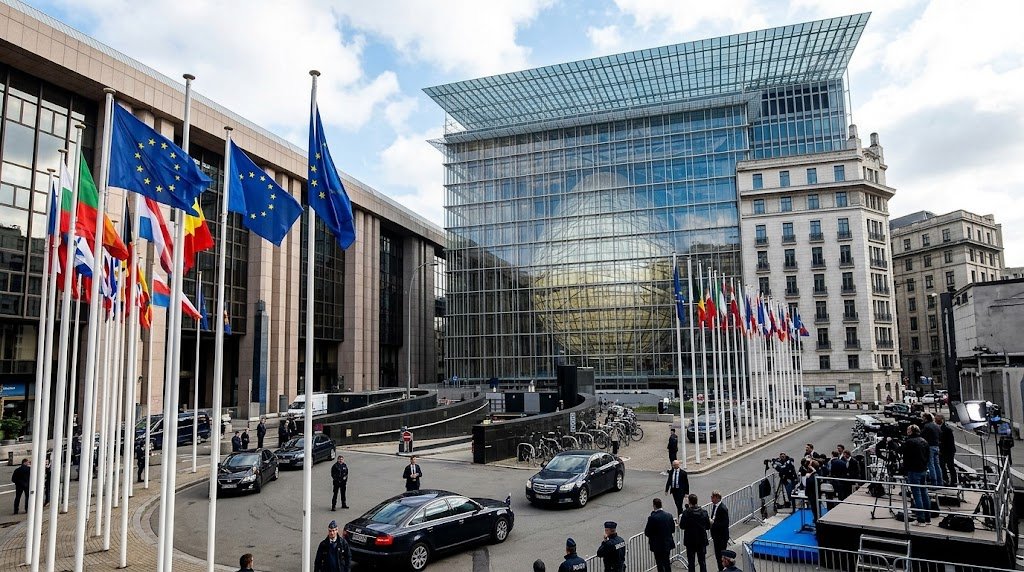
European Union leaders ended a two-day summit in Brussels on Friday, October 16, 2026, without agreeing on the bloc’s next long-term budget. The EU summit budget talks covered the 2028–2034 spending plan, which sets how much the EU can spend and on what. Leaders also made no new financial commitments for Ukraine and ended a heated migration discussion with only mild conclusions. The EU Council President, António Costa, will now try to build a new compromise, and leaders are due to meet again on November 26.
What the EU Summit Budget Talks Were About
The budget at the centre of the summit is the EU’s seven-year spending plan, known formally as the Multiannual Financial Framework. It decides how much money flows to areas such as farming, regional development, research and infrastructure. Every one of the 27 member states must agree to it, which is why negotiations tend to run long and end in last-minute deals.
According to EUalive’s report from the summit, a negotiating draft from the Irish presidency, which had proposed significant cuts to win over countries that pay in more than they receive, was effectively set aside. Leaders restated their goal of agreeing before the end of 2026, so that programmes can begin on time in January 2028. Several capitals, however, signalled they feel little pressure to settle by year-end.
Ukraine Asks for More Money
President Volodymyr Zelenskyy addressed the leaders in Brussels. He said the war would cost Ukraine about €155 billion in 2027 and asked for at least another €70 billion in assistance. He argued that the existing €90 billion EU support loan, which covers 2026 and 2027, would not be enough.
The leaders did not agree to a new payment. They reaffirmed political, financial and military support and asked the European Commission, the EU’s executive arm, to prepare a proposal on Ukraine’s extra financing needs for 2027. How any new burden would be shared among member states, and whether frozen Russian assets could be used, remain unresolved. For Ukraine, this means the gap Zelenskyy described has been acknowledged but not yet filled.
Migration Produces the Sharpest Exchanges
Migration caused some of the summit’s most open disagreements. Danish Prime Minister Mette Frederiksen criticised Spain’s plan to give legal status to roughly 600,000 migrants in irregular situations, and said she had asked the Commission to look at the implications. Denmark, Italy and Poland pushed for tougher wording against measures that could encourage irregular migration.
The final text was more restrained than those governments wanted. A separate informal discussion among some leaders reportedly focused on possible emergency tools, such as temporarily pausing asylum processing during a crisis. No such measure was agreed, so the practical rules facing migrants and asylum seekers have not changed as a result of this summit.
Other Issues on the Table
Energy prices were also on the agenda, and leaders asked for an updated assessment of the design and effects of ETS2, an EU carbon-pricing system planned for road transport and buildings. They did not agree to postpone it. On trade, leaders called on the Commission to develop more tools to defend European industry against Chinese overcapacity.
Discussion on EU enlargement stayed general, with continued emphasis on a merit-based process and internal EU reforms. Several reports described the summit as following a familiar pattern: broad statements of solidarity, limited progress on the hardest questions, and more work passed to the Commission and future meetings.
Who Could Be Affected
The effects of the budget deadlock are still potential rather than real, because no agreement has been reached and existing programmes continue under the current budget. Farmers, regional authorities, universities and infrastructure planners depend on EU funding streams and will be watching to see how much of their funding survives the negotiations. If a deal is not reached in time, the start of new programmes in 2028 could be delayed, though no one has said that will happen.
For Ukraine, the question is how its 2027 financing gap will be covered and who will pay. For migrants and the countries that receive them, the disagreements suggest future rules could look quite different depending on which governments prevail. These are possible outcomes, not decisions, and the final shape of each issue is still being negotiated.
What Happens Next
Costa is expected to produce a revised compromise proposal ahead of the special budget summit on November 26. Leaders have aimed for a deal at a further summit in December, but that timeline remains a target rather than a commitment. The Commission is also working on proposals for Ukraine’s 2027 funding. For further updates on this story and other developing crises, follow the latest reporting from Human Crisis News.