
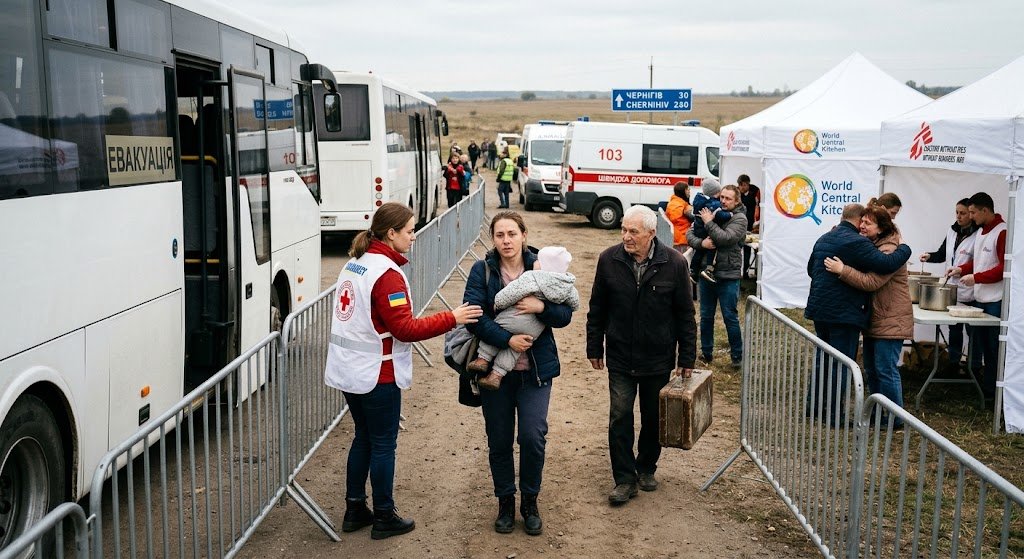
A joint Ukrainian-Russian relief operation moved civilians out of a town that UN monitors say went months without food deliveries. Officials are withholding how many people left, and the truce is due to expire Sunday.
The Oleshky evacuation brought residents of the Russian-occupied Ukrainian town into Ukrainian-held territory on Saturday, October 31, after a journey of about 19 hours through Russian-controlled Crimea, southern Russia and Belarus, according to the Kyiv Independent. Ukrainian authorities have not said how many people made the trip, citing the safety of those who stayed behind and of future aid missions, the Associated Press reported.
The operation was carried out under a localized ceasefire in Ukraine’s southern Kherson region. It began at 3 a.m. on Tuesday, October 27, and is due to last through Sunday evening. Both governments say it has held without violations, Reuters reported. The Kyiv Independent described it as the longest halt in fighting in any area since the full-scale invasion began in 2022, and the AP called it the most significant truce of the war. For background on the agreement, see HCN’s earlier report on the Oleshky ceasefire.
How the Oleshky evacuation worked
The United States played a central role. The White House said first lady Melania Trump brokered the deal, and Pope Leo XIV also urged both governments to allow aid and evacuations, the AP reported. Ukraine’s human rights ombudsman, Dmytro Lubinets, and Russia’s human rights commissioner, Yana Lantratova, coordinated the mission on the ground, according to the Kyiv Independent.
Demining of the routes into the town finished late on Thursday, October 29. The AP reported that two people were killed during the work. A humanitarian mission with a convoy of 25 buses, ambulances and aid supplies entered Oleshky on Friday. In identical statements, both sides said anyone who wanted to leave could do so safely, and that those who stayed would receive humanitarian support.
Oleshky sits on the Dnipro River, a few miles from Ukrainian-held territory. Because the river cannot be crossed directly, evacuees went south to Armiansk in occupied Crimea, then to Anapa in Russia’s Krasnodar region, where four planes carried them to Gomel in Belarus before buses took them to the Ukrainian border, according to the AP and the Kyiv Independent. Ukrainian public television reported that the route covered hundreds of miles.
Residents could also choose Russia. Lantratova said buses carried people who wished to live there, and Russian media showed arrivals at a temporary accommodation site in Simferopol, Crimea, the AP reported.
Who arrived at the border
At the Ukrainian-Belarusian border, relatives waited alongside ambulances, tents serving hot meals, and volunteers from the Red Cross, Doctors Without Borders and World Central Kitchen, the AP reported. The two ombudsmen said the oldest evacuee was 94 and the youngest had recently turned one, according to the Kyiv Independent. More than 30 staff from a Chernihiv hospital were on hand, with transfers to Kyiv available.
Liudmyla Burychenko, 39, told the Kyiv Independent that she sheltered in a basement as drones flew overhead in recent months. Liza Paliy, 19, told the AP she last saw her father more than two and a half years ago. She had left occupied territory with her mother and sister expecting to return within weeks. Some relatives told the Kyiv Independent that loved ones had stayed in Oleshky out of fear of Russian screening checks.
Why civilians needed to leave
Oleshky had about 24,000 residents before the war. Ukrainian officials put the number remaining before the operation at roughly 2,000, including nearly 50 children.
The UN Human Rights Monitoring Mission in Ukraine reported in June that no food had reached Oleshky since May 26. It documented at least 29 civilians killed and 54 injured in Oleshky and the neighboring town of Hola Prystan in 2026, mostly in attacks involving short-range drones. The mission called for a local ceasefire, and noted that under international law an occupying power must ensure food and medical supplies for the population. Residents interviewed by the Kyiv Independent described mined roads and constant drone attacks that made leaving, or bringing in supplies, extremely dangerous.
The Institute for the Study of War, a US-based conflict monitor, has assessed that the Russian military uses Oleshky as a key forward position, according to CNN. CNN also reported that Ukraine has attacked the area with drones to disrupt Russian supply lines, which has affected civilians still in the town.
Disputed claims about the operation
Several accounts challenge how the operation was run. They are allegations, and HCN has not independently verified them.
Kseniia Arkhipova, an evacuation volunteer from Oleshky who now lives in Ukrainian-held territory, said Russia violated the agreement by starting evacuations early. The Kyiv Independent reported that TASS footage appeared to show civilians being moved before the agreed October 30 date. Residents interviewed by the Media Initiative for Human Rights said Russian forces cleared debris and chose a route that avoided the most damaged areas, which they said was meant to give American television a less severe picture. An anonymous source told the Kyiv Independent that patients at the town’s hospital were told they faced screening if they left for Ukraine. Arkhipova also told the AP that Russian soldiers were pressuring residents to go to Russia instead.
Ukrainian officials had warned before the operation that Russia would stage videos of the mission. Russia’s installed head of occupied Kherson Oblast, Volodymyr Saldo, said before the operation that residents would be able to choose between staying in Russia and traveling to Ukrainian-held territory, the Kyiv Independent reported. HCN did not find a Russian response to the specific allegations above.
What happens after the ceasefire
The ceasefire ends Sunday evening. President Volodymyr Zelensky said that further de-escalation steps and a real approach to peace are also needed. Nothing published so far says whether the truce will be extended or whether aid deliveries will continue. The people who chose to stay depend on the supplies delivered this week, and how many of them there are has not been disclosed.
Fighting continued elsewhere during the truce. Russia launched drones and missiles at Ukrainian energy infrastructure overnight, and Ukrainian drone strikes were reported in Russia, according to the AP.