The Saudi Arabia pipeline drone attack has forced the kingdom to shut down its critical East-West crude oil pipeline, and Iraq’s prime minister has ordered an investigation after confirming the strikes originated from Iraqi territory near the Iranian border.
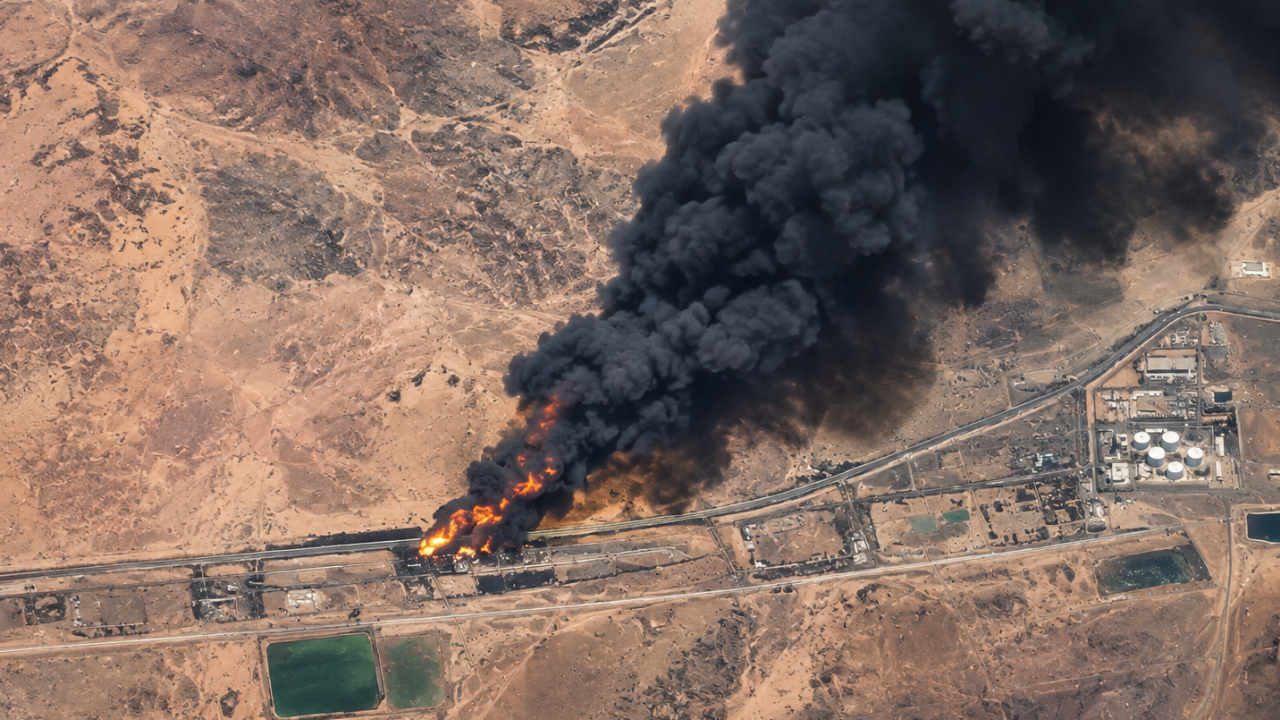
The strikes hit the pipeline, widely known as Petroline, on the morning of Thursday, Sept. 10, in the Riyadh and Medina regions, sparking fires and damaging pump stations along the route. The Saudi Energy Ministry said several people were injured and that the closure was a precautionary measure while emergency and technical teams assessed the damage. Satellite images captured in the days after the attack show black smoke rising from a section of the pipeline south of Medina and extensive fire damage at a pumping station.
How the Saudi Arabia pipeline drone attack disrupted oil flow
The East-West pipeline runs roughly 1,200 kilometers, or about 745 miles, from the Abqaiq processing complex in Saudi Arabia’s Eastern Province to the export terminal at Yanbu on the Red Sea. It has a design capacity of around 7 million barrels a day, though it typically carries between 4 million and 5 million barrels daily — enough to account for roughly 4% to 5% of global oil supply.
That volume has become far more important than usual because of the wider war between the United States, Israel and Iran, which has left the Strait of Hormuz effectively closed since March. With the strait blocked, Saudi Arabia has been rerouting close to 5 million barrels a day of crude that would normally move through the Gulf, sending it instead through the East-West pipeline to avoid the chokepoint. Saudi Aramco’s chief executive said last month that the pipeline had done more to soften the impact of the disrupted oil supply than the release of emergency crude reserves. Losing it, even temporarily, removes the kingdom’s main alternative export route at a moment when it has few others to fall back on.
Iraq confirms the origin, denies involvement follow
Iraq’s prime minister’s office said an investigation confirmed the drones were launched from Maysan province, an area in southern Iraq that borders Iran, and announced that a military commander had been dismissed as a result. Iraq also closed two border crossings with Iran following the findings.
An umbrella group representing Iran-backed militias operating in Iraq denied any role in the strikes. No group has formally claimed responsibility for the attack. Iran-allied militias in Iraq have carried out drone strikes on Saudi energy infrastructure before, and one analyst quoted by CNN pointed to a broader Iranian strategy of using regional proxies to pressure Arab governments over their military ties with the United States — though that remains an assessment rather than a confirmed motive behind this specific attack.
Part of a wider squeeze on Saudi oil exports
The pipeline strike did not happen in isolation. Earlier in the same week, Houthi rebels in Yemen launched separate strikes on Saudi energy facilities and other civilian sites, injuring more than 70 people, according to the Saudi government. Around the same time, Houthi forces seized Perim Island, a strategic point in the Bab el-Mandeb Strait at the southern entrance to the Red Sea — another vital route for global shipping and energy exports, distinct from the Strait of Hormuz to the east.
Taken together, the two developments squeeze Saudi Arabia’s oil export options from both directions: the Strait of Hormuz remains effectively closed to the east, and the newly vulnerable Bab el-Mandeb Strait now threatens the western Red Sea route that the East-West pipeline was built to protect. Global oil prices climbed above $100 a barrel following the developments, reflecting how directly the fighting has begun reaching the infrastructure that keeps oil moving out of the region. The disruption echoes the kind of repeated industrial strikes seen elsewhere in the region’s conflicts, including Russia’s recent strikes on Ukrainian steel plants, where critical infrastructure has similarly become a direct target rather than incidental damage.
What happens next
Saudi officials have not said how long the pipeline will remain closed, saying only that further updates will come once safety assessments are complete. Separately, Iran is expected to meet with Gulf states in Oman on Monday to discuss the status of the Strait of Hormuz, a meeting that will likely take on added weight given the pipeline attack and the loss of Saudi Arabia’s main workaround route. Whether Iraq’s investigation identifies who directed the strikes, and whether Saudi Arabia can restore the pipeline without further incident, are likely to shape how much worse the region’s energy squeeze gets in the days ahead.