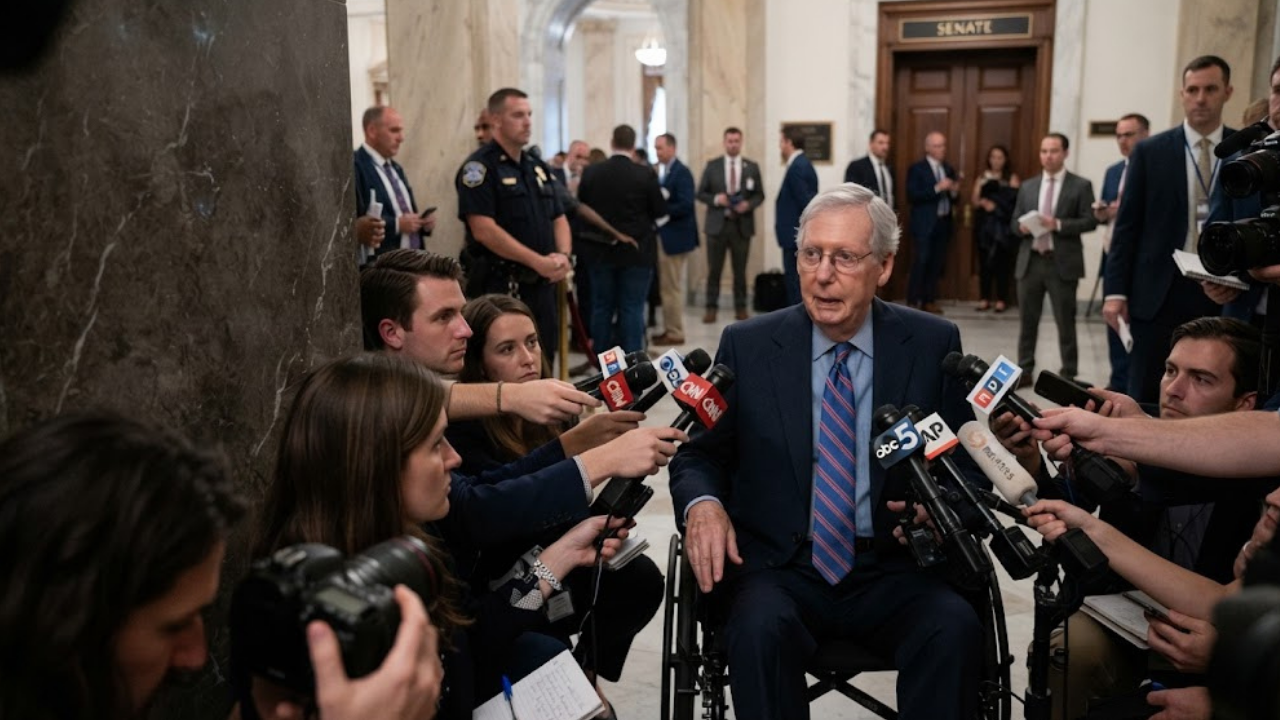
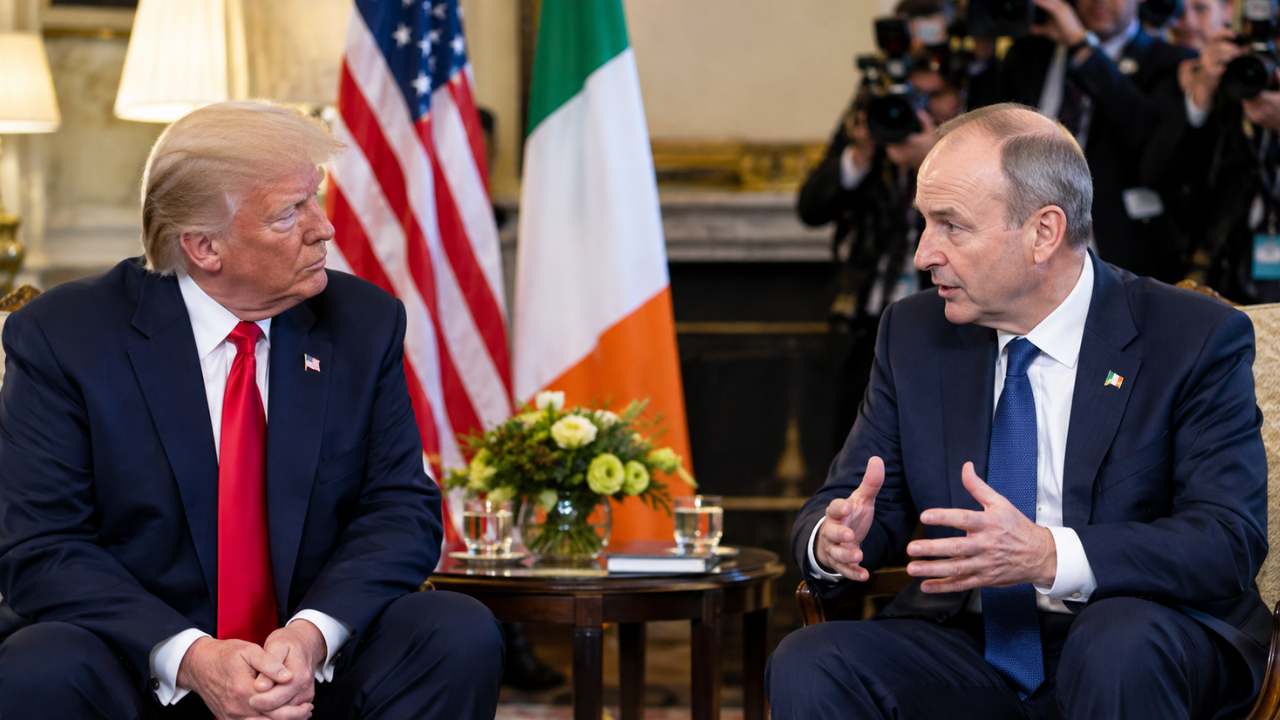
Trump Irish reunification comments, made during a Saturday visit to Dublin, broke with decades of American neutrality on one of the most sensitive constitutional questions facing Ireland and the United Kingdom, and triggered immediate pushback from unionist politicians in Belfast and London.
Trump’s 48-hour visit formally began with separate meetings in Dublin: first with Irish President Catherine Connolly at her official residence, Áras an Uachtaráin, and then with Martin at the government’s Farmleigh state guesthouse. He also addressed American and Irish business leaders at the U.S. ambassador’s residence before heading west to Doonbeg, County Clare, where his Trump International Golf Links course is hosting the Irish Open. It is the second European Tour event held at a Trump-owned property this year, and Trump is expected to present the trophy to the tournament’s winner on Sunday.
How Trump’s Irish reunification comments broke decades of US neutrality
Reunification of Northern Ireland, part of the United Kingdom, with the Republic of Ireland has been a defining fault line in Irish and British politics since the island’s partition a century ago. Successive U.S. administrations from both parties have avoided taking a side on the issue.
That changed when a reporter asked Trump directly for his view during the Martin meeting. Trump initially hedged, saying, “Well, I don’t want to cause any trouble,” before adding, “But I will tell you, I’d love to see it unified,” calling the prospect “a great feather in everybody’s cap” and, later, “a fantastic thing.” He said he believed unification was “going to happen eventually,” acknowledged that “the U.K. will have something to say about it,” and asked, “how can it be bad?”
Speaking later at the U.S. Embassy, Trump seemed to recognize the political weight of what he’d said, joking that the question had put him in a no-win spot: “I think we’ll read about it tomorrow. That’s one of those questions where, no matter what you say, no matter how well you say it, there’s no good answer, right?”
Under the Good Friday Agreement, which ended three decades of violence in Northern Ireland in 1998, any vote on unification can only be called by the U.K. government’s Secretary of State for Northern Ireland — and only if it appears likely a majority there would support leaving the U.K. No such referendum is currently planned.
Why unionist parties in Belfast reacted so fast
The reaction from Northern Ireland’s unionist community was swift. Democratic Unionist Party leader Gavin Robinson said on social media that “Northern Ireland’s constitutional future will be decided by the people of Northern Ireland, not by commentary in London, Dublin or Washington,” adding that “as unionists we are not interested in the destruction of our country by joining with the Irish Republic.”
Ulster Unionist Party leader Jon Burrows took a more measured line, saying Trump was entitled to a personal opinion but that it carried no formal weight, pointing to the “principle of consent” written into the Belfast Agreement. In London, Conservative Party leader Kemi Badenoch compared Trump’s comments to his past talk of acquiring Canada and Greenland, framing it as part of a pattern of casually floating changes to other countries’ borders. The office of U.K. Prime Minister Andy Burnham responded that there is currently no majority public support in Northern Ireland for a border poll, and no new vote will be called until that changes.
For unionist politicians, the concern isn’t an immediate legal shift — Trump has no authority over the Good Friday Agreement’s mechanism — but the signal a sitting U.S. president sends by publicly favoring one outcome in a dispute Washington has long treated as strictly a matter for Northern Ireland’s own voters.
A visit shadowed by protest and a fraught recent history
Trump’s arrival drew a heavy security presence, with police cordoning off Dublin’s 1,750-acre Phoenix Park, and it prompted street protests from a coalition of left-leaning parties, anti-war groups and pro-Palestinian organizations.
Some Dublin residents voiced frustration over the disruption. One taxi driver told reporters Trump was “causing mayhem in this city because he wants to go down to Doonbeg and play golf,” while a university student criticized the Irish government for what she called a warm welcome to a leader whose “attitudes towards women, towards immigrants, towards minority communities in general are abhorrent.”
The meeting with Connolly carried its own history. Connolly, elected to the largely ceremonial presidency last year, was among those who protested Trump’s first visit to Ireland as president in 2019, demonstrating outside Shannon Airport. She has said her sister, Dr. Margaret Connolly, was detained by Israeli forces in May after they intercepted a Gaza-bound aid boat — an episode Martin publicly condemned and that President Connolly called “quite upsetting.”
During a St. Patrick’s Day visit by Martin to the Oval Office in March, Trump referred to Connolly as “he” when asked about her past criticism of “violations of international law” in the Middle East. Saturday’s meeting stayed brief and cordial, limited to a greeting and a shared viewing of a military band.
What the reunification remark means going forward
Trump’s trip arrives days after the Republican National Convention and in the same week as the 25th anniversary of the September 11 attacks, as his party campaigns to hold its majorities in both chambers of Congress ahead of the midterms. White House officials said the substantive Dublin agenda centered on bilateral economic ties and expanding opportunities for U.S. industry, along with international issues of shared concern — a category Irish officials say includes their unease over the ongoing Iran conflict. Ireland’s close economic relationship with the U.S., anchored by major American technology and pharmaceutical employers, gives both governments strong incentive to keep ties steady even as Trump’s unscripted remarks generate friction elsewhere.
The reunification comment is likely to outlast the golf headlines from this trip. It hands Irish nationalist politicians, including Sinn Féin, a high-profile talking point despite carrying no legal force, while giving unionists a fresh grievance about Washington’s traditional impartiality. Officials have not signaled any formal change in U.S. policy — what continues instead is political fallout in Belfast and London over a comment Trump himself described as almost an afterthought on his way to a golf tournament.
Related: Read our previous coverage of US-Ireland relations for background on how past administrations have handled the Northern Ireland question.