
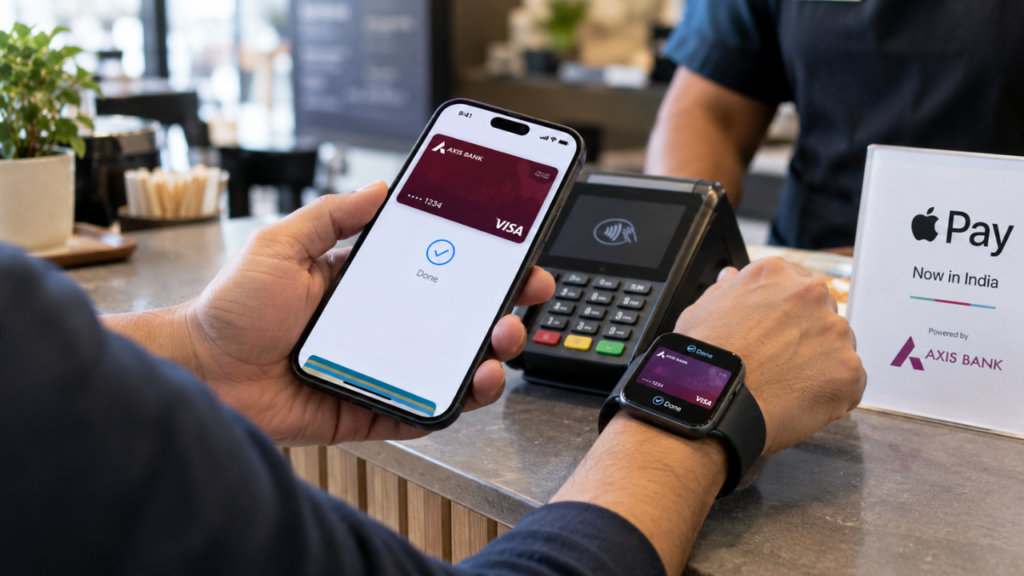
Apple Pay India is now live: the payment service launched on 30 September through a partnership with Axis Bank, giving Apple its first foothold in one of the world’s largest digital payments markets. At launch it works only with eligible Axis Bank credit cards on the Visa and Mastercard networks, which means most Indian cardholders cannot use it yet.
Apple Pay India: what works today for Axis Bank customers
Axis Bank, India’s third-largest private lender, is the first Indian bank to offer the service, according to Reuters. Apple’s announcement says eligible customers can pay in shops, inside apps and on websites using an iPhone, iPad or Apple Watch, with Mac support listed as coming soon. Apple says cardholders keep the rewards their cards already earn.
In a shop, the customer double-clicks the side button, confirms with Face ID, Touch ID or a passcode, and holds the device near a contactless reader. Apple says no PIN or one-time password is needed at checkout. The company lists an iPhone XR or later running iOS 18 as the minimum for iPhones, and an Apple Watch Series 6 or later paired with a compatible iPhone.
Apple named Zomato, Blinkit, Croma, Chaayos, Tata 1mg, Reliance brands and its own stores among launch merchants, and said it worked with payment processors including Razorpay, Paytm, PayU and Pine Labs. Its announcement describes acceptance both as thousands and as millions of merchants, and gives no figure that could be independently checked, so the real breadth of coverage will only become clear through use.
How to add a card to Apple Pay in India
Apple describes two ways to get started. A customer can add an eligible card directly from the latest version of the Axis Bank app, or open the Wallet app on an iPhone, tap the plus sign and follow the prompts. Once the card is added, Apple says it can be used straight away.
Only Axis Bank-issued Visa and Mastercard credit cards are supported for now. A card from any other bank, or a RuPay card of any kind, will not be accepted by the service at this stage.
Which cards and banks are missing at launch
Cards on RuPay, India’s homegrown network, are not eligible, Reuters reported. Apple’s announcement refers only to Visa and Mastercard credit cards issued by Axis Bank, and it does not say when other card types or other lenders might follow. That leaves the reach of the launch tied to a single bank’s customer base.
Axis Bank is India’s fourth-largest credit card issuer, with 16.3 million of the country’s 124 million cards outstanding as of August, according to central bank data cited by Reuters. By HCN’s arithmetic that is about 13 percent of cards in circulation. Larger rivals HDFC Bank and ICICI Bank have held talks with Apple but had not agreed commercial terms, Reuters reported earlier this month.
TechCrunch, citing unnamed people familiar with the matter, reported that SBI Card is also not supporting Apple Pay at launch while negotiations over commercial terms continue. The publication said Apple, Axis Bank, HDFC Bank, ICICI Bank and SBI Card did not respond to its requests for comment. HCN has not independently confirmed the SBI Card detail.
How Apple Pay fits alongside UPI
India’s Unified Payments Interface, or UPI, is a real-time bank transfer system that accounts for 84 percent of digital payment volumes and is the world’s largest retail fast-payment system by transaction volume, according to a 2025 IMF report cited by Reuters. Scanning a QR code to pay straight from a bank account has become routine, and it does not depend on cards.
Apple Pay is card-based, so each bank and payment infrastructure provider has to integrate with it, TechCrunch noted. Nothing in Apple’s announcement mentions UPI. On the facts available, the launch of Apple Pay India adds a card-payment option for a limited group of customers rather than competing with the system that carries most digital transactions.
How the launch came together
Bloomberg News reported in February, citing people familiar with the matter, that Apple was in talks with ICICI Bank, HDFC Bank and Axis Bank and hoped to launch around the middle of 2026. Reuters said earlier this month that the launch was being prepared for October, starting with Axis Bank credit cards. It arrived on 30 September, ahead of that October timing and without the two larger banks.
What Apple, Visa and Mastercard say about security
Apple says actual card numbers are not stored on the device or on its servers and are not shared with merchants. Instead, a unique Device Account Number is encrypted and kept in a certified chip called the Secure Element. If an iPhone is lost, the owner can locate, lock or suspend payments through the Find My app.
Mastercard said its tokenisation technology protects every transaction with a unique token, and Visa described tokenisation as part of a safer way to pay. These are company descriptions, and HCN has seen no independent security assessment of the Indian rollout.
What is still unresolved
The main open question is whether HDFC Bank, ICICI Bank and SBI Card will sign on, and when. Reuters and TechCrunch both describe negotiations over commercial terms as unfinished, and no date had been announced for any additional issuer when this was written. Apple has also not said whether RuPay cards or UPI will ever be supported.
Axis Bank, Apple and the other banks had not published figures on how many customers have added cards since launch, so early adoption is unmeasured. Mac support, which Apple lists only as coming soon, also has no date. For another major technology rollout HCN has covered, see our report on the launch of OpenAI’s Dots always-on AI agents. HCN will update this story as banks, Apple or regulators provide more detail.