
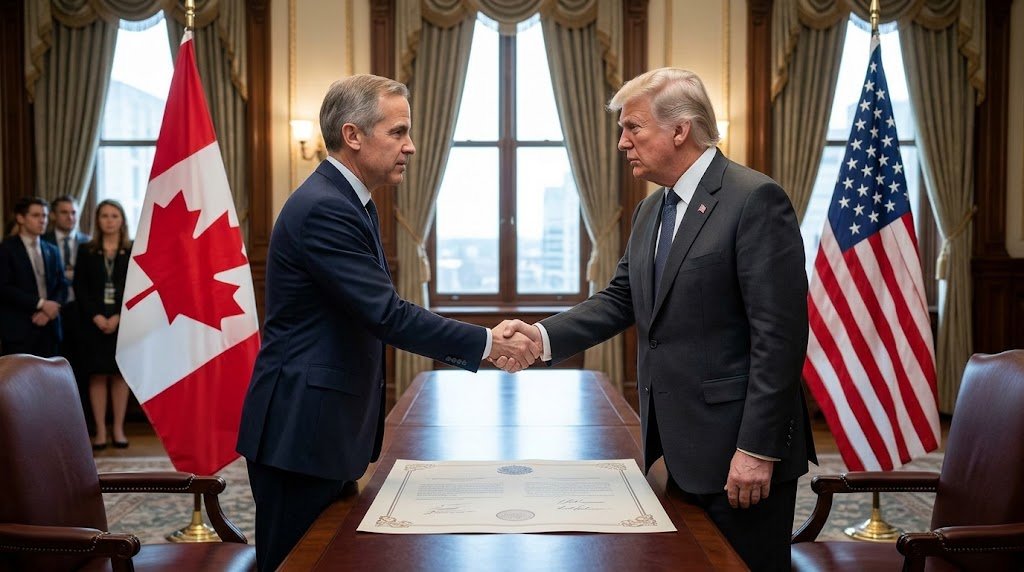
A Canada US trade deal moved a step closer to formal negotiations on Sunday, November 1, after Prime Minister Mark Carney and President Donald Trump spoke about ending a trade stalemate that began in August. Carney said he had a good conversation with Trump on the future of trade and that it built on recent constructive discussions about the outlines of a mutually beneficial deal. Trump told reporters in Dubuque, Iowa, that the two countries have the “concept” of a deal. Neither leader has released tariff rates, a deadline or written terms, so the substance of any agreement remains unknown.
What Carney and Trump Said About the Canada US Trade Deal
Carney said on social media that a good deal would create jobs for Canadian workers, improve affordability for families and fully respect Canada’s languages, culture and sovereignty. He added that negotiating teams would work in the coming weeks to deliver that outcome. Trump said he spoke with Carney again on Saturday and described the concept as great for American farmers and the country, and fine for Canada too. He also said the agreement would include the long-stalled Keystone XL pipeline, adding that Canada will build it.
The pipeline claim is Trump’s alone so far. Carney’s office did not immediately respond to a request for comment on it, and a spokesperson for Trade Minister Dominic LeBlanc offered nothing beyond Carney’s statement on Sunday evening. Keystone XL is a proposed oil pipeline from Canada to the United States that former President Joe Biden canceled in 2021.
Why the Trade Talks Stalled in August
Formal negotiations broke down in August, when Canada walked away from the table with the two sides deadlocked over matters including auto trade. Carney has said Washington demanded terms that would damage major Canadian industries, including autos, steel and aluminum. After the talks ended, Trump imposed 50% tariffs on roughly $20 billion worth of Canadian goods, and Canada responded with counter-tariffs. The United States also keeps separate tariffs of up to 50% on Canadian steel and 25% on cars, although Trump has since lifted some of the new levies ahead of the U.S. midterm elections.
Progress had looked limited until recently. On October 28, a Canadian official told Reuters that headway on easing tariffs for steel and autos had been small, and Carney described only a slight intensification in talks the week before. Carney has also acknowledged that he cannot be certain Trump would honor a new agreement.
What Is Still Unclear
Several basic questions remain open. There are no published tariff rates, and it is not known whether any deal would lower the U.S. duties on steel, aluminum, autos and lumber, or whether Canada would drop its counter-tariffs in return. The Keystone XL project raises its own questions, including who would build it, who would pay for it and whether Canada has agreed to any of it.
The wider trade relationship is also unsettled. Earlier this year, both governments conceded that the review of the Canada-United States-Mexico Agreement, known as CUSMA (the continental trade pact called USMCA in the United States), would not finish by its July 1 target. Canada has argued that renewing that pact is a separate issue from the tariffs the U.S. imposed on steel, aluminum, lumber and autos, and it is not yet clear how a new Canada US trade deal would fit with that review.
What Happens Next for the Canada US Trade Deal
Canada’s Globe and Mail reported, citing sources, that formal talks are expected to resume shortly for the first time since the summer, and that Trump ordered his team to restart them after the call. Those talks would pick up roughly where they left off in August. The timing also matters politically in the United States, because tariffs on Canada have become an issue in border states such as Michigan and Maine ahead of Tuesday’s midterm elections.
Canadian industry groups are watching closely. Flavio Volpe, president of the Automotive Parts Manufacturers’ Association, said any deal must be mutually beneficial and must also put Canada’s auto, steel, aluminum and lumber sectors on a path to recovery after a costly trade war. For workers and companies in those industries, the practical question is whether the concept turns into lower tariffs, and how soon. Until officials publish terms, that question has no answer. Read the Globe and Mail’s report on the resumption of talks, and follow more world coverage on Human Crisis News.