
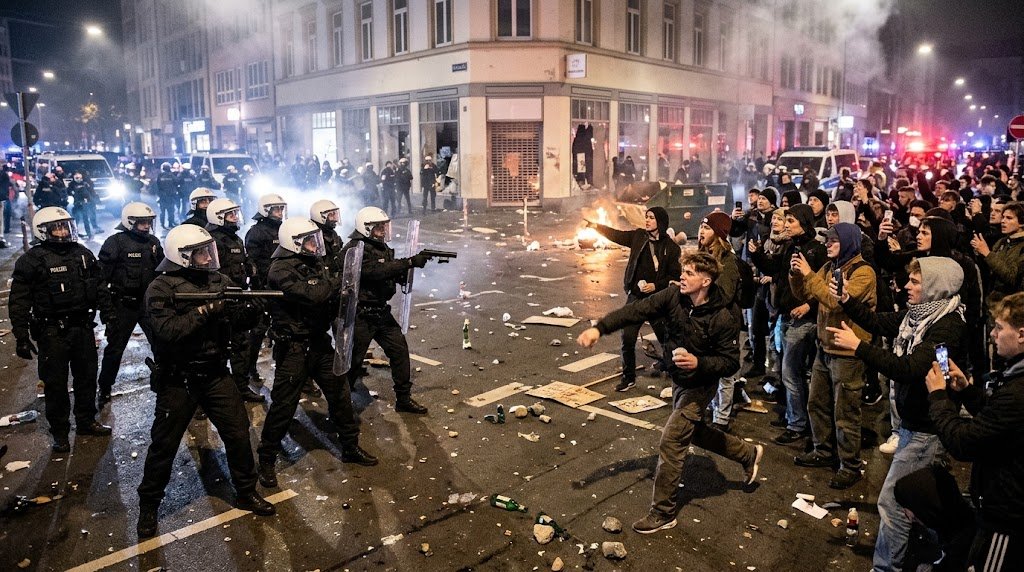
The Germany Gen Z protests on Saturday, October 31, drew tens of thousands of young people into the streets of more than 30 cities, then turned violent in several of them after dark. The campaign group Gen Z regelt, which translates roughly as “Gen Z takes charge,” organized the marches to demand better schools, relief from rising living costs and opposition to mandatory military service. Rioters later smashed windows, looted shops and attacked police in Frankfurt, while clashes were also reported in Cologne, Berlin, Hamburg and Bremen. The situation is still developing, and officials are giving conflicting accounts of who was responsible.
What Happened During the Germany Gen Z Protests
By day, the demonstrations were largely peaceful. Organizers said about 120,000 people took part nationwide, though the German news agency dpa reported turnout was more modest than expected and that no national police total was available. In Frankfurt, police said up to 8,000 people marched through the city center, while organizers put the figure at about 9,000. In Berlin, up to 5,000 people gathered peacefully at the Brandenburg Gate, and in Hamburg about 6,700 people took part in a mostly calm march.
The mood changed as night fell. In Frankfurt, police said they came under repeated attack with stones, bottles and firecrackers, and they used water cannons to break up the demonstration. Police also reported Molotov cocktails thrown at officers, and one section of the Zeil, one of Germany’s busiest shopping streets, was sealed off. Hesse’s interior minister, Roman Poseck, said hooded rioters damaged 17 stores, five of which were looted. A firearms shop was also attacked, and police recovered two weapons from it.
Injuries, Arrests and Conflicting Numbers
The official figures grew as the picture became clearer. On Saturday night, Frankfurt police reported about 30 people in custody, but on Sunday Poseck said 1,300 officers had been deployed, more than 100 were injured and 54 people aged 13 to 29 had been arrested. In Berlin, police said 27 officers suffered minor injuries, and up to 56 demonstrators were temporarily detained, though other outlets reported a higher figure of around 120 people taken into custody over the evening.
In Cologne, about 200 people, including some rioters, gathered near the cathedral, where bottles and bicycles were thrown at officers. One person was injured and five were detained. A police spokeswoman said the later incidents in the city appeared linked more to Halloween celebrations than to the earlier youth protest. Berlin’s violent evening march was also a separate event organized by left-wing groups, not the main Gen Z regelt rally.
Who Is Being Blamed, and What Is Unproven
Officials have blamed organized troublemakers, but their accounts differ. Federal Interior Minister Alexander Dobrindt said “violent left-wing groups and troublemakers from migrant communities” hijacked the peaceful protests. He did not provide evidence for the claim or say which groups were involved. Poseck said on Saturday that about 100 suspected left-wing extremists were behind the evening violence in Frankfurt. On Sunday he said police estimated between 1,000 and 1,500 violent troublemakers, predominantly from an immigrant background, while also saying most of those arrested were German nationals.
These claims have not been independently verified, and the difference between the two estimates is large. Gen Z regelt distanced itself from the violence after the protests, and the group had instructed participants to protest peacefully and keep their faces visible. Germany’s national school-student representative body has also distanced itself from the campaign, citing concerns about transparency, and has announced separate protests for November 20.
Why Young Germans Are Protesting
The marches draw on grievances that many young people share across Europe, including underfunded schools and universities, cuts to social services and the cost of living. Fear of a return to compulsory military service is also central, following a government agreement earlier this year that opens the door to conscripting young men if too few recruits sign up. Protesters carried signs criticizing conservative Chancellor Friedrich Merz’s government. The movement follows weeks of youth-led protests in France, where more than 320,000 people demonstrated on the same Saturday, and where riots and looting on October 17 damaged shops and public buildings.
What Happens Next
Dobrindt said he expects severe penalties for those responsible, and Poseck warned of a tougher response to any repeat of the violence. Gen Z regelt says it wants to join further European protests on November 20, so authorities and organizers face the same question again within weeks: how to keep peaceful marches separate from the violence that followed this one. Final police and court figures are still to come, and for the latest verified numbers, see the Reuters report carried by ABC News, or follow more world coverage on Human Crisis News.