
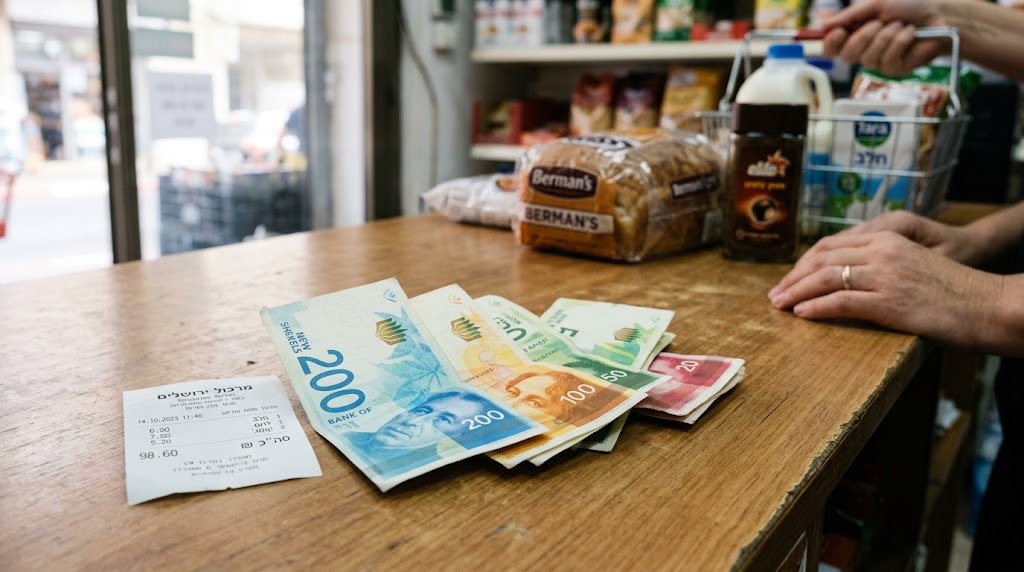
The Israel consumer price index fell 0.5 percent in September 2026 compared with August, the Central Bureau of Statistics (CBS) reported on Thursday, October 15. Annual inflation, measured from September 2025, stands at 1.6 percent, inside the Bank of Israel’s target range of 1 to 3 percent and below its 2 percent midpoint.
The monthly drop was deeper than economists had expected. Forecasts from Meitav and Leader Capital Markets, cited by bne IntelliNews on October 13, pointed to a 0.3 percent decline. In August, prices rose 0.7 percent on the month and annual inflation was 1.5 percent, the lowest since May 2021, according to the same outlet.
What fell and what rose
According to JFeed’s account of the CBS data, culture and entertainment prices fell 2.7 percent in September and transportation fell 2.5 percent. Clothing and footwear dropped 0.9 percent, while food, furniture and household equipment each declined 0.4 percent. Some prices rose. Fresh vegetables climbed 6.6 percent, education services rose 0.8 percent, and rent increased 0.4 percent.
The transportation decline may owe something to policy. bne IntelliNews reported that a Finance Ministry cut to fuel excise taxes lowered the price of 95-octane gasoline by 4.2 percent, to 7.75 shekels per liter, for most of September. The outlet described the effect as an administrative one rather than a sign of weaker demand. That is its assessment, and HCN has not confirmed it with CBS or the ministry. The annual rate edged up slightly from August, even though prices fell on the month. The sources reviewed do not explain why.
Housing prices
CBS also publishes a separate index of dwelling prices, which tracks completed transactions and is not part of the CPI. The latest release covers July and August, not September. It shows housing prices down 0.6 percent compared with the previous two months, with new apartments down 0.4 percent.
Only the Haifa district rose, by 0.4 percent. The North fell 1.5 percent, Tel Aviv 0.9 percent, the Center 0.7 percent, Jerusalem 0.3 percent and the South 0.1 percent. Compared with July and August 2025, housing prices were 1.8 percent lower, and every district recorded an annual decline, from 2.7 percent in the Center to 0.2 percent in Jerusalem.
The Israel consumer price index and interest rates
The Bank of Israel cut its benchmark rate by a quarter point to 3.25 percent on September 1, following a cut to 3.5 percent in July. In its September statement, the central bank said inflation had moderated and was below the midpoint of the target range. It also said the rate path would depend on inflation, economic activity, geopolitical uncertainty and fiscal developments. The bank’s decision set the next announcement for October 21, 2026. JFeed reports speculation that Governor Amir Yaron may cut again at that meeting. The central bank has given no explicit signal, and the outcome remains open.
How the latest reading compares with the central bank’s view
The September figure arrives close to what the Bank of Israel had been projecting. In its July 6 statement, the bank’s research staff expected inflation of 1.8 percent in both 2026 and 2027. The annual reading of 1.6 percent sits a little below that projection, though the two are not directly comparable, because the forecast refers to annual averages and the CBS figure compares one month with the same month a year earlier.
The central bank also looks at a narrower measure. In its September statement, it said annual inflation excluding energy, fruit and vegetables was 1.5 percent in July. Because vegetable prices jumped in September while fuel and transport costs fell, that kind of measure may give a clearer picture of underlying price pressure than the headline figure. The September version of it was not available in the sources HCN reviewed.
Over the past year, the benchmark rate has come down from 4.25 percent after the November 2025 cut to 3.25 percent today. Lower borrowing costs can ease mortgage and business loan payments over time, but only if the central bank continues cutting and lenders pass the changes on.
What it means for households
The September data point to cheaper fuel, leisure and some goods, but not to broad relief. Rent kept rising, and the housing price index measures purchase prices in an earlier period, so it does not show what tenants or mortgage holders pay now. bne IntelliNews reported that the CPI’s housing component was up 3.8 percent year on year in August. The data reviewed do not establish a general improvement in affordability.
The next test for the Israel consumer price index is the October reading, which comes after the Bank of Israel’s October 21 rate decision. That decision will show whether lower inflation translates into cheaper borrowing.