
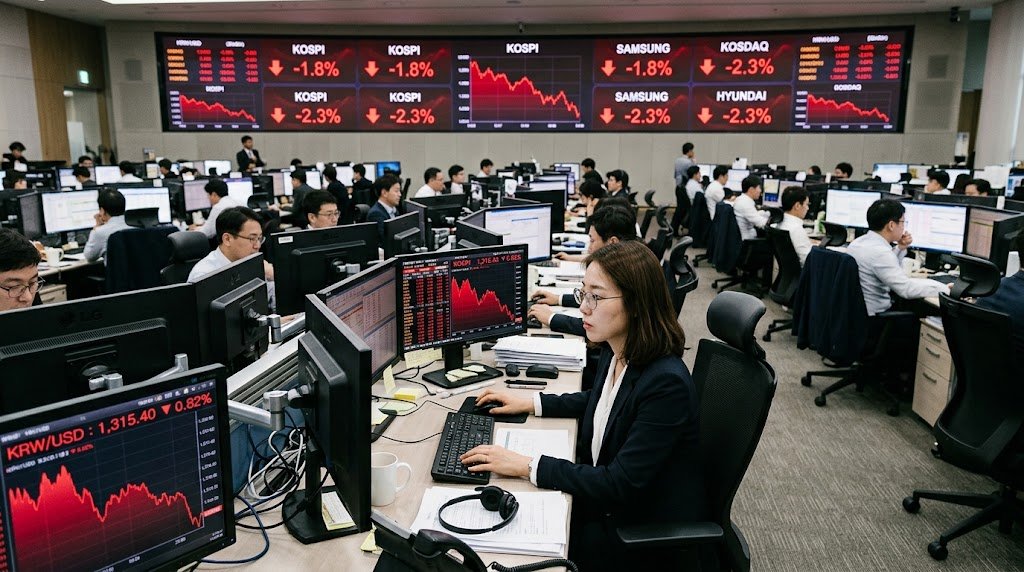
A Kospi circuit breaker halted trading in South Korea on Thursday, October 15, 2026, after a technology-led sell-off pushed the benchmark index down more than 8% from the previous close. Samsung Electronics and SK hynix, the country’s two biggest chipmakers, each lost roughly 10% of their value, and the tech-heavy Kosdaq also hit a circuit breaker.
The Korea Exchange suspended trading across the main market at 12:38 p.m. local time for 20 minutes. At its lowest point of the day, the Kospi was down more than 9%, at 5,450.81, before recovering part of the loss. The Korea Herald reported that the index finished more than 7% lower, back at levels last seen in July.
How the Kospi circuit breaker unfolded
SK hynix closed down about 11% at 1.26 million won. Samsung Electronics fell about 9.5% to 210,000 won, after dropping more than 10% earlier in the session. Samsung Electro-Mechanics lost more than 15%, and SK Square, a holding company tied to SK hynix, fell more than 10%.
The Kosdaq closed 7.65% lower at 760.82. It had already triggered a sell-sidecar, a short pause on program trading, at 9:12 a.m., and a full circuit breaker at 12:23 p.m. It was the first day since July 29 that both markets hit circuit breakers together.
The Level 1 rule applies when the index stays more than 8% below the previous close for at least one minute. By most counts this was the tenth Kospi circuit breaker of 2026 and the sixteenth since the mechanism was introduced. That fits Yonhap’s tally on July 29, when it recorded the ninth this year. The index has been under pressure for several sessions, reported at seven straight losses, and HCN previously covered an earlier chip-stock sell-off in Seoul.
Why investors sold
No single cause explains the drop. Several reports point to a mix of pressures.
One was U.S. inflation. Consumer price data released on Wednesday came in higher than forecast, and the Nasdaq fell nearly 2% overnight. Hotter inflation raises the chance that U.S. interest rates stay high for longer, which tends to hurt richly valued technology shares.
A second was doubt about how the AI boom will be financed. Analysts noted that rising borrowing costs for capital-intensive AI infrastructure companies, such as CoreWeave, have raised credit concerns. Samsung and SK hynix supply the memory chips that AI data centers depend on, so worries about AI spending reach them directly.
A third was competition from China. Some coverage cited investor concern over claims of progress by Chinese memory maker CXMT. HCN has not independently verified those claims, and the reports do not say how much they contributed to Thursday’s fall.
Market strategists at J.P. Morgan, quoted by the financial newsletter Finimize, also pointed to the end of share-buyback programs at Samsung and SK hynix. Those programs had provided steady buying that did not depend on daily price swings, and their end left the market with less support.
Foreign selling, the won and Asian markets
Foreign investors sold heavily. Reports put their net selling at between 2.9 trillion and 3.4 trillion won, probably because the figures were measured at different times of the day. The South Korean won weakened to about 1,350 per U.S. dollar by late morning, according to Yonhap.
The sell-off was not limited to Seoul. Japan’s Nikkei 225 fell about 5% in the same session, according to market analysis site TradingKey, suggesting the pressure was spread across Asia’s technology shares.
Who is affected
Samsung and SK hynix make up a very large share of the Kospi’s total market value, so their moves can swing the whole index. That concentration is why a fall in two companies can pull down pension funds, retail portfolios and the currency at the same time.
AFP-based coverage said retail investors were hit especially hard, particularly those holding leveraged exchange-traded funds linked to the two companies. These products magnify losses when the underlying shares fall. The reports reviewed gave no figures for how much retail investors lost.
What is still unknown
The exact closing level of the Kospi was not confirmed in all of the reports reviewed, and the weight of each cause behind the fall is still unclear. No statement from Samsung, SK hynix or South Korean regulators was found in the material available. Investors will be watching whether the market steadies in the next session after this Kospi circuit breaker, and how U.S. rate expectations and AI spending news develop in the coming days.