
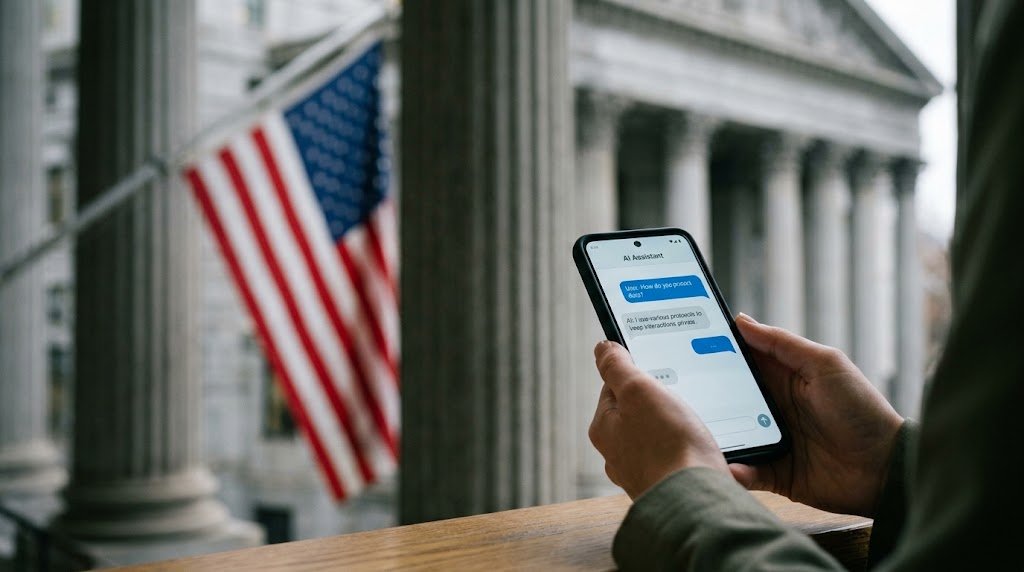
Eight US states sue OpenAI in separate lawsuits filed on Wednesday, October 14, 2026, accusing the maker of ChatGPT of misleading the public about how safe its chatbot is. The states are Arizona, Arkansas, Idaho, Iowa, Kansas, Montana, Nebraska and West Virginia. Everything described in this report is an allegation made in court filings. No court has ruled on any of these claims, and OpenAI has not been found liable.
What happened
Iowa, Kansas, Nebraska, West Virginia, Arkansas, Arizona, Idaho and Montana each sued OpenAI separately in their own state courts, according to Iowa Attorney General Brenna Bird, as CNBC reported. This is not one joint case or a single class action. When the states sue OpenAI this way, each complaint goes to its own court, which means the cases will move on separate timelines and could end with different results.
Bird announced Iowa’s lawsuit at a press conference alongside Kansas Attorney General Kris Kobach, Nebraska Attorney General Mike Hilgers and West Virginia Attorney General JB McCuskey. News outlets have described the effort as coordinated, and some have called the group of states bipartisan. Although the filings were coordinated in timing, each case rests on its own state laws and its own set of requests to the court.
What the states allege
The central accusation behind why the states sue OpenAI is that the company promoted ChatGPT as safe while knowing the product needed stronger protections. The lawsuits accuse the company of marketing an unsafe product that allegedly harmed multiple children and deceived thousands of parents. Prosecutors also argue that these alleged misrepresentations contributed to users being coached toward suicide or toward harming others, claims that OpenAI will have to answer in court.
Iowa’s complaint raises an issue about age. OpenAI lists 13 as the minimum age for ChatGPT but does not require age verification on its website, which the state says leaves children exposed. Bird said her state’s case is about protecting children and holding OpenAI accountable under Iowa law, and she argued that the company describes ChatGPT as safe while it allegedly gives dangerous medical advice.
Arkansas takes a particularly pointed line. It alleges OpenAI knew increasingly powerful systems needed stronger protections but released models without adequate safeguards or testing, putting growth and profit ahead of safety. Arkansas is also one of the states asking a court to pause testing of advanced AI models until adequate safeguards are in place, which is among the most far-reaching requests in the filings.
Which laws are being used
Because there is no single national rulebook for this, each state relies on its own statutes, which is why the lawsuits are not identical. Iowa invokes its Consumer Fraud Act, while Montana filed in Lewis and Clark County under its Consumer Protection Act and its Consumer Data Privacy Act. These laws give state attorneys general the power to act against deceptive business practices.
Arkansas cites its Deceptive Trade Practices Act and its Children’s and Teens’ Online Privacy Protection Act. Nebraska relies on its Consumer Protection Act, the Uniform Deceptive Trade Practices Act and the Age-Appropriate Online Design Code Act. Taken together, the filings show how states are stretching existing consumer-protection and child-safety laws to cover a fast-moving technology that Congress has not yet regulated directly.
What the states are asking for
The states that sue OpenAI are making requests that vary by state, but several themes repeat. Beyond financial penalties, they want OpenAI to clearly disclose the risks of its products, stop practices they consider deceptive and follow existing laws. Remedies differ because consumer-protection and child-protection laws differ across the country, so a request that is possible in one state may not be available in another.
Money is also on the table. Iowa is asking for civil penalties of up to $40,000 per violation of its Consumer Fraud Act, plus up to $5,000 more per violation affecting people aged 60 and older. Because penalties are counted per violation, the final figure could grow large if a court finds many violations, although no such finding has been made.
Why states sue OpenAI without waiting for Washington
Kansas Attorney General Kris Kobach said the states are not going to hold their breath waiting for federal legislation to keep AI companies in check. This reflects a wider pattern in which states have moved faster than Congress on AI oversight. The lawsuits also test whether ordinary consumer-protection law can be applied to the behavior of an AI chatbot, a question with no clear precedent yet in US courts.
How this fits a larger pattern
These suits did not come out of nowhere. Florida became the first state to sue OpenAI and CEO Sam Altman earlier this year, alleging the company marketed ChatGPT to children while concealing serious risks. A multistate investigation followed, with attorneys general subpoenaing OpenAI for internal documents on user data, the safety of minors and advertising. For a different example of technology risk drawing public scrutiny, see HCN’s report on the Cisco Secure Email Gateway vulnerability.
How OpenAI has responded
OpenAI disputes the broader claim that it has ignored safety and points to stronger protections it has introduced. In response to Florida’s earlier lawsuit, the company said it had put parental controls and age-detection tools in place, particularly to protect minors. Readers should remember that OpenAI’s side will be tested in court just like the states’ claims, and until judges rule, the allegations remain unproven.
A note on the number of states
Most major outlets report that eight states sued. However, one report says Arkansas’s attorney general’s office also listed Utah among the states that filed similar suits, which would make nine, while the Iowa, Montana and Nebraska announcements named eight. This article uses eight, the figure confirmed by the filing states, and will be updated if a ninth filing is verified.
What this means for parents and everyday users
Whatever the outcome, the cases highlight practical points for families. If your child uses an AI chatbot, check for parental controls and age-related protections, and explain that a chatbot can be wrong, including on health and safety questions. A chatbot is not a doctor, therapist or trusted friend, so serious concerns should go to real professionals. If a young person is struggling emotionally, contact a trusted adult or a local mental health service.
What happens next
As the states sue OpenAI in eight different courts, there may be eight different timelines and eight different judges. Early steps typically include OpenAI’s formal responses and possible motions to dismiss. Final outcomes could take a long time, and results may differ from state to state, so readers should expect updates rather than a single quick resolution.
Bottom line
The lawsuits mark one of the broadest state-level legal pushes yet against a major AI chatbot maker. Whether states sue OpenAI successfully under consumer-protection law is still an open question. The answer will matter well beyond OpenAI, because other AI developers are watching closely, and the outcome could shape how AI products are advertised to families.