
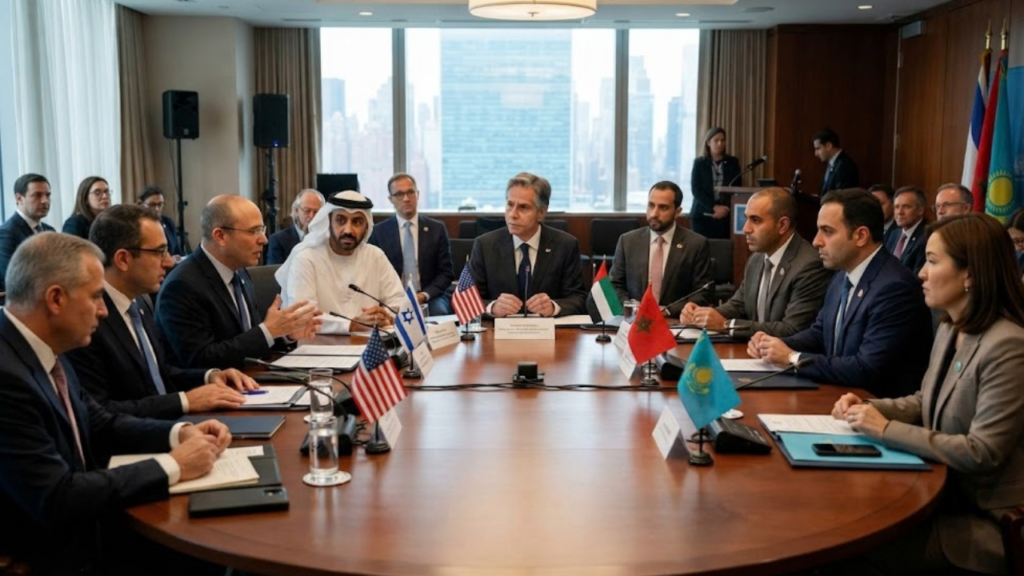
The Abraham Accords meeting held in New York on Thursday brought senior officials from Israel, the United States and accord-partner countries together for the first time since January 2023, restarting a diplomatic track that had been largely frozen since the October 7, 2023 Hamas attack on Israel.
The roundtable was convened by the N7 Foundation, a US-based organization that has hosted Abraham Accords meetings since 2021, and chaired by its founder, Jeffrey Talpins. It brought together US Under Secretary of State for Political Affairs Allison Hooker with officials from Israel, the United Arab Emirates, Bahrain and Morocco, along with a representative from Kazakhstan, the first time Kazakhstan has taken part in an official Abraham Accords engagement.
“Nearly three years after October 7, the Abraham Accords countries are back together,” Hooker said at the meeting, adding that the gathering showed the accords were “moving forward again.”
Abraham Accords Meeting: 5 Nations’ Urgent, Fragile Return
The Abraham Accords normalized diplomatic relations between Israel and the UAE, Bahrain and Morocco starting in 2020, during President Trump’s first term. Before October 7, 2023, there was active momentum toward Saudi Arabia and other countries joining the framework. That momentum stalled once Hamas’s attack on Israel triggered the war in Gaza, followed by conflicts in Lebanon and Iran that reshaped the region’s diplomatic priorities. For nearly three years, regional diplomacy centered almost entirely on the Gaza war, humanitarian access and the Israeli-Palestinian question, leaving the broader normalization push on hold.
What changed on September 24
Thursday’s meeting took place in Manhattan, roughly ten blocks from the United Nations General Assembly, where world leaders were already gathered for the UN’s annual high-level session. According to the N7 Foundation, the session focused on deepening ties among countries already part of the accords rather than announcing new members. “The next phase is about deepening the relationships that already exist and identifying practical opportunities for countries to work together,” Talpins said, according to CBS News’ report on the meeting.
Kazakhstan’s involvement points to where the framework may be headed next. Kazakhstan Ambassador Erzhan Kazykhan said the country views the accords as a platform to reinforce political dialogue across the Middle East and neighboring regions by expanding trade and investment, strengthening connectivity, promoting technological cooperation and creating economic opportunities. Kazakhstan first signaled interest in joining the accords last year, though it has not yet formally signed on.
What the meeting did not resolve
The gathering was described by participants as a restart of dialogue, not a breakthrough on new normalization agreements. No new country signed onto the accords at the meeting, and officials did not announce a timetable for expansion. The war in Gaza and the broader Israeli-Palestinian conflict, the issues that halted the accords’ momentum in the first place, were not reported as resolved or substantially advanced by this session. The significance of this particular Abraham Accords meeting lies mainly in the fact that the multilateral format itself has resumed after being dormant since January 2023.
Why this matters beyond the room
The Abraham Accords have functioned as a cornerstone of the Trump administration’s Middle East strategy, and Washington’s continued investment in the framework, even amid the ongoing war in Gaza, signals that US officials still see regional normalization as a live diplomatic goal. It’s a pattern that echoes elsewhere in US foreign policy this week: Washington has also been working to stabilize its economic relationship with China through a new tariff and AI dialogue agreement, suggesting a broader push toward reopening stalled diplomatic and economic channels on multiple fronts at once.
For Israel, renewed multilateral engagement offers a diplomatic channel that exists separately from, though not entirely insulated from, the war’s fallout. For Gulf and North African signatories, the return to the table suggests a willingness to keep economic and security cooperation with Israel moving even as public opinion in their own countries has been shaped by the war.
Whether this Abraham Accords meeting leads to expanded membership, deeper economic integration, or simply continued talks remains an open question. The next steps, including whether Kazakhstan formally joins and whether other countries reconsider participation — were not detailed publicly following Thursday’s session.