
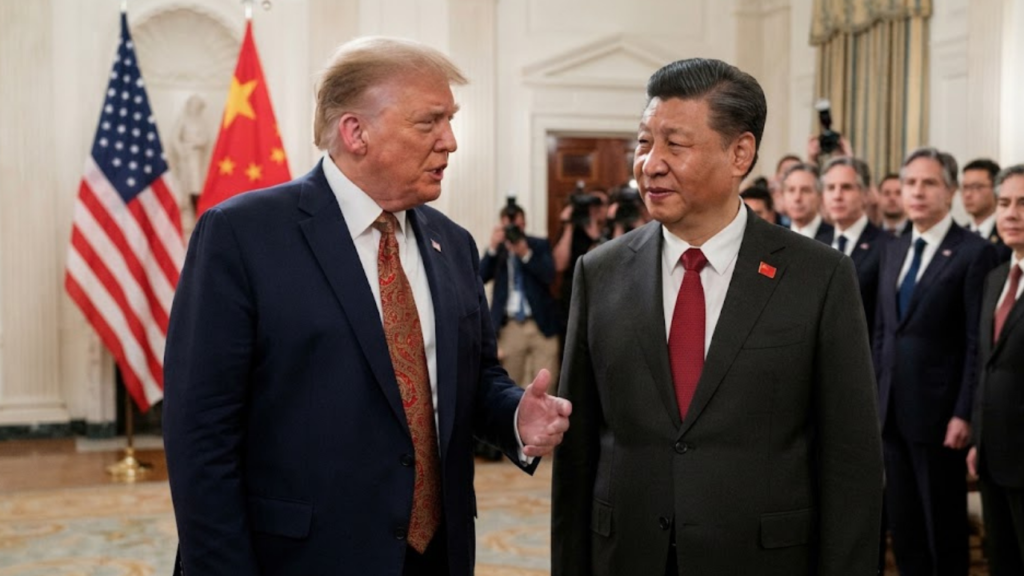
The US China tariff cut agreement announced this week will reduce duties on $30 billion worth of goods traded between the two countries, alongside a new dialogue on artificial intelligence, according to statements from both governments following a three-day state visit by Chinese President Xi Jinping to Washington.
The tariff arrangement was one of eight measures included in a broader understanding reached between President Donald Trump and Xi during talks that concluded on Friday. China’s Foreign Ministry described the outcome as an “eight-point consensus,” while the White House said the two sides had agreed on more favorable tariff treatment for $30 billion of “non-sensitive goods” moving in each direction.
According to the White House, the US side of the reduction would apply to American exports such as agricultural products, wood and cosmetics, while Chinese tariff relief would cover imports including small appliances, toys and decorations. Beyond the tariff measure, the two governments said they would set up a joint trade council and build on the results of earlier trade talks held in Kuala Lumpur.
What the US China tariff cut actually covers
The reduction is targeted, not sweeping. Officials on both sides described it as applying only to goods considered “non-sensitive” — meaning categories seen as low risk to national security or strategic industries. That leaves out the larger, more contentious tariff disputes involving semiconductors, electric vehicles and other technology-linked goods, which remain unresolved. For context, $30 billion is a small slice of the roughly $580 billion in annual two-way trade between the two economies, so the immediate economic effect of this US China tariff cut is likely to be modest even though the political signal is significant.
A dialogue on AI, not a joint AI policy
The agreement to launch AI talks marks a notable addition to the US-China relationship, which in recent years has been shaped more by restrictions and rivalry over technology than by cooperation. Neither government has yet detailed how the dialogue will be structured, what specific AI risks it will address, or how frequently the two sides plan to meet. For now, the announcement establishes a channel for discussion rather than a specific policy agreement or joint AI framework.
Part of a longer negotiation, not a standalone breakthrough
This latest understanding builds on a series of earlier steps. Washington and Beijing had already agreed to extend their existing trade truce by two months, moving its expiration from November 10 into January, US Treasury Secretary Scott Bessent said earlier in the week. That truce traces back to talks that began at a Trump-Xi summit in Busan, South Korea, last year, followed by further negotiations in Beijing this past May.
According to Reuters coverage of the summit carried by CNBC, the three-day Washington visit was defined more by personal diplomacy between the two leaders than by major public breakthroughs. That characterization fits the scale of Friday’s announcement: the tariff adjustment leaves the broader trade dispute that has strained relations since 2025 largely unresolved, and neither side has released full legal text of the agreement.
Why the US China tariff cut matters beyond Washington and Beijing
Because the US and China remain the world’s two largest economies, shifts in their trade relationship tend to ripple outward — affecting global shipping routes, commodity prices and the planning decisions of companies that operate across both markets. A new AI dialogue, even a limited one, is also being watched closely by other governments and technology companies trying to anticipate how the two countries will handle questions of AI safety, competition and export controls going forward.
What remains unclear is how durable the US China tariff cut arrangement will prove to be. Previous rounds of US-China trade diplomacy have produced agreements that later unraveled under renewed political or economic pressure, and both governments have described this deal as a step within an ongoing negotiation rather than its conclusion.