
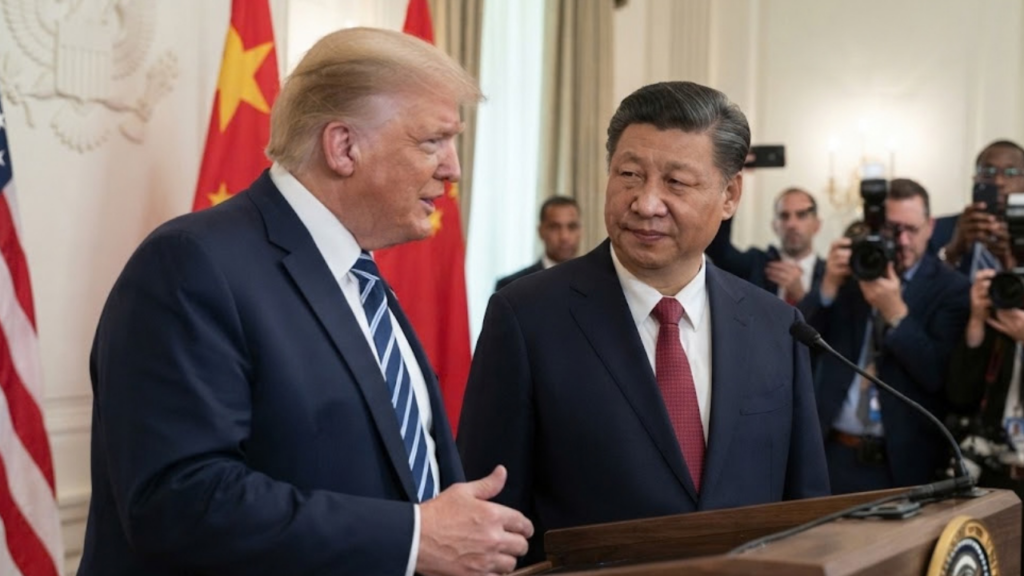
China has confirmed that the Xi Jinping US state visit will run from September 23 to 25, with the main talks with Donald Trump on Thursday, September 24. The foreign ministry in Beijing made the announcement on Monday, September 21. Washington had already said the two leaders would meet this week, so the news mostly puts China’s own word on the record. It will be their second face-to-face meeting this year, after Trump’s trip to Beijing in May.
How the Xi Jinping US state visit is scheduled
Xi lands on Wednesday, and Trump plans to greet him in person at Joint Base Andrews. A US official confirmed the airport welcome. The formal meetings follow on Thursday. Foreign ministry spokesperson Guo Jiakun gave the dates at his regular briefing and said the invitation came from Trump. In May, Beijing sent its vice president to receive Trump when he arrived for his own state visit.
AP notes that no Chinese leader has made a state visit to the US in more than a decade. Reuters reports that a group of Chinese business leaders is expected to travel with Xi. Some of them run firms under US regulatory scrutiny and want better market access. Benzinga, citing earlier reporting, says senior US finance and technology executives may attend the state dinner.
Beijing’s own account of the Xi Jinping US state visit is available on the foreign ministry’s website. The ministry publishes its briefing transcripts, so you can read exactly what Chinese officials have said about the trip in its regular press conference archive.
What Beijing says it wants
China describes the goal as a wide-ranging conversation on bilateral ties and on world peace and development. Guo called two leader visits within six months a “historic milestone.” He said Beijing wants to build on what it calls “constructive strategic stability,” keep the dialogue going, and manage disagreements through talks.
A Brookings Institution analyst quoted by Reuters reads it differently. In his view, Xi is after continuity more than concrete gains, mainly a longer trade truce. That is one outside opinion, not a Chinese government position.
What Washington says it wants
Trump told reporters aboard Air Force One on Sunday that he expects to cover almost every topic with Xi. Reuters reports that White House officials have been lowering expectations of a big breakthrough. According to Reuters, the US wish list includes Chinese purchases of Boeing aircraft and farm goods, plus firmer commitments on fentanyl precursor chemicals. Washington also sees Xi as someone who could press Iran to end the conflict there.
What the New York talks settled, and what they left open
Treasury Secretary Scott Bessent and Trade Representative Jamieson Greer met Vice Premier He Lifeng in New York on Sunday to prepare the summit. Bessent said the sides discussed a “U.S.-China AI Dialogue.” Washington proposed a way for each side to notify the other about AI incidents that reach a national-security level. In his words, the idea is to move from “opaque to more transparency.”
Greer said the US-China Board of Trade, agreed in May, is now operational. Its job is to pick out a group of goods that could be handled separately from any future trade measures. The News International reports the aim is possible tariff cuts on a small set of non-sensitive products. US energy, farm goods and medical devices are candidates, as are Chinese consumer and low-tech goods. The same outlet says US export controls on AI chips and chipmaking equipment are not part of the AI discussion.
The tariff truce is still the biggest open item. It has held for nearly a year without a lasting deal behind it. Some trade-press reports put its expiry at November 10. Reuters says the central question for the summit is whether the leaders signal an extension.
A leading Chinese newspaper has accused the US of double standards on AI, according to Benzinga. The Trump administration has favored voluntary, national-security-focused safeguards over broad mandatory rules.
Where the two sides disagree: Iran trade and Taiwan arms
Reuters reported earlier this month that China is selling billions of dollars in goods to Iran through a sanctions-evasion scheme. China’s foreign ministry says it is not aware of any such scheme. Washington threatened secondary sanctions last month on countries trading with Iran. Reuters says they do not appear to have been applied to China so far.
On Taiwan, Trump has said Xi raised the island repeatedly at their May meeting, including the question of arms sales. He called a pending $14 billion arms package a “negotiating chip.” Some officials in Taipei and Tokyo worry it could be traded away. Beijing claims Taiwan, which has its own elected government. The sources reviewed contain no Chinese government response to Trump’s description.
What the Xi Jinping US state visit means for US–China ties
Both governments present the trip as a way to keep relations steady, so it reads as continuity rather than a turning point. Analysts cited by Reuters say stability suits both leaders, and each has reasons to want it. Trump is dealing with falling approval ratings and a costly war with Iran. China is dealing with weak domestic demand and a long property downturn, even as its exports and trade surplus keep growing.
The effects reach beyond the two capitals. Companies that depend on tariffs, rare earths and Pacific supply chains are watching the trade track. Taiwan, Japan and other Asian governments are watching the arms question. If the AI incident-notification channel is agreed, it would be the first formal channel of its kind between the two countries.
What to watch after the summit
Xi arrives on September 23, the leaders meet on September 24, and the visit ends on September 25. Three things will show how it went. The first is whether they signal an extension of the trade truce. The second is whether the AI dialogue and notification mechanism are formally launched. The third is whether the Taiwan arms package or Iran-related sanctions come up in public. No agreement has been announced so far.
Political disputes are also playing out elsewhere this week. In India, the Election Commission has frozen the Trinamool Congress’s name and symbol ahead of the October 6 by-elections. Mamata Banerjee’s camp has asked the Supreme Court for an urgent hearing on the decision. HCN’s earlier report on the TMC symbol freeze covers that dispute in detail.
[…] it did not like their reporting, and that it did so without notice or process. They said the government does not get to decide what the press publishes. All three said they will keep covering the […]
[…] The US China tariff cut agreement announced this week will reduce duties on $30 billion worth of goods traded between the two countries, alongside a new dialogue on artificial intelligence, according to statements from both governments following a three-day state visit by Chinese President Xi Jinping to Washington. […]