
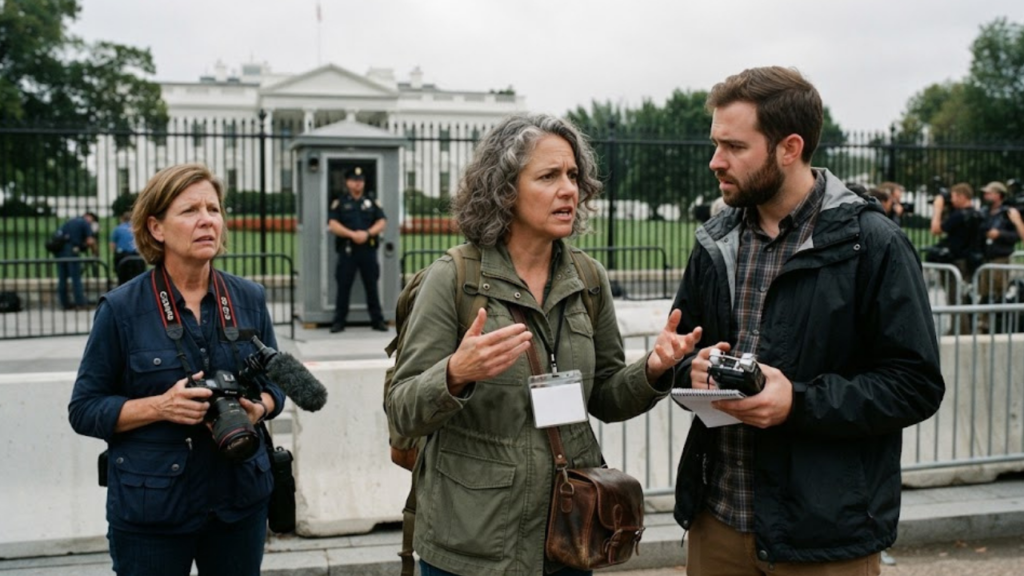
CNN, MS NOW and Politico have taken the White House to court, and the White House press credentials lawsuit asks a federal judge to give their reporters their access back. The three outlets said Monday morning that they had notified the government of the filing. It comes three days after President Donald Trump announced that he was barring them from the White House.
What happened between Friday and Monday
Trump announced the ban on Friday afternoon, September 18, in a post on Truth Social, and said it applied immediately. He did not name a particular story, according to CNN. He spoke instead about coverage he considered unfair. Later, in the Oval Office, he put it this way: “I don’t have to let them into the people’s house.”
By Saturday morning the ban was real at the gate. CNN’s Betsy Klein, MS NOW’s Akayla Gardner and Politico’s Cheyenne Haslett each showed up for work and found their badges no longer worked. Secret Service officers took the badges of an MS NOW reporter and cameraman at a security gate outside the West Wing, according to MS NOW. Klein and Gardner reported live from outside. CNN and NBC News both reported that some White House staff, including people in the press office, had not known the announcement was coming.
What the White House press credentials lawsuit asks for
The outlets argue that the ban breaks the First Amendment and the Constitution’s due process guarantees. Their filing says reporters and news organizations have a protected interest in their press credentials, and that an official cannot take them away on a whim, with no notice or process. In practical terms, they want a temporary restraining order. It would stop the White House from enforcing the ban and force it to hand back their hard passes, the credentials that get reporters onto the grounds.
The defendants named include Trump, communications aide Steven Cheung and Chief of Staff Susan Wiles, according to CNBC. The outlets hired Ted Boutrous, the First Amendment lawyer who argued CNN’s case over Jim Acosta’s pass in 2018. MS NOW and Variety report the case was filed in the DC federal court, where the Associated Press already has a separate suit pending over limits on its access.
For a plain account of how the White House press credentials lawsuit was announced, the Associated Press has the timeline. Its report on the outlets’ notice that they were suing includes the full joint statement from the three organizations.
The outlets’ side
In their joint statement, the three outlets said the White House pulled their credentials because it did not like their reporting, and that it did so without notice or process. They said the government does not get to decide what the press publishes. All three said they will keep covering the administration.
Press-freedom groups have lined up behind them. Jacqui Heinrich, president of the White House Correspondents’ Association and a Fox News reporter, asked for access to be restored right away. Her point was that a rule used against one outlet today could be used against any outlet later. Bruce Brown of the Reporters Committee for Freedom of the Press and Jameel Jaffer of Columbia’s Knight First Amendment Institute both called the ban unconstitutional. Several Democratic lawmakers, including Senate Minority Leader Chuck Schumer, also criticized it.
The administration’s side
Trump’s argument is that the White House is his to manage and he does not have to admit reporters he thinks are unfair. He told reporters Friday that he does not think a court should allow what he calls fake news to continue. Asked whether the ban could survive in court, he said it was worth calling attention to the coverage either way. A senior White House official told NBC News on Saturday that the outlets have spread falsehoods about Trump and his administration for years, and that this hurts the public.
One administration official has pointed to a Supreme Court decision from 1965. CNN reports that the official, in a Sunday TV interview, said the ruling on the government’s refusal to validate passports for travel to Cuba backs up the White House’s position. The White House and the Justice Department had not answered requests for comment on the lawsuit when CNBC and MS NOW published their reports. Trump has also said he could add more outlets to the ban.
Courts have seen this before
The outlets’ draft filing leans on the 2018 Acosta case. When CNN sued over Acosta’s revoked pass, a federal judge appointed by Trump temporarily restored it, finding a due process problem. The White House later reinstated the pass for good, and CNN dropped its suit. CNN notes that courts have mostly sided with journalists in these disputes, though none has ruled that access to the White House has to be unlimited.
Why the White House press credentials lawsuit matters beyond three newsrooms
A hard pass is what lets a reporter through the gate on an ordinary workday. Without it, the three outlets have to cover the White House from outside. CNN was scheduled for press pool duty on Monday, but MS NOW reports it did not appear on the list, and no outlet was listed for the main TV pool that day. The pool covers presidential events on behalf of the rest of the press corps, so an empty slot can affect what other outlets get to see. That is why the White House press credentials lawsuit is being watched by newsrooms that were never banned.
What happens next
The outlets are asking for emergency relief, and CNN says hearings could begin as soon as this week. The judge’s first decision will be whether to grant the temporary restraining order. Even if that goes one way or the other, the case itself would continue and be decided on its merits.