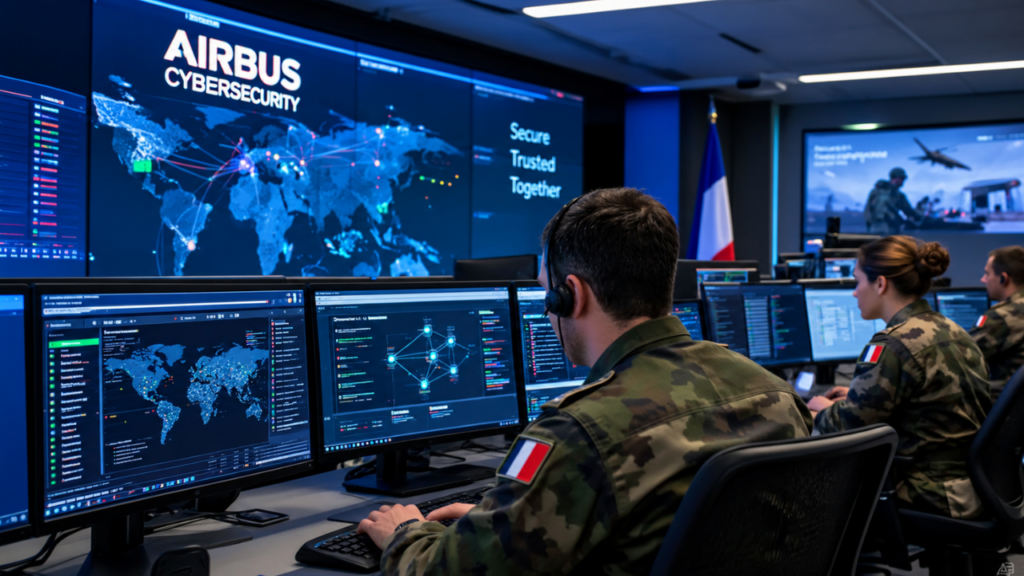
The Airbus PARACOM contract will decide how France’s armed forces move sensitive data between military networks for the next 25 years. France’s defense procurement agency, the DGA, has awarded the deal to Airbus Cybersecurity SAS, an Airbus subsidiary, tasking the company with building the digital checkpoints that keep classified and unclassified military systems from leaking information into each other.
Airbus announced the award this week, saying the contract followed a competitive tender. The company did not disclose its financial value.
What the Airbus PARACOM Contract Covers
At its core, the Airbus PARACOM contract is about controlling how information flows across a military network that is not really one network at all. France’s armed forces, like most modern militaries, operate systems at different classification levels, some restricted to “secret” clearance, others left unclassified, and information regularly needs to cross between them without exposing anything beyond its intended level of access.
The gateways built under the contract will handle that filtering. Airbus said PARACOM equipment will be certified for exchanges ranging from secret to unclassified, and will eventually be deployed across the Ministry of the Armed Forces and Veterans’ Affairs, reaching its directorates, departments, and operational units.
The contract’s scope goes beyond manufacturing hardware. It covers the design, development, production, and long-term maintenance of the gateways across the full 25-year term, a structure that treats cybersecurity as an ongoing service rather than a single purchase, consistent with how many governments now approach long-term defense technology contracts.
Inside the Airbus PARACOM Gateways
The hardware itself will not be one-size-fits-all. Airbus described several versions built for different operating environments: rack-mounted units designed for data centers, self-contained units intended for command posts, and smaller, ruggedized variants built for constrained tactical settings where space and durability matter more than raw processing capacity.
Airbus said the gateways are meant to support a wide range of platforms, including surface vessels, submarines, aircraft, helicopters, drones, and armored and other land vehicles. That list reflects how deeply networked modern military equipment has become, a submarine and a command post now share the same basic cybersecurity requirement, even though they operate in very different physical conditions.
Why the Contract Matters
Airbus tied the deal to a broader shift in how militaries operate. As more of a force’s operations move through digital systems, the points where those systems connect, rather than the systems themselves, become one of the more exposed parts of the network. Filtering and controlling that data flow has become a growing priority for armed forces generally, not just France’s. “This gateway strengthens the digital shield the French Armed Forces rely on to execute their missions,” said François Lombard, director of connected intelligence at Airbus Defense and Space.
The award extends a relationship rather than starting a new one. Lombard noted that Airbus has supplied gateway technology to French land forces since 2013, meaning the PARACOM contract builds on equipment and expertise the company has already fielded for more than a decade.
An Unusually Long Contract
A 25-year term is long by the standards of the cybersecurity industry, where both threats and the technology used to counter them tend to change quickly. Systems considered adequate today are not guaranteed to hold up against the threats of the 2040s, and neither Airbus nor the DGA has said publicly how the gateways will be updated or replaced to keep pace over such a long period.
That detail, along with the contract’s overall value, has not been made public. For now, what is confirmed is the scope of the deal: a single, long-running arrangement to build, certify, and maintain the equipment that decides what data can move across some of France’s most sensitive military networks, and what cannot.
[…] around automated systems instead of manual processes. HCN recently covered a similar shift in Airbus’s cybersecurity partnership with France, where a traditional vendor relationship was restructured around automated monitoring rather than a […]