
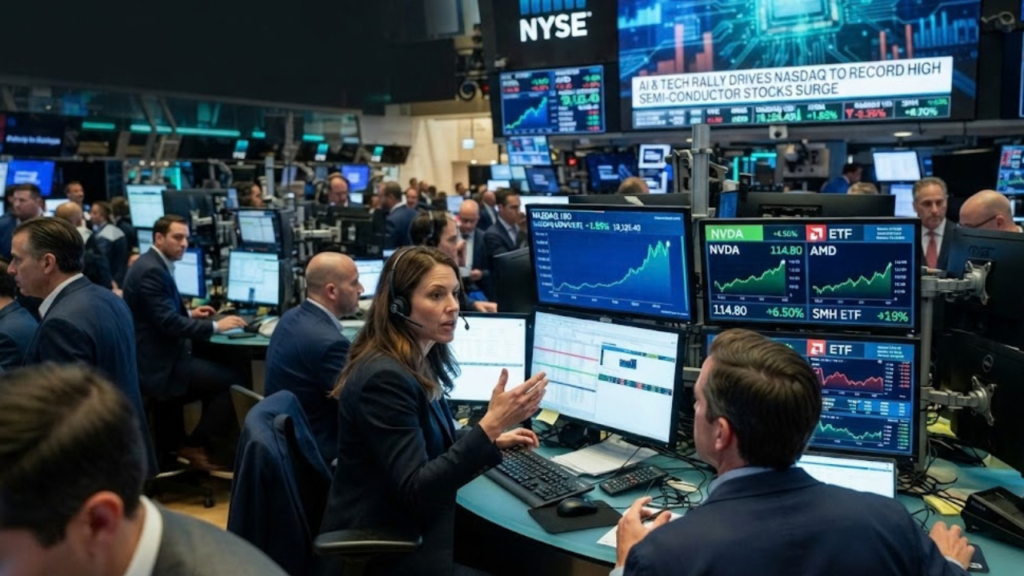
Nasdaq record high AI stocks are back in focus after the index closed at an all-time high for the second day running. The Nasdaq Composite closed Tuesday at 27,244.28, up 122 points, its second consecutive all-time closing high after touching an intraday peak of 27,288.79 during the session. It followed an even bigger move a day earlier, when the index jumped 599 points, a 2.26% gain, its sharpest single-day rise since early August, to end Monday at 27,122.09, breaking a record that had stood since June.
What’s pulling the index higher isn’t a broad market story. It’s a narrow one, concentrated almost entirely in technology and semiconductor names, and it traces back to a single product launch. Meta released a new autonomous AI assistant called Muse earlier this month, and within roughly two weeks it climbed to the top of Apple’s free-app chart, a speed of adoption that caught Wall Street off guard. Meta’s own stock surged nearly 12% on Monday alone, helped along by a fresh price-target upgrade from analysts who’d been more cautious just weeks earlier.
Why Nasdaq Record High AI Stocks Keep Climbing
Chipmakers rode the same wave. Intel gained 12% and Qualcomm more than 9% on Monday, while Advanced Micro Devices climbed roughly 10%, pushing its market value past $1 trillion for the first time. By Tuesday, a widely tracked semiconductor index was riding a sixth straight day of gains, its longest winning run since April.
None of this happened in isolation. Barely two weeks earlier, the same AI trade had gone through a rough patch, when several prominent figures in the industry publicly called for frontier AI development to slow down, and investors briefly worried that caution at the top might translate into less spending on chips and infrastructure further down the chain. That worry has, for now, faded. Ulrike Hoffmann-Burchardi, chief investment officer for the Americas at UBS’s Chief Investment Office, described the bank’s position plainly: the case for AI stocks still rests on real adoption, real monetization, and capital spending that keeps climbing rather than leveling off.
The rally also got help from somewhere unrelated to artificial intelligence entirely. Oil slipped below $100 a barrel after Saudi Arabia restarted a major export pipeline, easing fears of a prolonged supply disruption that had built up following a weekend strike on a Russian refinery outside Moscow. Brent crude’s drop below the $100 mark took real pressure off inflation expectations and dragged Treasury yields lower with it, a combination that tends to make growth stocks, tech chief among them, considerably more attractive to hold. Energy shares paid the price on the other side of that trade: Marathon Petroleum fell more than 5%, and Exxon Mobil and ConocoPhillips each dropped over 3%.
Not every part of the market joined in. The Dow Jones Industrial Average, weighed down by financial and other economically sensitive names, slipped roughly 0.3% to 0.4% on Tuesday even as the Nasdaq pushed to a new high, and the S&P 500 finished the session little changed after a strong Monday of its own. The unevenness is worth sitting with, it suggests this remains a rally about a handful of very large companies rather than a broad vote of confidence in the wider economy.
There’s also a bigger conversation sitting just off to the side of the trading floor. Investors are watching a US-China leaders’ summit scheduled in Washington later this week, one that’s expected to touch on artificial intelligence policy alongside trade, at a moment when concerns are already growing that cheaper Chinese AI models could make the far more expensive American approach look hard to justify economically. Whether this week’s record closes hold up may depend less on what happens inside the stock market over the next few sessions, and more on what gets said in that room.
[…] record close, at 27,244.28, lifted by Micron and other chip names, according to Reuters. HCN covered the AI-led rally that pushed the Nasdaq to a record high. On Wednesday, US stocks fell as yields […]