
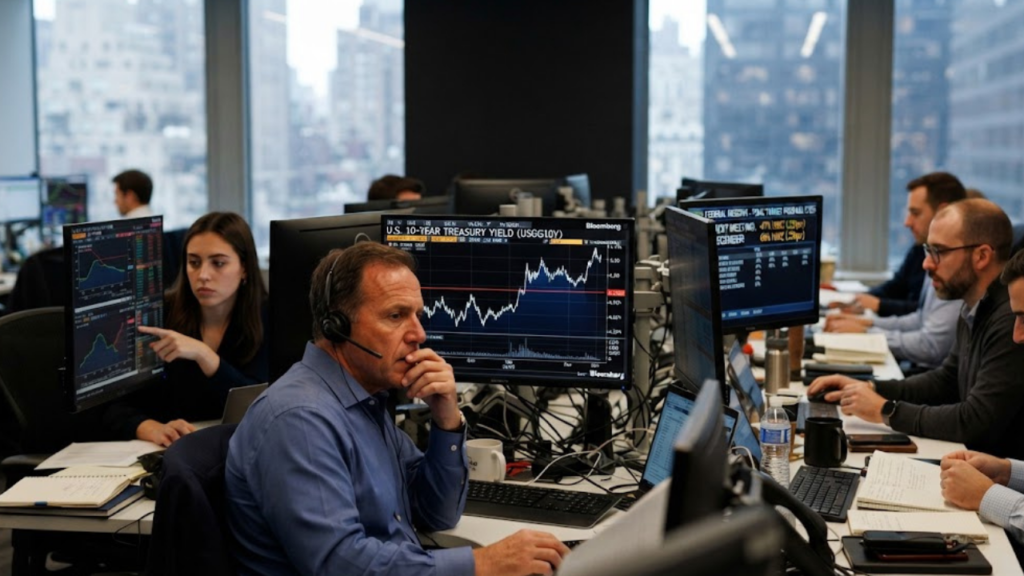
One business survey was enough to push the world’s most closely watched bond yield up by roughly 14 basis points on Wednesday. The 10-year Treasury reached about 5.1%, its highest level since July 2007, and the explanation traders offered was simple: an October Fed rate hike suddenly looked more likely than not.
The strange part is that the news behind it was good. The precise level varies by data provider. CNN put the 10-year at 5.11% after a 15-basis-point jump, while Reuters data relayed by CNA showed 5.106%, up about 14 basis points and the biggest one-day rise since April 2025. Neither figure changes the story.
How a business survey became a bond sell-off
S&P Global’s preliminary September survey of purchasing managers asks executives a plain question: are output, orders and hiring rising or falling? Anything above 50 means expansion. The composite reading landed at 58.4, up from 56.0 in August and the highest since July 2021, with services at 58.7. S&P Global said the pace fit annualised growth of around 5% for the month and roughly 4% for the third quarter.
Costs jumped too, mostly because of energy. That pairing, fast growth plus rising prices, is exactly what bond investors dislike. If the economy is strong enough to absorb higher rates, the Fed has little reason to stop raising them, and investors who expect higher policy rates want a higher yield before they will buy new bonds. Existing bonds get sold, and yields climb.
Two other things piled on. Bloomberg reported that a weak $70 billion auction of five-year notes deepened the sell-off, and CNN noted the five-year yield went above 5% for the first time since 2007. Oil did its part as well: Brent crude settled at $103.08, up 3.86% and breaking a five-day decline, with the Strait of Hormuz standoff still unresolved. Both feed the case for an October Fed rate hike.
Where an October Fed rate hike stands after Wednesday
The Fed raised its benchmark rate by a quarter point to 3.75%–4.00% on 16 September, a unanimous decision and its first increase since 2023. The median official pencilled in one more this year. Since then, the debate has been about timing, and Wednesday moved it. CME FedWatch showed the probability of an October Fed rate hike at 66% in CNN’s report, up from 55% the day before. Reuters figures cited by another outlet had it at about 73%, and a third report said 64%. The exact number depends on the hour and the tracker, but every version points the same way. Fed Governor Michael Barr was also reported to have said further tightening may be needed.
Chair Kevin Warsh has kept forward guidance thin, so markets treat each data release like a clue. He told reporters last week that higher long-term yields reflect economic strength, competition for capital and geopolitical factors. Wednesday’s survey backs the first of those. There is a history worth remembering here. The 10-year first broke above 5% on 15 September, before the Fed met, then eased once the decision was out. Wednesday’s move undid that relief.
The Nasdaq link, and why AI belongs in this story
The day before, the Nasdaq had posted its second straight record close, at 27,244.28, lifted by Micron and other chip names, according to Reuters. HCN covered the AI-led rally that pushed the Nasdaq to a record high. On Wednesday, US stocks fell as yields rose.
Those two days are connected in a way that is easy to miss. Yahoo Finance’s market coverage reported that the four biggest hyperscalers are expected to spend around $800 billion on capital projects this year, and that the borrowing behind the AI build-out is increasingly coming from bond markets, with about $250 billion of investment-grade debt expected by year-end. A higher Treasury yield raises the price of that borrowing. That is an inference from the numbers, not something the data proves, but it helps explain why an October Fed rate hike matters to tech investors, and not only to people with mortgages.
What to watch if you borrow, save or invest
The 10-year sets the tone for mortgages, car loans and corporate credit. Mortgage News Daily had the average 30-year fixed mortgage at 7.19% on 16 September, before this latest jump, so quotes are more likely to drift up than down for now. If an October Fed rate hike arrives, it lands on borrowing costs that have already moved.
The signals worth following are the next US inflation report, the direction of oil, and whether hard economic data confirms what the survey suggested. A flash purchasing survey measures sentiment among managers, and it gets revised. If the real economy agrees with the survey, an October Fed rate hike may turn out to be an easy call. If it doesn’t, bond investors will have priced in a tightening that never comes, and the correction could be as sharp as Wednesday’s move.
[…] cash, and debt and equity commitments still being finalised. The withdrawal came on a day when the 10-year Treasury yield hit its highest level since 2007, which tends to make large debt-funded deals more expensive. Nobody has linked the two, and this is […]
[…] plan also arrives while global rate expectations are moving. HCN’s earlier report on October Fed rate hike odds, PMI data and the US Treasury yield jump covers the American side of that picture. HCN will update this report as the IMF review and the […]