
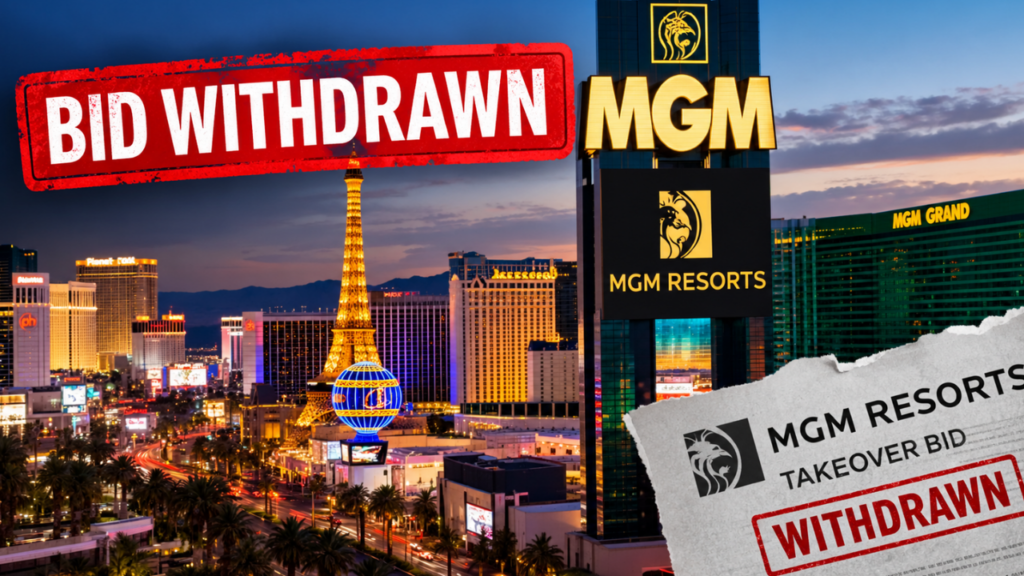
The $48.30-a-share offer for MGM Resorts is off. Barry Diller’s People Inc. told the casino operator on Wednesday that it has withdrawn its MGM Resorts takeover bid, ending nearly four months of talks and leaving one of Las Vegas’s biggest names to carry on by itself. The market reacted within minutes. Reuters reported that MGM shares dropped 8% in extended trading after the news.
The Wall Street Journal broke the story, and MGM confirmed it soon afterward. Neither side has said what specifically stopped the deal. Diller offered only a general explanation: “We didn’t feel the mix was coming together in the way we had hoped.” People, he said, will not pursue taking MGM private “at this time,” though his belief in the company’s future is unchanged.
What Diller keeps now that the MGM Resorts takeover bid is dead
People Inc., the company formerly known as IAC, is not leaving. It still holds its roughly 27% stake, which the Las Vegas Review-Journal counts at 66.8 million shares, and it said it stays open to some other strategic deal with MGM. The wording matters. A company that meant to walk away entirely would not leave that sentence in.
The stake itself has a history. People began buying in 2020, when pandemic closures had hammered MGM’s share price, and Diller has long viewed the company as undervalued. For a business built around magazines such as People and Food & Wine, MGM was also a way to diversify. It echoes his earlier move into travel through Expedia, which IAC acquired in 2002 before spinning it off.
The June proposal was also not a plain buyout. People said it would end up with just over 50.1% of MGM’s equity, with other investors, possibly including existing MGM shareholders, holding minority stakes. Diller, who sits on MGM’s board, agreed at the time to step out of all board discussions about it. A committee of independent directors handled the negotiations, which began after the June 1 proposal and ran through the summer.
The price the market had already put on it
The MGM Resorts takeover bid valued the company at about $18 billion and carried a 10.6% premium to the stock’s previous close. Investors, though, did not treat $48.30 as the ceiling. On 1 June, the day the proposal became public, MGM closed at $50.69, above the offer itself, which PlayUSA read as a sign that traders expected a higher bid. That makes Wednesday’s after-hours drop easier to follow. Part of the share price had been paying for the MGM Resorts takeover bid, and once it was withdrawn, that part went with it. It is a fair reading, not a proven one, that some holders were still counting on a sweetened offer.
The company left to run itself
MGM owns properties that account for roughly 40% of the Las Vegas Strip, but Reuters describes foot traffic there as sluggish, with recent growth coming from its China assets, including Macau, and from digital. That digital side includes BetMGM, the sportsbook MGM shares 50-50 with Entain. MGM reported record first-quarter revenue of $4.5 billion this year, according to PlayUSA, again led by China and digital.
Diller’s original argument, made in June, was that MGM offers real-world assets that AI cannot easily copy, alongside strong digital growth. MGM’s board chairman, Paul Salem, answered Wednesday that the board is excited to keep leading MGM as a standalone company and pointed to its Las Vegas position, its regional properties, BetMGM, MGM China and the Osaka project.
One thing neither company has addressed is the money. In June, People said it expected to fund a deal with its own cash, MGM’s cash, and debt and equity commitments still being finalised. The withdrawal came on a day when the 10-year Treasury yield hit its highest level since 2007, which tends to make large debt-funded deals more expensive. Nobody has linked the two, and this is context rather than a finding. Any revived MGM Resorts takeover bid would be financed in that rate environment.
What comes next
Because the proposal was non-binding, no signed agreement has fallen apart and MGM shareholders have no vote to cast. A 27% holder that calls itself open to alternatives and confident in the business is closer to pausing than to quitting, and the next move belongs to whoever decides the price is worth revisiting. If a second MGM Resorts takeover bid does come, the terms will show how far each side has moved.