
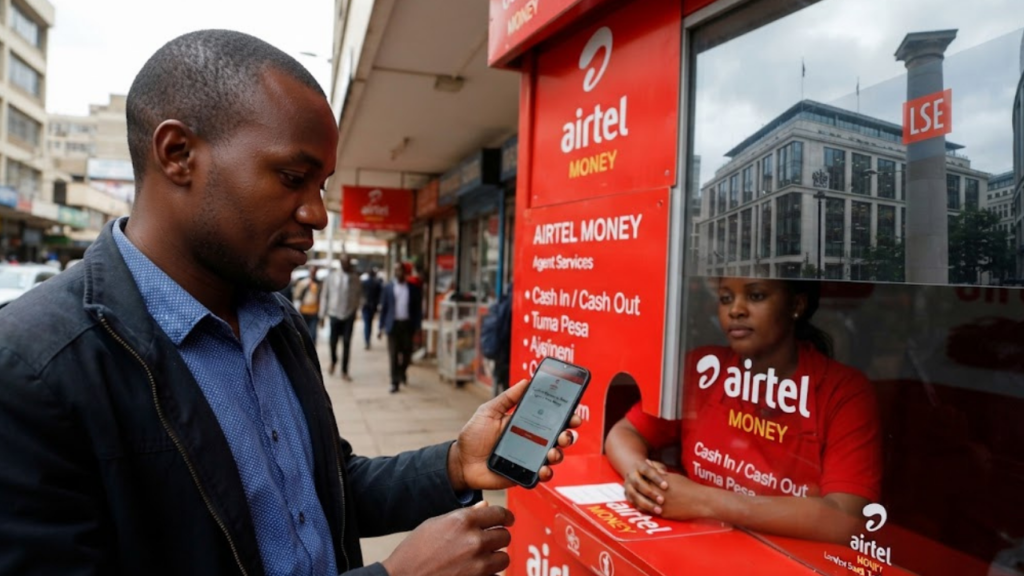
The Airtel Money London IPO is moving forward, and the numbers attached to it say almost as much as the listing itself. Africa’s biggest mobile money business is about to become a London-listed company. Airtel Mobile Commerce N.V., known to its more than 50 million customers simply as Airtel Money, confirmed this week that it intends to float on the Main Market of the London Stock Exchange. The plan has been public in outline since July, when Airtel Africa first said it had picked London over rival venues in the Middle East. What’s new now is the shape of the deal, and it’s noticeably smaller than the one investors were originally pitched.
This is a secondary offering, not a fundraising round for the company itself. Existing shareholders, led by parent company Airtel Africa, which holds a 77.85% stake, will sell some of their shares to the public. Airtel Money won’t receive any of that money directly, though the exercise will still put a public price tag on one of the group’s fastest-growing units for the first time.
That price tag has been shrinking. Earlier discussions floated a valuation approaching $10 billion and a raise of $1.5 billion to $2 billion. The figures now circulating put the valuation closer to $8-9 billion, with the amount actually being sold down to at least $800 million, roughly 10% of the company changing hands, enough to satisfy the free-float rules for a Main Market listing. One piece of the puzzle is already on paper: the International Finance Corporation has agreed to sell part of its holding worth up to £67.2 million, or about $90 million, once the final offer price is set.
Why the Airtel Money London IPO Got Smaller
The scaling-back isn’t really about Airtel Money’s underlying business, which is hard to fault on paper. It serves customers across a Sub-Saharan African footprint spanning well over a dozen markets, generated $1.36 billion in revenue in its last full financial year, and pushes well over $200 billion worth of transactions through its network annually, money moved for people who often have no other route into digital banking. Growth in its customer base has stayed in double digits. What’s changed is the environment the deal is landing in.
Earlier this year, the escalation between the US, Israel and Iran rattled global markets enough that Airtel Africa pushed the listing from the first half of 2026 into the second. Airtel Money wasn’t alone, several companies quietly shelved or delayed IPO plans through the same stretch. London itself hasn’t had much to celebrate on the new-listings front either: IPOs on the exchange have raised less than $700 million between them this year, a total padded mostly by a single spring listing from an Uzbek investment fund. Against that backdrop, a company arriving with an $800 million-plus deal looks less like caution and more like one of the few genuine bright spots the market has had in months.
Airtel Africa’s chief executive, Sunil Taldar, has pointed to London’s familiarity with fintech and payments businesses, and its access to international capital, as the reasons the group stuck with the city even after considering a Middle East listing. There’s also a family resemblance here: Airtel Africa itself has been listed in London since 2019, with a secondary listing on the Nigerian exchange, so choosing London again for its mobile money arm follows a path the group has already walked once.
The ownership history adds some texture too. Back in 2021, a group of outside investors, TPG, Mastercard, the Qatar Investment Authority and Chimetech Holding, bought minority stakes in Airtel Money for a combined $550 million, a bet that the mobile money side of Airtel’s African business was worth carving out on its own eventually. This listing is, in a sense, that bet finally being tested against a public market.
A full prospectus, with the actual price range and offer size spelled out, is expected in early October. Until then, everything about the size of the deal remains provisional, Airtel Money’s own statement is careful to note it could still walk away from the listing entirely, and that nothing is guaranteed to happen on the timeline suggested. For a business built on moving small amounts of money reliably for millions of people every day, the irony is that its own next move is, for now, the least certain thing about it.
[…] chain. That worry has, for now, faded. Ulrike Hoffmann-Burchardi, chief investment officer for the Americas at UBS’s Chief Investment Office, described the bank’s position plainly: the case for AI stocks still rests on real […]