
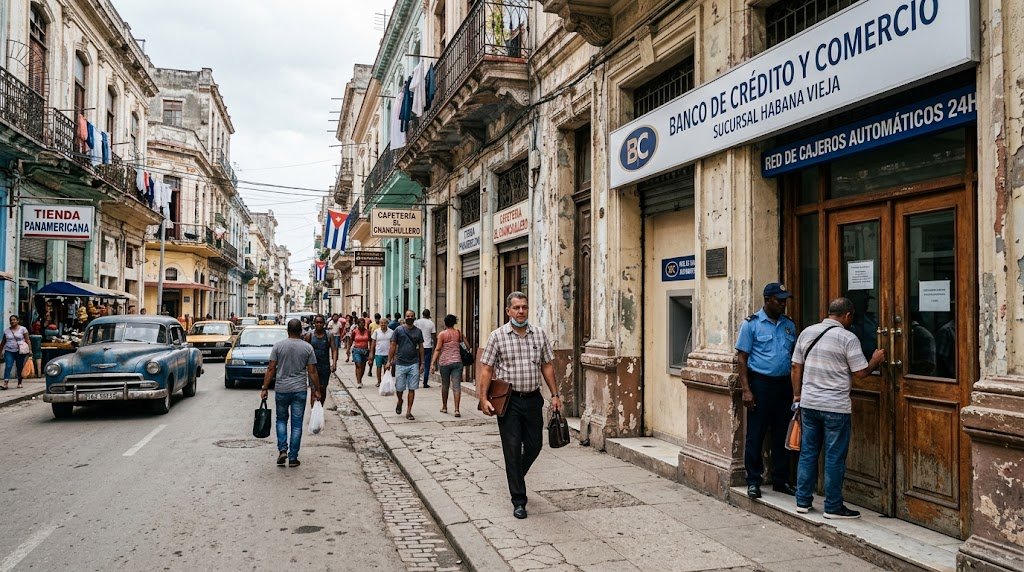
BICSA sanctions announced on Thursday, October 15, 2026, place Cuba’s state-owned Banco Internacional de Comercio S.A. on a U.S. blocking list. Washington accuses the bank of serving an Iranian lender that was already under American sanctions. The State Department says BICSA has provided services to Iran’s Karafarin Bank since at least 2022. The Treasury Department sanctioned Karafarin in 2020.
Secretary of State Marco Rubio announced the designation in a statement. The department relied on Executive Order 14404, which allows sanctions on those operating in Cuba’s financial services sector. It timed the move with a separate Treasury action against Iranian financial networks.
What the BICSA sanctions do
The designation adds BICSA to the Treasury Department’s list of blocked persons. Any BICSA property in the United States, or held by U.S. persons, is frozen and must be reported to the Office of Foreign Assets Control (OFAC). Entities owned 50 percent or more by blocked persons are also blocked. U.S. companies were already barred from dealing with BICSA because the Cuban government owns it. Treasury said licenses may still cover some humanitarian and diplomatic activity permitted under existing Cuba rules.
The wider effect falls on non-U.S. firms. According to reporting by the Miami Herald, republished by News Beep, the State Department warned that foreign companies doing business with BICSA could face sanctions themselves. Treasury guidance gives foreign companies and banks until November 14, 2026, to end their dealings with the bank. The same reporting says Treasury cautioned that sending funds back to BICSA, or moving them somewhere the bank could use them, carries serious sanctions risk.
Part of a wider action on Iran’s finances
The Cuba designation came alongside a Treasury campaign called “Operation Economic Outcast.” CiberCuba reports that the campaign also named Iraq’s International Development Bank for Investment and Finance and two Iranian banks operating in free trade zones: Jazireh International Bank Company and Chabahar International Bank Overseas Company. Report.az says the Iraqi bank received a general license allowing wind-down transactions through October 30.
Why BICSA matters to Cuba’s trade
The Miami Herald reporting says the bank’s importance goes well beyond Iran-related business. Some U.S. companies licensed to export food and goods to Cuba, several foreign firms, and some private Cuban businesses hold accounts there. BICSA became more important to foreign companies after earlier U.S. sanctions hit Fincimex, a financial institution controlled by the military conglomerate GAESA. Foreign firms that had used Fincimex moved their dollar accounts to BICSA.
One Cuban American exporter, who asked not to be named, told the paper the measure “is going to affect many people.” The exporter said it conflicts with U.S. calls for Cuba to open its economy to private business. HCN has not independently confirmed that account.
A widening U.S. pressure campaign on Cuba
The designation follows a series of steps since President Donald Trump signed Executive Order 14404 in May 2026. A legal analysis by law firm Holland & Knight describes the order as authorizing sanctions across large parts of Cuba’s economy and warning of secondary sanctions on foreign financial institutions that deal with blocked entities. According to the Miami Herald, the measures taken since then include sanctions on GAESA, several mining and energy companies, Banco Exterior de Cuba, and members of the Castro family.
For banks outside the United States, the practical question is access. A foreign bank that keeps handling BICSA business after the deadline risks losing its own ability to operate with U.S. institutions. That pressure is why secondary sanctions often change behavior even when no U.S. company is directly involved.
What remains unknown
The allegation that BICSA served Karafarin Bank comes from the U.S. government. The public statements reviewed do not describe the transactions or their value, and HCN has found no independent evidence of them.
A primary-source response from the Cuban government has not been confirmed. One outlet, Democrata, reports that Havana called the measure an attempt to punish the country, but HCN has not verified that statement. It is also unclear how many foreign firms and banks will end their dealings with BICSA before November 14, and whether OFAC will issue further guidance or licenses before then.