
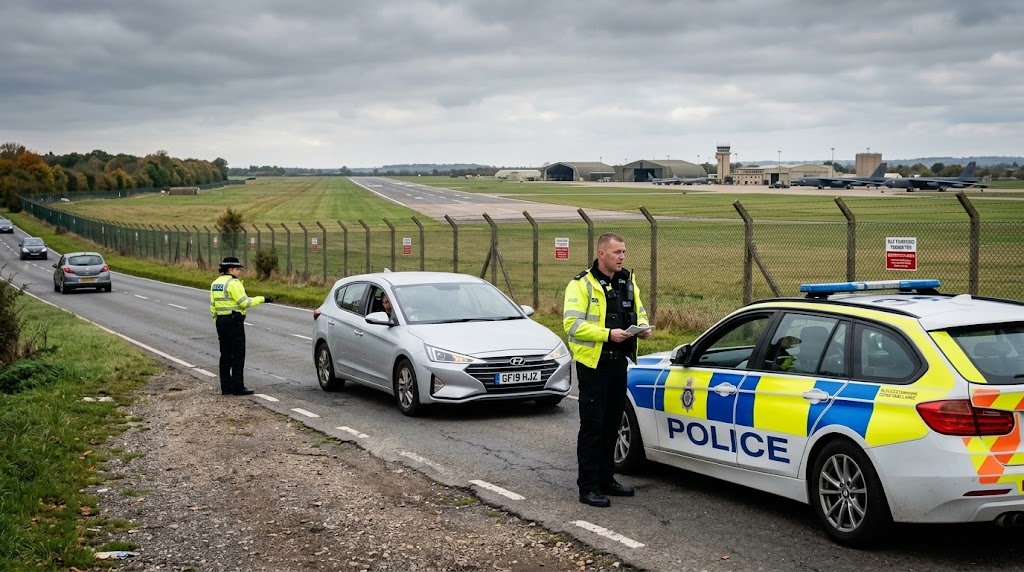
The RAF Fairford plot was “highly likely” coordinated in Iran and almost certainly directed by Iran’s Islamic Revolutionary Guard Corps, Prime Minister Andy Burnham told the House of Commons on Monday, October 12, 2026. No one has been charged over the incident, and Iran denies any involvement. The same day, the Foreign Office sanctioned two Iranian nationals. Foreign Secretary Ed Miliband also said he had summoned Iran’s ambassador to London.
What happened near RAF Fairford
In the early hours of September 27, police arrested five British men in their 20s near RAF Fairford in Gloucestershire. They were held on suspicion of terrorism and explosives offences. Officers found petrol in three vans linked to the men, but no explosives. The five were later released on police bail under what authorities called stringent conditions.
More arrests followed. On October 1, counter-terrorism police said they had detained a 25-year-old dual UK-Iranian national in Westminster on suspicion of preparing terrorist acts. According to Al Jazeera and AFP, the men arrested after the first five were also released. As of October 12, none of the suspects had been charged, and what exactly was being planned remained unclear.
The base itself matters. RAF Fairford is about 160 kilometers (100 miles) west of London and is the preferred European base for US bombers. It has been used as a staging point for US aircraft since the war on Iran began on February 28. US officials said earlier this month that the United States moved its bombers away from the base over fears of a suspected Iranian drone attack. The British government says the base is safe.
How the government’s position changed
For about two weeks, London chose its words carefully. On October 1, Burnham said there were “strong indications” that Iran played a part, and he stressed that the police investigation was still running. On October 12, he went much further. He told MPs the assessment was that Iran coordinated the plot and that the IRGC almost certainly directed it. He promised a crackdown on Iran’s use of criminal networks and further sanctions, though he gave no timetable. The reports HCN reviewed do not show that the intelligence behind the assessment has been made public.
Two sanctions, 29 countries
The Foreign Office named the two people it sanctioned. Ruhollah Bazghandi is described as head of IRGC counterespionage operations. He faces an asset freeze, a travel ban and a ban on serving as a company director. Shahram Ali Reza Tamarzadeh Jakki is described as a facilitator for the Zindashti criminal network. That group was already under UK sanctions and has been accused of plots against Iranian dissidents.
The reports reviewed do not say either man had a direct role at Fairford. The Foreign Office described their actions more broadly as hostile activity on behalf of the Iranian state. On the diplomatic side, a joint statement from 29 countries, including the United States, Canada, Australia and New Zealand, recognized the UK’s attribution. It condemned Iran’s use of violent attacks, naming plotting, arson, sabotage and cyber-attacks among them.
Iran rejects the RAF Fairford plot claim
Iran has denied the allegation from the start. Its embassy in London called the earlier speculation “unfounded and malicious.” On Monday, Ambassador Ali Mousavi met UK Middle East minister Stephen Doughty and rejected any Iranian role, according to Iran’s state news agency IRNA. He urged Britain to avoid unsubstantiated statements and said Tehran was willing to cooperate with the investigation. Iran had also summoned the British ambassador in Tehran on October 1.
What we still don’t know
Three basic questions remain open. Police have not said publicly what, if anything, the suspects intended to do. The reports reviewed do not show whether any suspect had a documented link to the IRGC. And no charging decision has been announced. The next confirmed steps are modest. The investigation continues, bail conditions remain in place, and the government says more sanctions are coming, though it has set no date.
[…] Department’s list of blocked persons. Any BICSA property in the United States, or held by U.S. persons, is frozen and must be reported to the Office of Foreign Assets Control (OFAC). Entities owned 50 […]