
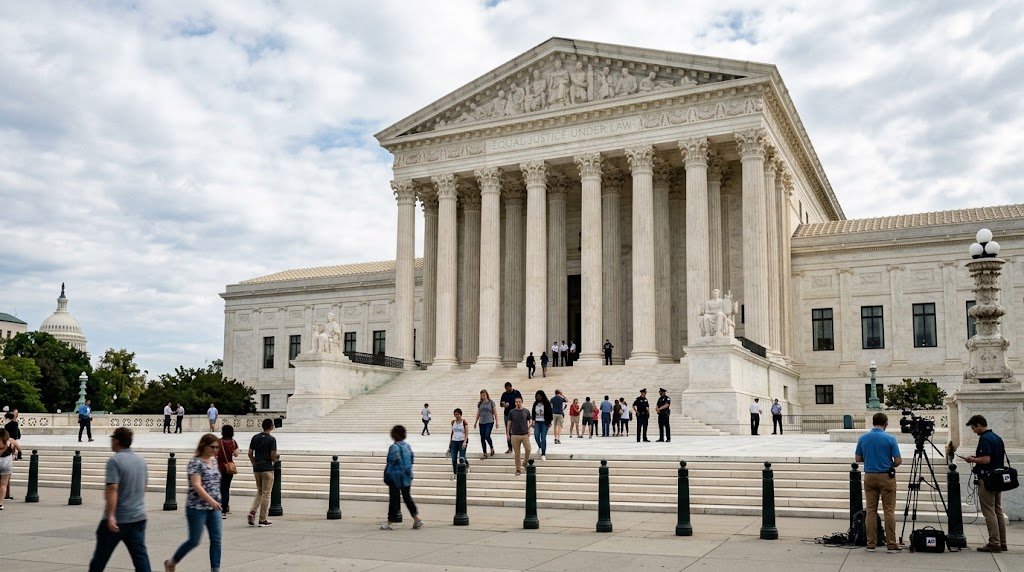
The DOGE records case is headed to the U.S. Supreme Court, which agreed on Tuesday, October 13, 2026, to decide how far a federal court may go in probing the Department of Government Efficiency (DOGE) for a transparency lawsuit. The dispute, brought by the watchdog group Citizens for Responsibility and Ethics in Washington (CREW), will help determine whether lower courts may order evidence-gathering about DOGE’s authority before deciding whether the office must follow the Freedom of Information Act (FOIA).
The justices granted review in No. 25-1103, U.S. DOGE Service, et al. v. U.S. District Court for the District of Columbia, et al., according to the Court’s order list. The Trump administration asked the Court to take the case. The order list shows no noted dissents, and no argument date has been set.
What the DOGE records case is about
CREW sued for records on DOGE’s operations early in President Donald Trump’s second term. The group argues that DOGE is a federal agency and therefore covered by FOIA. The administration says DOGE is a presidential advisory body that falls outside the law.
Before ruling on that question, U.S. District Judge Christopher Cooper allowed CREW to gather evidence on how DOGE operates, including a sworn deposition of DOGE acting administrator Amy Gleason. He also ordered expedited processing of CREW’s records request, according to the Associated Press.
How the DOGE records case reached the Court twice
This is the second time the justices have stepped in. In June 2025, the Court’s conservative majority ruled 6-3, in a brief unsigned order, that Cooper’s discovery order went too far and sent the case back, according to Bloomberg Government and the AP. Newsweek reported that the Court did not decide whether DOGE is subject to FOIA.
CREW then narrowed its requests. It dropped questions about what DOGE “recommended” but kept seeking information on DOGE’s structure, functions, and decisions it “directed,” Bloomberg reported. A three-judge panel of the U.S. Court of Appeals for the D.C. Circuit declined to disturb the revised discovery in July 2025, and the full court declined to rehear the matter in mid-December, according to Bloomberg.
The competing arguments
Justice Department lawyers say the appeals court ignored the Supreme Court’s instructions and intruded on the “autonomy and confidentiality” of presidential advisers, as the AP reported. They argue that discovery aimed at deciding whether FOIA applies would hand CREW much of what its underlying requests seek before any court has held that the law covers DOGE.
The petition asks the justices to decide two questions, as quoted by Newsweek. The first is whether the appeals court departed from the Court’s earlier instructions and from separation-of-powers principles drawn from Cheney v. U.S. District Court. The second is whether a court may order broad discovery against an Executive Office advisory body to decide whether FOIA applies at all.
CREW says the appeals court followed the Supreme Court’s instructions. Its lawyers argue that public facts, including statements by the president, show DOGE exercised substantial independent authority across the government. They also say the administration’s proposed rule would let the executive place powerful entities in the Executive Office of the President and avoid a major open-government law.
CREW attorney Nikhel Sus said the lower courts have uniformly found that CREW is entitled to evidence that could help establish whether DOGE holds authority that would make it subject to FOIA. He said the group will keep pursuing transparency about the administration’s efforts to remake the federal government.
Why the DOGE records case matters
The ruling could affect how courts test whether a White House-based body is an agency under FOIA. It could also clarify what evidence-gathering is allowed when that status is disputed. Former federal prosecutor Neama Rahmani told Newsweek he expects limited broader impact because DOGE appears to be a one-off, but that is one analyst’s view and the Court’s reasoning could still reach further.
What happens next
Newsweek reported that arguments are likely later in the Court’s new term, with a decision probably next year. The Court has not announced a date. Whether DOGE is itself covered by FOIA remains undecided.
Read the primary documents: The Supreme Court’s October 13, 2026 order list records the grant of review in No. 25-1103, and the Associated Press report, republished by Federal News Network, summarizes both sides’ filings. Additional background is in Newsweek’s report.