
Pope Leo XIV lung cancer was confirmed on Tuesday, October 13, 2026, when the Vatican announced that surgeons at Rome’s Agostino Gemelli University Hospital had removed the lower lobe of his right lung. A medical bulletin said tissue examined during the operation confirmed lung adenocarcinoma, a diagnosis doctors had already suspected from earlier tests.
The Vatican described the operation as successful and free of complications. It lasted about 90 minutes. The 71-year-old pontiff woke normally, spent a short time under observation and was moved to his room on the hospital’s tenth floor. On Wednesday morning, the Vatican said he had passed a peaceful night.
Pope Leo XIV lung cancer: what the Vatican confirmed about the operation
The procedure was carried out by a thoracic surgery team led by Professor Stefano Margaritora, the hospital’s chief of thoracic surgery. Earlier on Tuesday, the Vatican press office had said the surgery was finished on schedule and as planned. The evening bulletin added that a rapid examination of tissue taken during the operation matched what the pre-operative tests had indicated.
The Holy See Press Office has also characterized the tumor as a type of non-small cell lung cancer, the broader category that includes adenocarcinoma. Adenocarcinoma is the most common form of lung cancer in the United States, accounting for roughly 40 percent of diagnoses, according to the Lung Cancer Foundation of America. Reports describe the surgery as curative, meaning it was intended to remove the cancer entirely rather than only relieve symptoms.
A diagnosis the Pope announced himself
The news followed an unusually open series of disclosures. On Sunday, October 11, Leo told pilgrims in St. Peter’s Square after the Angelus prayer that doctors had found a small, localized nodule in his lung and advised removing it. He said it had been caught early and asked the faithful to pray for him. It was the first major health problem made public in his roughly 17 months as pope, and the decision to announce it himself broke with a long tradition of secrecy around papal health.
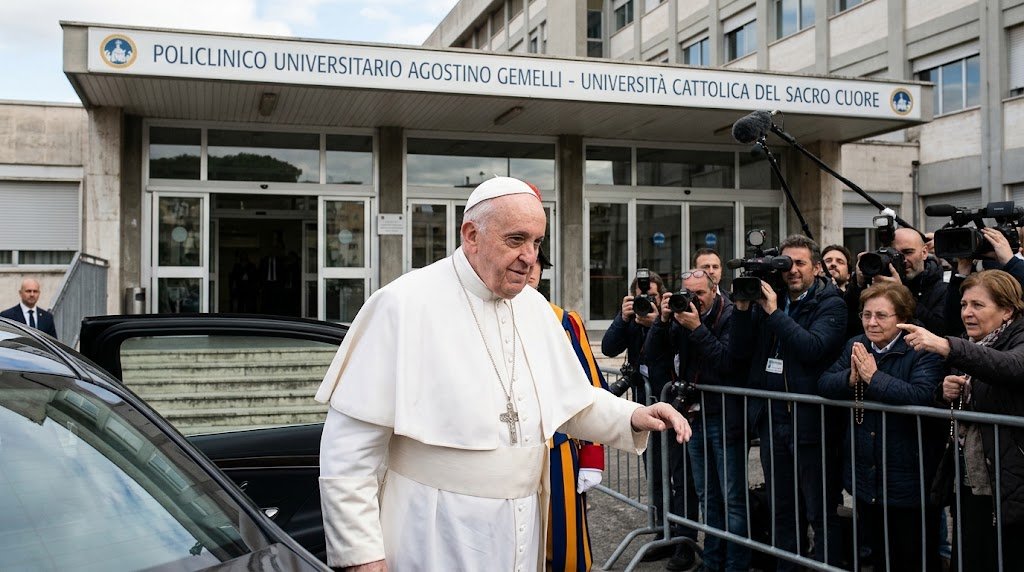
Vatican spokesman Matteo Bruni later told reporters that the hospitalization would come in the first days of the week and that recovery was expected to take about a week. On Tuesday, Leo left the Vatican by car and arrived at Gemelli, where he was welcomed by the hospital’s health director, Andrea Cambieri. He walked in through the main entrance and waved to dozens of well-wishers who had gathered outside. Gemelli has long been the hospital where popes are treated, including John Paul II and Francis.
What is not yet known about the Pope Leo XIV lung cancer case
The Vatican has not yet published the stage of the cancer or said whether it had spread beyond the lung. It has also not said whether any further treatment is planned after surgery, so the full outlook for the Pope Leo XIV lung cancer case remains unclear. Before the operation, oncologists told the Associated Press that the Pope’s outlook would be excellent if the nodule proved cancerous and was removed at an early stage. That was a general assessment made before the pathology results. It was not a statement from the Pope’s own medical team about his case, and the Vatican has not yet given a prognosis.
Recovery and schedule
The Vatican has canceled the Pope’s audiences, and his public schedule has been largely cleared until at least October 20. The hospital stay is expected to last about a week. The Vatican has not said how the surgery and recovery will affect a trip planned for November, and no updated itinerary has been published.
Why the Pope Leo XIV lung cancer news matters
Leo is both the head of the Catholic Church and the sovereign of Vatican City, so the health of a pope has long drawn international diplomatic scrutiny well beyond the Church’s own members. Born Robert Francis Prevost in Chicago, he was elected on May 8, 2025, as the 267th pope and the first from the United States. He was 58 at his election, which made him the youngest pope chosen since John Paul II.
His predecessor, Francis, dealt with repeated health problems during his papacy, including pneumonia. Leo’s own record had been free of publicly known health concerns until this month. The Vatican’s decision to announce each stage of his treatment as it happened, from the first disclosure to Tuesday’s bulletin, gives the public an unusually detailed account of a pope’s medical care.
What comes next
The next confirmed milestone is the Pope’s discharge from Gemelli, expected about a week after surgery, followed by an updated schedule from the Holy See. Until the Vatican releases more detail on staging and any follow-up care, the confirmed facts on the Pope Leo XIV lung cancer diagnosis are limited to what Tuesday’s bulletin states: a successful operation and a recovery now under way.