
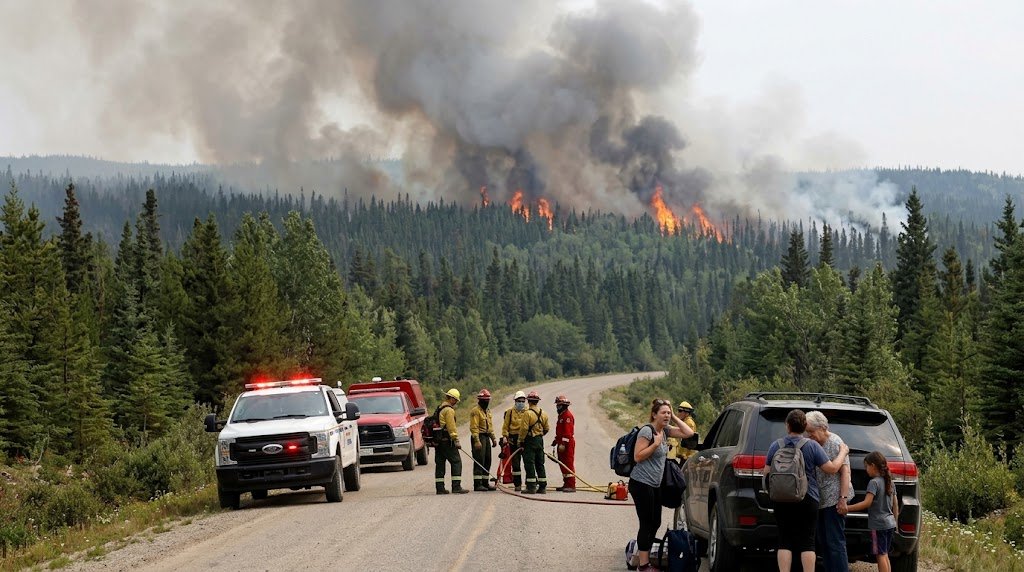
Canada wildfire evacuations in 2026 have forced more than 33,750 people from their homes since April, including more than 8,800 people from First Nations communities, the federal government said on Thursday, October 15. In an end-of-season update, Public Safety Canada reported more than 5,400 wildfires that burned about 4.5 million hectares, an area of roughly 45,000 square kilometres. The department said conditions on the ground have improved significantly, although several fires are still burning.
Canada wildfire evacuations: what the numbers show
The 33,750 figure covers the whole season, so it is not a count of people who are displaced today. Many evacuees return home within days or weeks once a fire moves away, and the federal release does not say how many are still out. It also gives no breakdown by province, so HCN could not confirm current evacuation totals for any single region.
What the update does say is where the pressure was greatest. Northwestern Ontario and southern British Columbia saw sustained fire activity that threatened communities and critical infrastructure. The Northwest Territories accounted for more than a third of all the area burned in Canada, although burned area is not a measure of how many people were displaced, since that depends on where fires burn in relation to towns and reserves.
The season itself had an uneven shape. Activity started slower than average, then picked up under prolonged heat, drought and low humidity. At 4.5 million hectares, the total is a little below the ten-year average of about 4.76 million hectares and above the 25-year average of about 3.3 million, according to national fire data from Natural Resources Canada. As of October 17, that data showed 149 active fires, 11 of them out of control. A seasonal outlook issued on October 14 by Canadian and American fire agencies said snow was starting to move south and that only a few regions remain open to new ignitions.
First Nations communities carried a heavy share
About 8,800 of the 33,750 evacuees came from First Nations communities, which works out to roughly one in four. For comparison, Statistics Canada’s 2021 census counted just over one million First Nations people, roughly 3 percent of the national population. That comparison is HCN’s own calculation and not an official finding, and it should be read with care. Evacuations depend on where fires burn, and many First Nations communities sit in forested areas that are harder to reach and harder to leave quickly. Even so, the gap between the two shares is large.
One example from northwestern Ontario shows how demanding these operations can be. After the province sent a precautionary request for federal help on July 15, the Canadian Armed Forces began evacuating Eabametoong First Nation, also known as Fort Hope, on July 18. The release says about 900 residents were moved by air. Indigenous Services Minister Mandy Gull-Masty said thousands of people had to leave their homes and that families and communities faced significant disruption.
Housing evacuees in British Columbia
Southern British Columbia presented a different problem: finding somewhere for people to stay. The province asked Ottawa for help with accommodation, and the Canadian Armed Forces provided lodging for evacuees at the Vernon Cadet Camp. In August, the federal government also said it would match donations to the Canadian Red Cross’s 2026 British Columbia wildfires appeal. Groups including the Red Cross, the Salvation Army, St. John Ambulance, Search and Rescue Volunteer Association of Canada and Team Rubicon Canada provided shelter, first aid and mental health support alongside local responders.
The release does not say how many B.C. evacuees were housed in this way or how many still need lodging, and HCN has not been able to confirm current evacuation numbers with the provincial authorities.
Response capacity and what the update leaves out
The federal government points to new firefighting capacity as a sign of progress. This was the first season with a national aerial surge fleet, ten leased aircraft funded through a $316.7 million, five-year investment. The aircraft logged more than 2,120 flight hours and made over 14,400 water and fire-retardant drops across nine provinces and territories. More than 560 firefighters from Mexico, Costa Rica, New Zealand and Australia also helped over the summer.
On recovery, the update is much less specific. It says recovery does not end when the fires are out and that Ottawa will work with provinces, territories and Indigenous partners on rebuilding. It gives no figure for homes lost, no count of evacuees who have not yet returned, and no recovery funding amounts. Those are the numbers that would show how many families are facing a long period away from home, so their absence is the main gap in the public record.
What to watch next
A fuller summary of the 2026 fire season is expected later this fall, according to the federal wildfire information site. The questions to watch are how many people are still displaced, how many homes were destroyed, and how First Nations communities that lost access to housing or services will be supported through the winter. HCN will update this report as official figures are published. For more of our coverage, visit the Human Crisis News homepage. The full federal figures are in the Public Safety Canada update.