
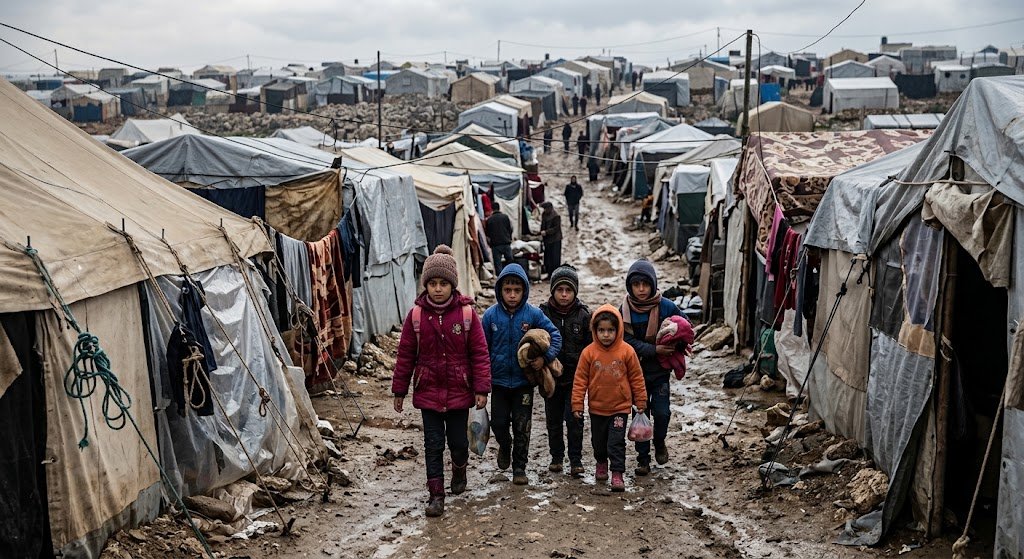
Gaza winter shelter is running short as the rainy season approaches. UNICEF said on Friday, October 16, that about 800,000 children in the Strip are still displaced, and that most of them live in tents or damaged buildings. The agency also warned that all six wastewater treatment plants remain out of service and that a large stormwater basin could overflow when the rains arrive.
Where the children are living
The 800,000 figure comes from UNICEF, which presented a new report at a briefing in Geneva. Its deputy spokesperson, Ricardo Pires, described a fourth winter in which children are living in damaged tents, with little sanitation, in whatever space their families can find. UNICEF counts roughly 60,000 children who have lost one or both parents, according to its own estimate, and says nearly every child needs some form of mental health support.
Other UN data points to the scale of the shelter problem. In its situation report of October 2, the UN humanitarian office (OCHA) said more than 4,000 buildings in Gaza are unsafe and need full or partial demolition. Over 2,300 of them are still occupied, sheltering nearly 44,000 people. The International Organization for Migration (IOM) has also said that close to two million people in Gaza need shelter-related help, a figure HCN has not been able to confirm against the original statement.
Gaza winter shelter and the sewage risk
The second danger is water. UNICEF says most of Gaza’s raw sewage is pumped straight into the sea, affecting the coastline for miles. It also points to the Sheikh Radwan stormwater basin, which it says is half full of wastewater. If the winter rains arrive before it is emptied, contaminated water could flood residential areas downstream. UNICEF says children have drowned in sewage-contaminated water in Gaza before.
The agency says the basin could be drained within about two weeks, but that the equipment needed has not yet been allowed into Gaza by Israel. HCN has not seen a response from Israeli authorities to this specific claim, and it should be treated as UNICEF’s account until one is available.
For ordinary families, these are not abstract problems. A leaking tent, a flooded camp and untreated water add up to a higher risk of illness at a time when people are already weak from years of disruption. OCHA’s October 2 report said the health situation remains critical, citing widespread infectious diseases linked to overcrowded displacement sites and poor water, sanitation and hygiene conditions. This matches what the UN described last winter: in January, it reported that heavy rain had damaged thousands of fragile shelters.
Food gains are fragile
The shelter warning comes alongside a food-security warning. UNICEF’s report found that acute malnutrition rates have fallen since the ceasefire that began in October 2025, but that only one in three children under two reaches the minimum standard of dietary diversity. A June survey found chronic malnutrition affecting one in eight children under five.
Those gains are now exposed to a new disruption. Israel said on Wednesday, October 14, that commercial goods were no longer entering Gaza, citing a tax dispute between local merchants and Hamas, which Gaza’s traders deny. UNICEF said both commercial and humanitarian supplies need to flow predictably and without interruption, and called for all crossings to stay open. OCHA has also warned that funding shortfalls will shrink hot meal production and household food parcels from October onward.
What aid is reaching families
Humanitarian work has not stopped. UNICEF says it continues to supply safe water to 1.2 million people, that more than 560,000 children have returned to some form of learning since the ceasefire, and that it has given digital cash assistance to more than 380,000 people this year. It says this work is lifesaving but far from restoring services to the level children need.
UNICEF has also said that children are still being hurt despite the ceasefire. It reports that more than 340 children have been killed since the truce was announced, including seven in the past two weeks. That is a UNICEF count of reported cases, not an independently verified total.
What to watch next
Three things will show how this winter unfolds: whether the equipment to drain the Sheikh Radwan basin is approved and delivered before heavy rain, whether tents, tarpaulins and winter supplies arrive in time at scale, and whether commercial goods resume entering Gaza. UNICEF has called on Israeli authorities to allow in spare parts, generators and engine oil at scale so that existing services can keep running, and on donors for flexible, long-term funding. The full UNICEF statement is on UNICEF’s website. HCN will update this report as new figures are published. For more of our coverage, visit the Human Crisis News homepage.