
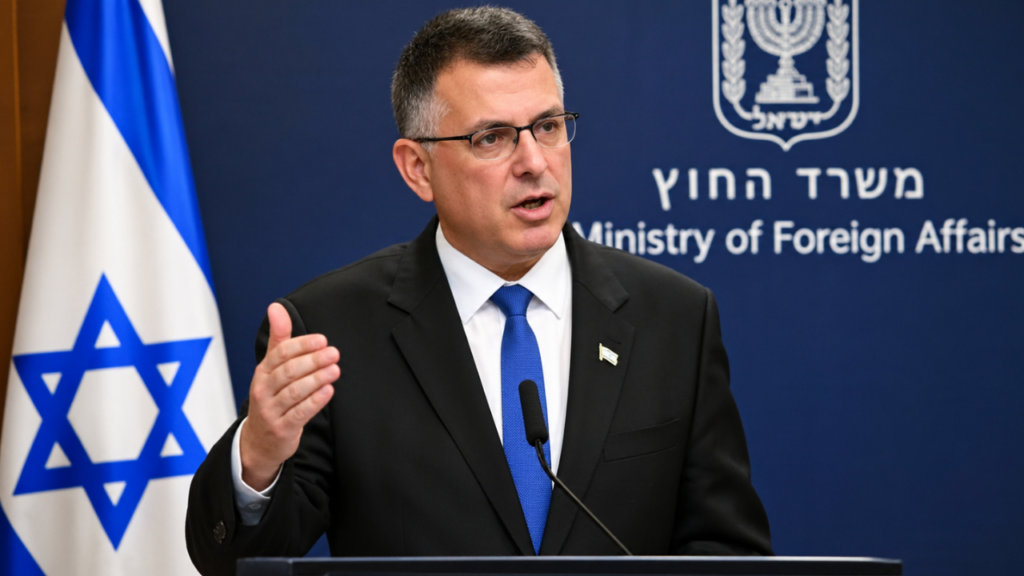
Israel has ordered the Dutch diplomats in Ramallah to surrender their Israeli-issued diplomatic documents within seven days, five days after the Netherlands began enforcing a ban on goods from Israeli settlements. Foreign Minister Gideon Sa’ar announced the decision on Sunday, 27 September, in a post on X, saying he had informed the Dutch Embassy in Israel that evening. When the week ends, the immunities and privileges those documents confer will lapse. The Dutch Foreign Ministry declined to comment, according to The New Arab, and no other Dutch response had been published when this report was written.
What Israel has withdrawn from the Dutch diplomats in Ramallah
Many governments, the Netherlands among them, keep diplomats in Ramallah to deal with the Palestinian Authority, the self-governing body in the occupied West Bank, while the diplomats themselves live in East Jerusalem. Israel has traditionally accredited these officials and extended certain protections to them under the Vienna Convention, the treaty that governs diplomatic relations, The New Arab reported. The arrangement rests on Israeli permission, because diplomats accredited to the Palestinians typically operate out of Israel rather than Ramallah, according to i24NEWS. Once the credentials expire, Israel will no longer recognise the immunities it had granted. Neither government had said whether Dutch diplomats in Ramallah could keep working from the Dutch representative office in the meantime.
Sa’ar framed the order on Dutch diplomats in Ramallah as a direct consequence of Dutch policy. He said the Netherlands could keep representing its interests with the Palestinians, but that “it may do so from Palestinian Authority territory” instead of Israel, and that Israel would not leave measures aimed at harming it unanswered. He also argued that the Dutch government, instead of confronting antisemitism at home, was feeding it through its policy, The Jerusalem Post reported. That is Sa’ar’s characterisation, and no Dutch reply to it had been published.
The Dutch order that set off the dispute
The Dutch measure took effect on 22 September and bans the import, purchase and sale of goods from Israeli settlements in the West Bank, East Jerusalem and the Golan Heights. Products made only partly in those areas are covered as well, even when most of their components come from elsewhere, and The Times of Israel reported that the rule reaches items carried by travellers. Deliberate violations can bring up to six years in prison or a large fine, while unintentional ones carry up to one year, according to The Jerusalem Post.
The Dutch government has said the settlements are unlawful and that the ban gives effect to its international legal obligation not to contribute to that situation, Middle East Eye reported. Passengers who arrived in Amsterdam on an El Al flight from Tel Aviv said customs officers searched their luggage for settlement products, The Times of Israel reported, though the accounts were not independently verified.
Not the first Israeli countermeasure
In August, Israel barred Dutch officials from the International Support Center for Gaza, a US-led coordination hub based in Israel, after the Dutch government announced its trade measure, The Times of Israel and The New Arab reported. The New Arab also reported that earlier this month Israel ordered the British consulate in East Jerusalem, London’s channel to the Palestinian Authority, to close after Britain announced a similar ban.
France and Canada also joined Britain this month in announcing bans on settlement goods, and Israel has taken no comparable step against either, according to the same outlet. The Dutch decision also followed comparable measures by Ireland, Belgium and Spain, Middle East Eye reported. The order on Dutch diplomats in Ramallah extends that pattern from a Gaza coordination hub to the Dutch channel to the Palestinians.
Settlement businesses and open questions
Israel’s Ministry of Economy and Industry plans to offer businesses in the settlements up to 200,000 shekels, about $54,000, and help finding alternative markets, Middle East Eye reported, citing the Israeli outlet Calcalist. Several questions remain open: whether Dutch diplomats in Ramallah will keep working after the deadline, whether the Netherlands will respond in kind, and whether Israel will extend the step to other countries with similar bans. HCN will update this report as facts emerge.
More from HCN: Pope Leo’s Paris Mass and the 800,000 worshippers in France
[…] date. Officials have not publicly said how many troops remain or where they will go, and an unnamed US official gave no such detail to the Associated Press in […]
[…] Israeli officials say Captain Smit Machchhar, an Indian national, unlocked the cockpit door despite being wounded, letting passengers and crew in. Passenger Yaniv Hayun has said he entered the cockpit and subdued the attacker, and Netanyahu has met him. Another passenger told an Israeli outlet that a doctor aboard bandaged the captain. These accounts come from officials and passengers and have not been independently confirmed. […]