
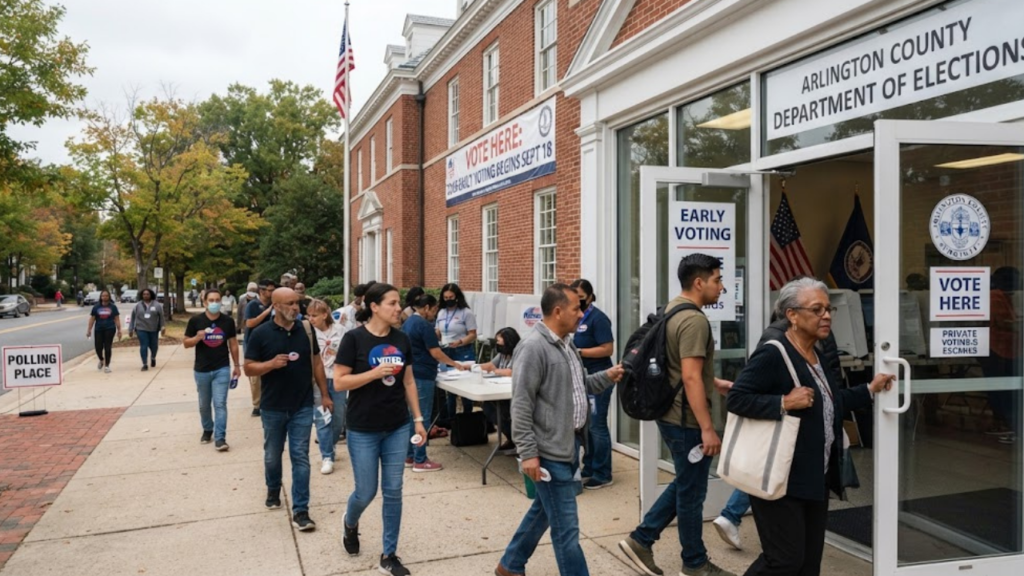
Early voting 2026 is now open in Virginia, where residents began casting ballots in person on Friday, Sept. 18, and can keep doing so through Saturday, Oct. 31. The opening comes 46 days before Election Day, and it arrives four days after the Supreme Court refused to let the administration impose new rules on mail ballots. Republicans enter the Nov. 3 elections with their House and Senate control at risk.
Virginia is not alone, but it is the largest state voting in person this week, so it is getting most of the attention. Related: Read more on HumanCrisisNews
Early voting 2026: who can vote now, and who has to wait
Virginia, Minnesota and South Dakota opened on Friday, and Al Jazeera reports that voters in the latter two can cast absentee ballots in person at local offices. The Associated Press adds Idaho to that group. Illinois follows on Sept. 24.
For most Americans, the wait is longer. North Carolina began sending absentee ballots on Sept. 4, but in-person early voting there runs Oct. 15 to Oct. 31. Iowa’s early voting runs Oct. 14 to Nov. 2. That matters because Iowa is already seeing heavy campaigning. Vice President JD Vance headlined a rally in Council Bluffs with Republican gubernatorial candidate Zach Lahn, and Republicans there are fighting to hold a Senate seat and the governorship, both of which the Guardian described as uncomfortably close. Iowans can’t yet vote in person, though.
In Virginia, the rules are straightforward:
- No excuse is needed. Voters give a name and address and show an accepted ID, or sign a statement confirming their identity.
- Sunday voting exists. It is available Oct. 18.
- Registration has a deadline, but not a hard stop. The regular deadline is Oct. 23; after that, eligible voters can register and vote a provisional ballot.
- Mail ballots have more room. Ballots postmarked by Election Day can now arrive up to noon three days later, and the absentee witness requirement is gone.
Early options are now normal across the country. The number of states offering voting before Election Day rose from 24 in 2000 to 47 this year, plus Washington, D.C. Alabama, Mississippi and New Hampshire do not offer no-excuse early voting.
The mail-ballot ruling voters walked in behind
The dispute began with an executive order Trump signed in March. It directed the Postal Service to build a system that could block delivery of mail ballots to voters not on lists submitted in advance by state election officials. The case reached the Supreme Court’s emergency docket three times, each time after U.S. District Judge Indira Talwani blocked the plan.
On Monday, the justices declined to lift her injunction. Justices Samuel Alito and Clarence Thomas dissented. Justice Brett Kavanaugh, a Trump appointee, sided with the majority but wrote separately. He said the rule may well fall within the Postal Service’s authority, but that applying it in 2026 would be arbitrary because election officials lack time to implement it. That distinction matters. The ruling does not settle whether the policy could ever be lawful; it says this election is too close to change the rules.
Talwani had also noted that the record contained no evidence of fraudulent mail voting to justify rushed implementation. The administration’s lawyers have argued the opposite: Solicitor General D. John Sauer called the plan modest and said every day of the injunction sends more ballots through the mail without added protections. A top Postal Service official has now said the agency stopped work on the computer system at the center of the plan.
The practical result is that states run mail voting as they did in earlier elections. Even so, the president is still pursuing other steps, including court challenges, a federal search for noncitizen voters and pressure on election officials to hand over sensitive voter data.
Why Virginia’s House map is not the one Democrats wanted
Virginia’s congressional lines are more settled than they looked in the spring. Voters approved a Democratic-drawn map on April 21 by 51.69% to 48.31%. On May 8 the state Supreme Court struck the amendment down 4-3, ruling that lawmakers approved it after voting had already started in the 2025 elections. The U.S. Supreme Court then rejected Democrats’ emergency appeal, ending the effort. The current districts, which give Democrats a 6-5 advantage, stay in place.
That leaves a smaller set of contested seats. Inside Elections rates the 2nd District a toss-up and the 1st as leaning Republican. In the 2nd, Republican Rep. Jen Kiggans faces a rematch with Democrat Elaine Luria. The Senate seat is also on the ballot, where Democratic incumbent Mark Warner faces Republican Bert Mizusawa.
What is pushing voters to the polls
The issues are economic first. The Wall Street Journal reports that mortgage rates are nearing 7%, consumer prices rose 3.4% in the year to August, and gas prices are near their highest since 2022. Health costs are part of the mix too, after Republicans let Affordable Care Act subsidies expire this year and plan costs rose. Voters are also weighing a prolonged war in Iran, artificial intelligence and immigration enforcement.
The voters we can name give less tidy reasons. Sanya Singhal, a college student among Virginia’s first early voters, told Al Jazeera, “I really want to participate in my democracy.” That is one voter, not a trend. Early-voting numbers, once published, will show who is voting early. They won’t show who is winning.
For readers outside the United States, the stakes are practical. If Democrats retake Congress, the final two years of Trump’s term would likely bring investigations and other oversight, including of decisions on the Iran war that are already shaping fuel prices worldwide.
What to watch next
Early voting 2026 continues Thursday, Sept. 24, when Illinois opens. Iowa and North Carolina follow in mid-October, and Virginia’s window closes Oct. 31. The larger open question is whether the fight over how Americans vote produces new rulings before then, or whether the courts’ message this week stands: the rules for 2026 are the ones states already had.