
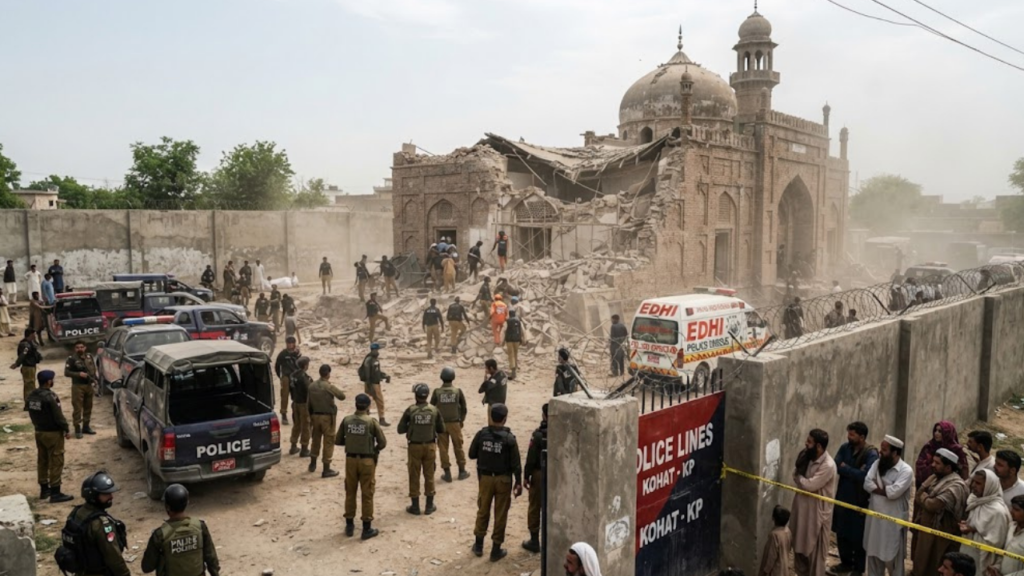
The Kohat mosque attack on Friday, September 18, 2026, killed at least 21 people, 15 of them police officials, and wounded more than 100. An explosives-laden vehicle was detonated at a mosque inside the old Police Lines in Khyber Pakhtunkhwa as prayers were under way, and gunmen then stormed the compound. The Hafiz Gul Bahadur-led Ittehadul Mujahideen claimed responsibility. Police said an operation to clear the compound lasted about 21 hours.
What happened at Kohat Police Lines during Friday prayers
According to Dawn’s reporting, the vehicle exploded near the mosque and attackers then entered the compound and fired on police facilities. The provincial police chief, Zulfiqar Hameed, described it as a suicide bombing. The blast badly damaged the mosque, and an outer wall of the police station collapsed. Residents said it could be heard from a distance. The Kohat mosque attack was therefore a two-stage assault: a vehicle bomb first, then a gun attack on the compound.
Six of the seven attackers who entered the compound were killed within the first two hours. On Saturday, Khyber Pakhtunkhwa police said the clearance operation had finished and that eight attackers were killed in total. Elite Force commandos, Counter Terrorism Department teams and security forces took part.
Among the dead were SP Traffic Akbar Shinwari and Dr Israel Orakzai, head of the paediatric department at the district headquarters hospital in Kohat, along with Special Branch and CTD officials. Rescue officials told AP that most of the wounded were worshippers. Funeral prayers for the 15 police personnel were held in Kohat on Friday evening. Their bodies were then taken to Kohat, Karak, Lakki Marwat, Bannu and Mardan.
Why the Kohat mosque attack death toll differs between reports
Early reports put the toll at 16 and then 17. AP and Dawn later reported at least 21 dead, a figure confirmed by the district health officer, and the toll of the Kohat mosque attack has held at 21 in most outlets since. Al Jazeera’s headline says 27, but its own breakdown of six civilians and 15 police adds up to 21. The reason for the higher number is not explained.
The number of wounded also varies: 50, 75, 80 and more than 100, depending on the outlet and the hour. Dawn’s figure of over 100, with three in critical condition, is the most recent from an official source. Treat all figures as provisional until the provincial government publishes a final count.
Who claimed the attack, and what the claim does not settle
The Hafiz Gul Bahadur-led Ittehadul Mujahideen said it carried out the attack. Al Jazeera describes the group as linked to the Pakistani Taliban network, and Pakistan’s government uses the term “Fitna al-Khawarij” for the TTP and associated militants. A claim of responsibility for the Kohat mosque attack is not a finding. Investigators have not published who planned it, how the vehicle reached the compound, or whether security lapses played a part.
What the numbers say about the Kohat mosque attack
The Pakistan Institute for Conflict and Security Studies (PICSS), an Islamabad think tank, tracks militant violence monthly. Its August 2026 data recorded 199 militant attacks nationwide, up from 144 in July, but deaths from those attacks fell to 158 from 268. Attacks were becoming more frequent and less deadly.
In mainland Khyber Pakhtunkhwa, the province’s settled districts where Kohat lies, PICSS counted 54 attacks in August and 44 deaths from them. A single attack that kills 21 people, as this one did, is nearly half of that whole-month figure. The comparison is rough because counting methods differ, but it shows how much deadlier one well-planned assault can be than a month of smaller ones. PICSS also recorded three suicide attacks in August, two of them vehicle-borne, and 112 security personnel killed in July, the highest monthly toll since January 2023.
Why Kohat, and why a police compound
Kohat lies close to the Afghan border and on the route to North Waziristan, Bannu and Dera Ismail Khan, areas that Al Jazeera’s Kamal Hyder said have seen deadly attacks in recent months. The day before, a roadside bomb killed six soldiers in Hangu district, and the military said ten suspected militants were killed in operations. AP reported that Pakistani Taliban militants have increasingly targeted police and other security forces as the government intensifies operations against them.
The method also has a precedent. In February 2026, a suicide vehicle bomb followed by a gun assault hit a security checkpoint in Bajaur district, killing 11 security personnel and a child, and the TTP claimed it. The two cases are alike in method. Investigators have not linked them.
Michael Semple, a former EU representative in Afghanistan, told Al Jazeera that an attack this complex needs planning, logistics and training. He said it fits a pattern of sanctuary in Afghanistan for TTP factions. Pakistan accuses the Afghan Taliban of letting these groups operate from Afghan soil, and Kabul denies it.
Is this part of a wave of mosque attacks in Pakistan?
The Kohat mosque attack shares a setting, Friday prayers, with other bombings, but the evidence does not point to a single campaign. In February 2026, a suicide bomber attacked a Shia mosque in Islamabad during Friday prayers, killing more than 30 people. The Islamic State claimed that attack, which was sectarian in motive, and the government blamed Afghanistan and India, both of which deny involvement. In February 2025, a blast at a seminary mosque in Nowshera killed at least five people, including the cleric Hamidul Haq Haqqani.
Kohat differs in one important way. The target was a mosque inside a police headquarters, and most of the dead were police, so it reads as an attack on the security forces, not on a congregation. Different groups, different motives and different targets are involved. Treating them as one wave hides how the threat is changing.
What is confirmed and what is not
Confirmed by officials and multiple outlets:
- At least 21 people died, including 15 police officials, and more than 100 were wounded.
- The attack combined a vehicle bomb near the mosque with a gun assault on the compound.
- Eight attackers were killed, and the clearance operation is over.
Not yet established:
- Who planned the Kohat mosque attack, beyond the group’s own claim.
- How the vehicle reached the entrance of a police compound.
- The final toll and the final number of wounded.
What comes next
President Asif Ali Zardari called for the complete elimination of the militants, and Prime Minister Shehbaz Sharif directed authorities to speed up rescue work. KP Chief Minister Sohail Afridi asked for a detailed report, and the Interior Ministry said the attack would not weaken national resolve.
The main unanswered question is how a vehicle packed with explosives got so close to a police compound’s mosque. The report the chief minister has requested, and the police investigation, should say. Until then, the confirmed facts are the toll of 21, the claim by Ittehadul Mujahideen and a compound where most of the victims were officers.
Also on Human Crisis News: read our coverage of the migrant crisis and new camp in Ceuta.
[…] talks with Chinese Vice Premier He Lifeng and said Chinese officials had been “very engaged” in Washington’s economic pressure campaign against Iran. He also said Washington was holding positive discussions with Chinese […]