
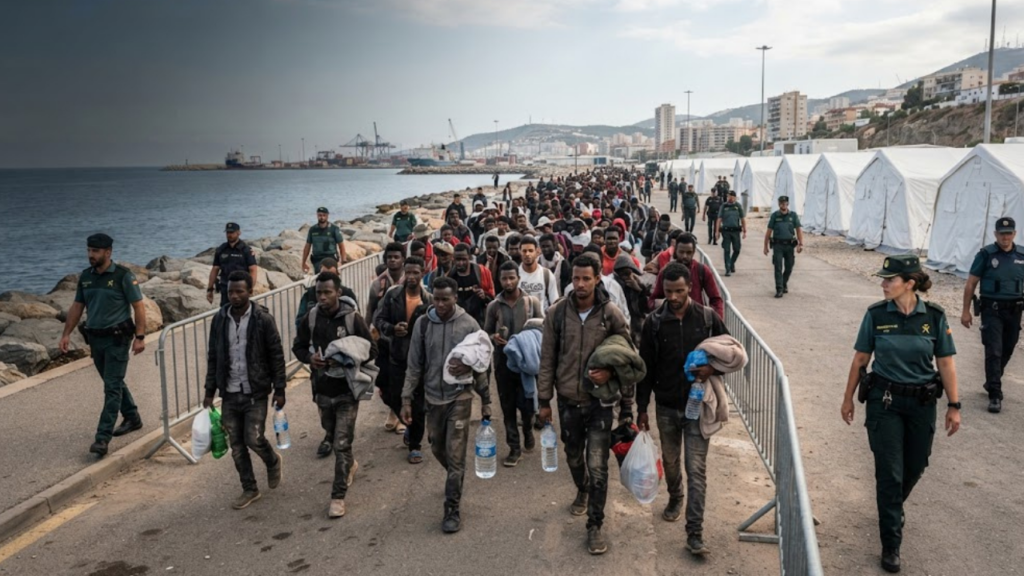
Officers fired shots into the air on Friday morning as the Ceuta migrant crisis flared up again. Authorities had opened a fifth temporary reception site at the city’s port, meant to finally move people off the beaches where thousands have been sleeping for weeks. Instead, the operation turned chaotic within hours: migrants who feared being left without a spot ran toward the new site, and police responded with batons and warning shots to regain control.
The scenes are the latest flashpoint in a crisis that has been building since late July, when more than 70,000 people crossed into the Spanish enclave from Morocco over the course of a single weekend — one of the largest irregular border crossings Europe has recorded in years. Roughly 5,000 to 13,000 migrants are still believed to be in Ceuta, depending on which count you use, six weeks after that initial surge.
How the Ceuta migrant crisis turned chaotic at the new port camp
The plan itself was simple enough. Civil Guard patrols were sent to the Trampolín and Benítez beaches shortly after 6:30 a.m. to walk migrants roughly two kilometers to the new settlement at Ceuta’s port. What they hadn’t fully accounted for was how desperate people had become to secure a place indoors after weeks of living in makeshift tents.
Videos from the transfer show large crowds sprinting through the streets toward the site, some shouting, some cheering, all trying to avoid being turned away. Spanish national police and army personnel struggled to hold formation as the crowd pushed forward; at points, officers used batons to break up fights and fired shots into the air to disperse the surge. Several people were injured in the process, though authorities haven’t released a precise count.
There’s a legal backstory to why this camp opened when it did. Spain’s Unified Police Union had gone to the National Court earlier in the week to try to block the site from opening at all. According to Euronews’ reporting from Ceuta, the court briefly sided with the union on Wednesday, suspending the opening — only to reverse that decision a day later. Spanish authorities moved immediately once the suspension lifted, which is part of why Friday’s operation felt rushed to people watching it unfold.
A crisis that intelligence services reportedly saw coming
What’s made this episode harder for the Spanish government to manage politically is a set of documents that surfaced weeks after the original crossing. Officials initially said they had no advance warning of the July 30 rush. Since then, Spain’s Government Delegation in Ceuta has released roughly 40 previously classified communications showing that the National Intelligence Centre had flagged organized attempts to enter the enclave, by land and sea, as early as July 29 — a day before it happened.
That gap between what intelligence services reportedly knew and what local authorities said publicly has become its own controversy, separate from the humanitarian strain the crossings created.
Life in Ceuta has grown more volatile, residents and officials say
Beyond the camps, residents describe a city under sustained pressure. Ceuta’s public prosecutor, Silvia Rojas, has described what she called an “exponential increase” in crime since the crisis began, citing a rise in sexual assaults — including some cases she said involved minors — along with attacks on soldiers stationed in the enclave. Public safety researchers cited in Spanish media have warned that conditions could deteriorate further if the reception system keeps falling behind the number of people who need housing.
Health conditions in the informal camps have also raised concern. A Moroccan teenager was found to have tested positive for mpox this week and has been isolated for treatment — a single case, but one that underscores how difficult it’s been to run basic health screening in settlements that were never designed to hold this many people for this long.
Spain and Italy, meanwhile, have extended their suspension of the Schengen free-movement arrangement between the two countries for another 15 days, citing security concerns and the possibility that unscreened arrivals could include people wanted for other reasons.
Why the numbers stay high despite Spain’s crackdown
The July crossing wasn’t a one-off surprise so much as the peak of a pattern that’s continued in smaller waves since. Spain’s Interior Ministry says a large share of those who entered in July — tens of thousands, by its own figures — have since returned to Morocco, some voluntarily and some through coordinated readmission agreements between Rabat and Madrid. But a hard core of people has stayed, either waiting for asylum processing or hoping conditions will eventually allow onward travel to mainland Spain, which current policy explicitly rules out. European Commissioner for Migration Magnus Brunner has said plainly that no one who crossed into Ceuta irregularly will be granted access to the Spanish mainland or any other EU member state.
That policy, combined with slow-moving reception infrastructure, is part of why the Ceuta migrant crisis has stayed stubbornly unresolved even as headline crossing numbers have dropped. People aren’t leaving because there’s nowhere for most of them to go next.
What Brussels has — and hasn’t — done
The European Union’s response has been more diplomatic than material so far. European Commissioner for the Mediterranean Dubravka Šuica has publicly praised Morocco’s “swift cooperation” in facilitating returns, and the EU continues to fund Rabat’s migration management program at roughly €160 million through 2027. Ceuta’s mayor-president, Juan Jesús Vivas, has pushed back on that framing. He has accused Morocco of pursuing what he called a “policy of harassment” toward the enclave — an allegation Rabat has firmly denied — and has asked Brussels for direct financial support to build out border infrastructure.
According to Vivas, EU commissioners have expressed sympathy in private meetings but made no firm financial commitments. Brussels did send a technical mission to Ceuta earlier this month to assess conditions on the ground, though it’s not yet clear what, if anything, will come of that visit.
Related: Greenland’s new security deal shows how differently Western governments respond when a strategic territory, rather than a crisis-hit border town, is on the table — a contrast worth keeping in mind as Ceuta keeps waiting on Brussels.
What comes next
The immediate question is whether the new port facility can actually absorb the people still living rough on Ceuta’s beaches without repeating Friday’s chaos on subsequent transfer days. The longer-term question is harder: whether the EU is willing to treat Ceuta’s population, however many thousand people that turns out to be, as its own responsibility rather than something Morocco’s cooperation can manage away. Until Brussels answers that, the Ceuta migrant crisis is likely to keep producing scenes like the one that played out at the port this morning.
[…] Also on Human Crisis News: read our coverage of the migrant crisis and new camp in Ceuta. […]