
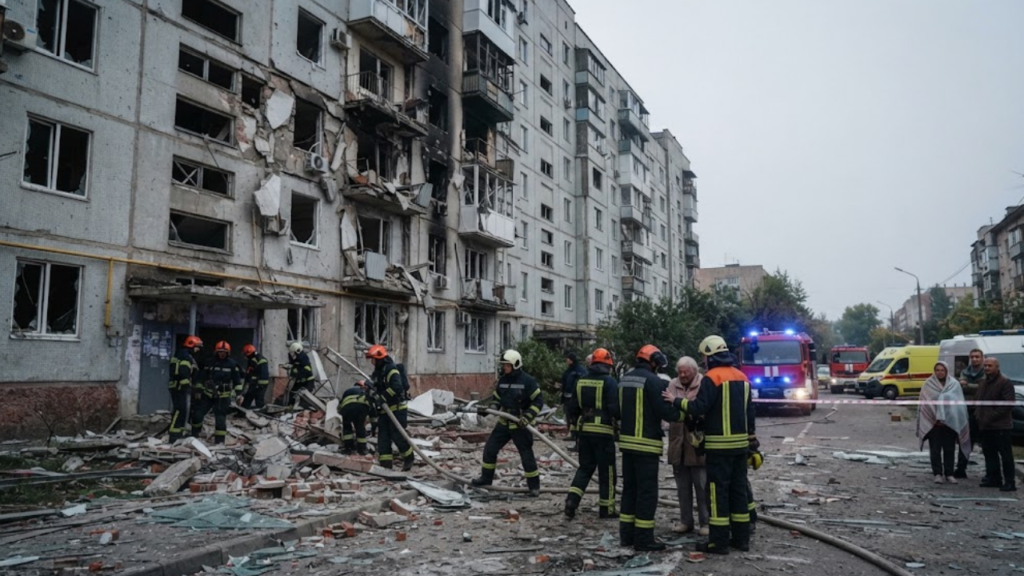
Russia Ukraine strikes escalated again this week, with a missile and drone barrage on Kyiv and its surrounding region injuring at least 19 people overnight into Thursday, Ukrainian officials said. Children were among those hurt. The same night, separate strikes hit Odesa and Zaporizhzhia, and Ukraine’s Air Force reported destroying or suppressing 131 Russian aerial targets before dawn.
Kyiv didn’t only absorb the hit. President Volodymyr Zelenskyy said Ukrainian forces struck back overnight too, hitting an oil refinery in Yaroslavl – roughly 700 kilometers inside Russian territory – along with a military airfield in the Rostov region. Neither side is behaving like a ceasefire is close. Peace talks have stalled over territorial concessions in eastern Ukraine, and the latest round of Russia Ukraine strikes shows both militaries are still operating at full intensity.
Why Russia Ukraine strikes keep converging on Kyiv, Odesa and Zaporizhzhia
There’s a pattern to which parts of the country take the brunt of these barrages, and it hasn’t shifted much this year. Kyiv remains the symbolic and logistical target Russia keeps returning to. Odesa and Zaporizhzhia sit closer to the front and the Black Sea coast, useful for degrading both supply routes and civilian morale at once.
What’s different this week is less the target list and more the timing. These strikes landed just as European officials were already warning – publicly, and in specific terms – that the war’s reach could be about to widen. Not by accident, but by design.
Poland’s warning: attacks built to look accidental
Polish Prime Minister Donald Tusk told his country’s parliament on Thursday that Russia is preparing “hybrid-style” drone and missile strikes against nations supporting Ukraine, Poland included. According to Tusk’s remarks reported by NPR, Polish intelligence points to a Kremlin strategy built around plausible deniability – strike something inside NATO territory, then call it accidental.
The logic is almost procedural: hit a member state hard enough to hurt, but ambiguously enough that Article 5 – NATO’s promise that an attack on one member is an attack on all – never quite gets triggered. “These potential strikes intend to paralyze NATO,” Tusk said, adding that even a partial success would “weaken the alliance’s willingness to respond collectively.”
This warning isn’t arriving in a vacuum. On Monday, Polish forces recovered a Russian drone off the country’s northwestern coast carrying a warhead. A day later, NATO jets shot down a drone over Lithuania. Earlier this month, Germany accused Russian operatives of attempting a drone strike on an airport serving as a major NATO hub. Russia’s Foreign Ministry has dismissed the accusations as “contrived” and “far-fetched.”
A pattern building across NATO’s eastern flank
Side by side, these incidents look less like isolated events and more like a slow accumulation European officials are now naming out loud. None has individually crossed the line into an act of war – which may be the point. A strategy built on staying just under that threshold, repeatedly, until the threshold itself stops meaning much.
Tusk traveled to Ukraine on Friday for the Carpathian 8 summit in the Ivano-Frankivsk region, putting him in direct contact with the front-line reality even as he asks fellow NATO members to take the hybrid-attack threat seriously back home.
Related: Yemen’s displacement crisis is deepening as fighting on another front pushes over 100,000 people from their homes – a reminder of how many active crises are competing for the same limited pool of international attention and aid.
What comes next
For Ukraine, the picture hasn’t changed: strikes continue, counterstrikes on Russian energy infrastructure continue, and peace talks remain stuck on territory neither side wants to concede. For Poland and its neighbors, the open question is whether NATO tightens its response protocols before an ambiguous incident forces the issue – or waits until an attack is unmistakably deliberate before it acts as one body. As Russia Ukraine strikes and hybrid threats both intensify, that answer may not stay theoretical for long.