
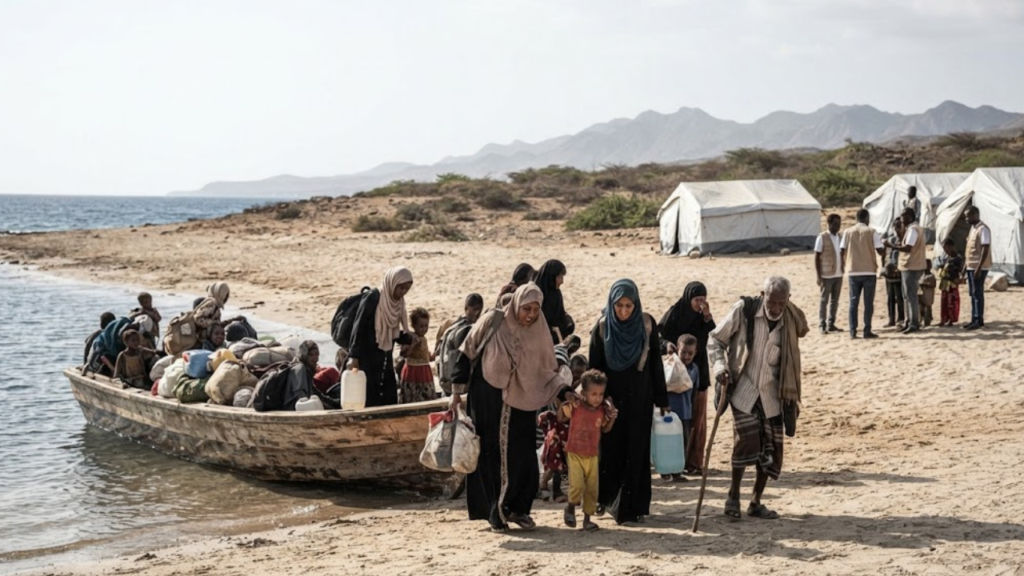
Yemen displacement Djibouti numbers have surged this week, with more than 112,000 people forced from their homes inside Yemen in just two weeks, and nearly 3,000 crossing the Gulf of Aden to Djibouti, according to United Nations figures released in Geneva on Friday. This wave of Yemen displacement toward Djibouti follows a rapid Houthi advance that has handed the Iran-aligned group control of Yemen’s entire Red Sea coastline, tightening its grip on the Bab al-Mandeb Strait — one of the busiest shipping corridors linking Europe and Asia through the Suez Canal.
The fighting pits Houthi forces against troops loyal to Yemen’s internationally recognized, Saudi-backed government based in Aden. Saudi and Yemeni air forces have struck Houthi positions in response, even as the Houthis have escalated attacks on Saudi cities and energy infrastructure. For coastal families, the practical outcome has been sudden displacement: most of the newly uprooted have fled the west coast and the provinces of Taiz and Lahj since the fighting intensified two weeks ago.
How the coastal seizure is driving Yemen displacement toward Djibouti
The turning point was the Houthis’ capture of the Red Sea port town of Mocha and their subsequent sweep along the coastline and its islands, giving the group effective control of the approach to Bab al-Mandeb. But the military significance of the strait has translated, for ordinary Yemenis, into displacement that outpaced aid agencies’ ability to respond.
Abdusattor Esoev, the International Organization for Migration’s mission chief in Yemen, told reporters that stockpiles are being drawn down fast: “Our resources are very, very, very limited and our stocks will be depleted very soon.” According to Al Jazeera’s reporting from Geneva, the 112,000 figure sits on top of a displacement crisis Yemen has carried for well over a decade.
The dangerous crossing behind the Djibouti numbers
For those unwilling to remain inside Yemen, the alternative has been a sea crossing that has claimed lives in earlier phases of the war. Nearly 3,000 people have reached Djibouti in under a week, UNHCR’s representative Sandrine Desamours told journalists by video link from Djibouti — a key driver of the current Yemen displacement Djibouti trend. The IOM says arrivals are coming in on overcrowded boats, many landing with almost no food or water left.
The influx isn’t limited to Yemenis — IOM has begun recording a small number of Ethiopian migrants on the same route, and Somaliland and Puntland report growing arrivals, though those remain in the low hundreds. A fuel shortage inside Yemen has, at times, slowed departures even as demand for passage grows; earlier this month, more than 500 people were rescued off Djibouti’s coast near Obock after their boat ran out of fuel mid-crossing.
Obock, a coastal town roughly 20 kilometers across the water from Yemen, has absorbed most new arrivals. Djibouti has recorded single-day surges of over 1,000 people, and the country’s prime minister, Abdoulkader Kamil Mohamed, has traveled there to review the response in person.
Djibouti’s reception effort is running out of room
Djibouti’s capacity to absorb arrivals is narrowing fast. UNHCR’s Desamours said the Markazi refugee camp near Obock has space for roughly 5,000 more people, but the agency is bracing for over 10,000 arrivals. “An overwhelming number are children and adolescents,” she said, adding UNHCR is working with Djibouti’s government to place them in already-crowded local schools.
Local officials describe an operation stretched thin. Obock’s governor, Moussa Aden, said even basic provisions are a daily struggle: “It is difficult to provide everything immediately for all these people. They need water, they need food, and even the most basic thing they need is a toilet.” Djibouti’s finance minister, Ilyas Dawaleh, has thanked Obock’s residents for absorbing the strain while acknowledging the situation is becoming harder for the country to manage alone.
A crisis stacked on Yemen’s existing collapse
UN agencies describe this wave of displacement as a crisis layered on several others. Yemen’s civil war, now well into its second decade, has already shattered much of the country’s health system and economy, producing what aid groups call one of the world’s largest humanitarian emergencies. Some monitoring groups tracking the current escalation estimate tens of thousands of children have been displaced in this surge alone.
Related: Gaza City Building Collapse in Tal al-Hawa — another Middle Eastern population currently facing mass displacement under active conflict, underscoring how simultaneous crises are straining global humanitarian response capacity this year.
What comes next
Aid agencies are appealing for more funding, tents and medical support inside Yemen and in Djibouti, but UNHCR has already flagged budget constraints. Desamours warned some of those now in Djibouti could move onward toward Somalia — itself managing its own displacement crisis — if camp conditions don’t improve. As the Yemen displacement Djibouti figures continue to climb, whether the Houthi advance continues, and whether renewed talks or a ceasefire follow, will likely determine whether this week’s numbers mark a peak or the early stage of a longer exodus.
[…] Yemen’s displacement crisis is deepening as fighting on another front pushes over 100,000 people from their homes – a reminder of how […]