
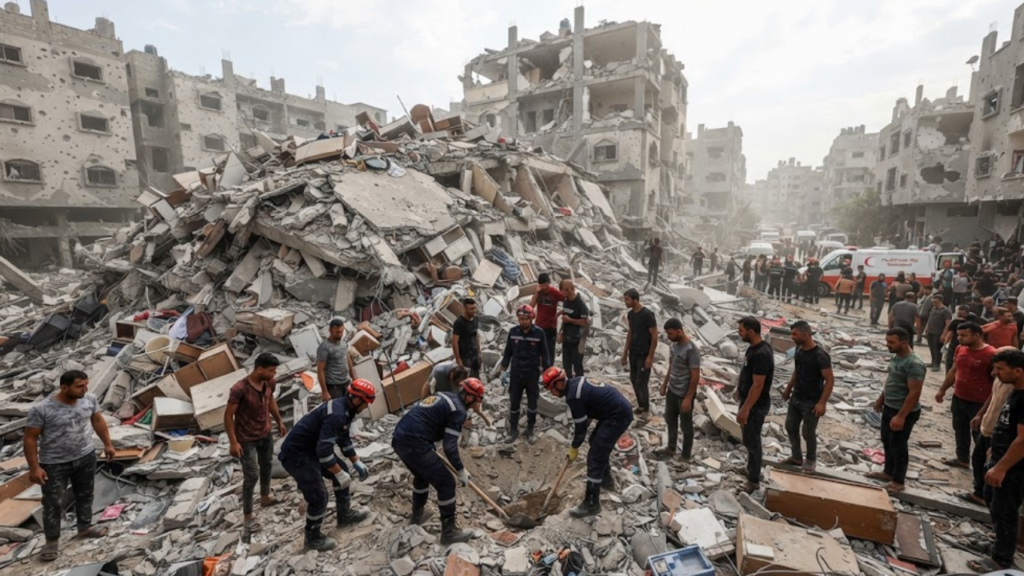
The Gaza City building collapse that leveled a six-story apartment tower overnight has killed at least 20 people and left dozens more trapped beneath the rubble in the Tal al-Hawa neighborhood. By Wednesday, families were already burying their dead even as rescue crews kept digging through the wreckage with their hands, unable to reach everyone still calling out from underneath.
The building, known locally as al-Saada, held four apartments on each of its six floors and had become home to roughly 100 displaced people, including about 50 children, according to the United Nations. Gaza’s Civil Defense agency, which operates under Hamas authority, said the structure had already been cracked by an Israeli strike earlier in the nearly three-year war and had been structurally unsound ever since. The Israeli military, for its part, said it had never struck the building — leaving the exact cause of the collapse unresolved as of Wednesday.
Casualty figures shifted through the day as rescue teams worked, a common pattern in the chaotic hours after a mass-casualty event. The Gaza Health Ministry put the death toll at 21, including 11 children and five women, while other tallies from Civil Defense and international outlets cited at least 20 dead. Civil Defense spokesperson Mahmoud Basal said crews believed close to 100 people remained buried in the debris as of Wednesday, describing the recovery effort as slow going because rescuers lack heavy equipment. Between 14 and 25 injured people were taken to area hospitals, depending on the count.
Why the Gaza City building collapse happened in a still-inhabited tower
The collapse is a direct consequence of a housing crisis that has defined Gaza throughout the war. The United Nations estimates the large majority of structures across the territory have been damaged or destroyed since fighting began in October 2023, while Israel has kept tight restrictions on construction materials entering Gaza (according to UN News). With nowhere else to go and building supplies scarce, displaced families have repeatedly moved into structures still standing but structurally compromised — exactly the kind of building that came down in Tal al-Hawa.
Zaher al-Wahidi, a Gaza Health Ministry spokesperson, said it was not immediately clear Wednesday what triggered the collapse itself, as opposed to the earlier damage that left the building vulnerable. That distinction matters for a territory where nearly every structure carries some history of bombardment, and where identifying what finally brought a building down can take investigators days or longer.
Funerals held before recovery work even finished
Even as search teams kept pulling bodies from the wreckage, mourners gathered Wednesday for funerals of people already recovered. Among them was Bashir Abu Al-Shaar, who said his uncle and his uncle’s entire family were killed in the collapse. He said the tragedy showed that promises about Gaza’s reconstruction — including pledges that building materials would be let in and that Gaza City would eventually be rebuilt — had not translated into safety for people still living in damaged buildings today.
Footage verified by news organizations showed rescue workers and residents digging side by side, at times by hand, as children’s voices could reportedly still be heard from beneath the debris hours after the collapse. Medical sources said rescuers were following those sounds in an effort to locate survivors before the search shifted fully toward recovery.
A UN warning about “hundreds” of unsafe shelters
Ramiz Alakbarov, the UN Humanitarian Coordinator for the Occupied Palestinian Territory, said he was devastated by reports of people trapped in the rubble and confirmed the estimate that around 100 people, half of them children, had been living inside the building. He said the emergency response had mobilized quickly given the limited medical and shelter supplies still available in Gaza, and that saving any remaining lives depended on reaching trapped survivors as fast as possible.
Alakbarov went further, framing Wednesday’s collapse as a symptom of a much larger problem rather than an isolated accident. He said families across Gaza are currently sheltering in hundreds of buildings that are damaged and structurally unsafe, and that the collapse underscored how urgently displaced residents need safer places to live — not just aid to survive where they already are.
The broader toll behind one building’s collapse
Wednesday’s disaster adds to a war that has already killed more than 73,700 Palestinians, according to Gaza’s Health Ministry, which tracks fatalities but does not distinguish between combatants and civilians in its public totals. The conflict began after the October 7, 2023, Hamas-led attack on southern Israel that killed roughly 1,200 people and saw 251 others taken hostage. Israel’s ensuing military campaign has left the majority of Gaza’s housing stock damaged or destroyed, according to UN assessments, driving the sheltering pattern that put dozens of families inside the al-Saada building in the first place.
What remains unresolved is not just the final death toll, but accountability for why a building already flagged as unsafe was still housing dozens of families when it came down. Civil Defense crews said Wednesday they would keep searching the rubble as long as there was a chance of finding survivors, while humanitarian officials renewed calls for safer alternatives for the tens of thousands of Gazans still living in structures compromised by nearly three years of bombardment.
[…] Gaza City Building Collapse in Tal al-Hawa — another Middle Eastern population currently facing mass displacement under active conflict, […]