
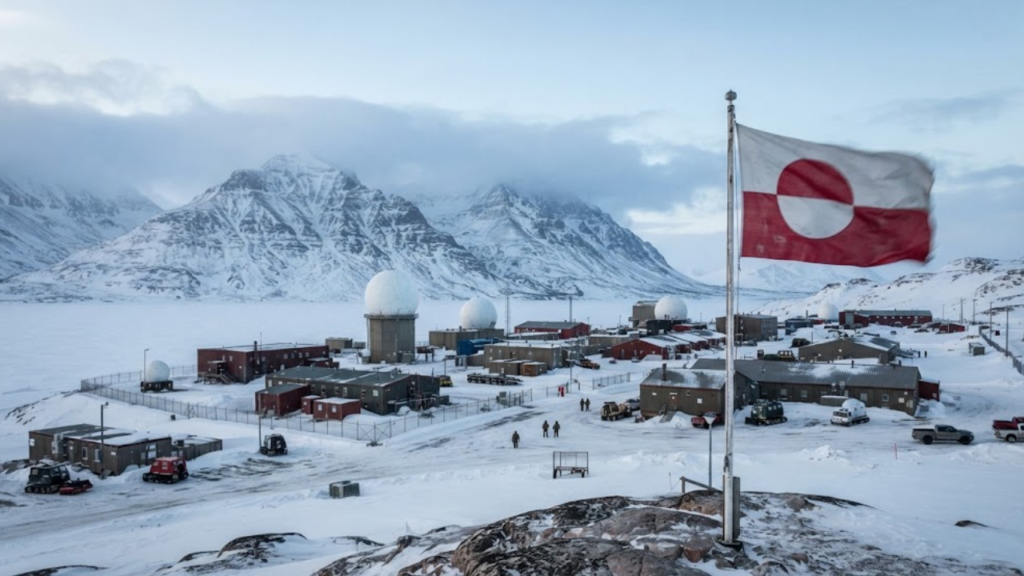
The Greenland security deal announced by President Donald Trump on Friday would give the United States open-ended access to the island for defense, including the option of building more bases. The governments of Denmark and Greenland confirmed that they reached a deal.
Trump said the arrangement gives Washington “permanent control over security, and all other needs, in Greenland.” Danish officials say the agreement is not final, and it stops far short of Trump’s long-stated goal of taking possession of the territory. Much of the detail so far comes from Trump’s post and from unnamed US officials. That makes it useful to separate what all three governments have said from what only Washington has described.
Greenland security deal at a glance
- Trump announced the deal on Friday, September 18, 2026. Both the Danish and Greenlandic governments confirmed an agreement was reached. Denmark’s prime minister’s office says all three governments plan to sign next week, during the UN General Assembly in New York. Two US officials told CBS News the signing is expected on Tuesday.
- Danish Prime Minister Mette Frederiksen’s office says the text recognizes the sovereignty and territorial integrity of Denmark and Greenland, and their peoples’ right to self-determination. The Danish and Greenlandic governments still need parliamentary action before the deal can be enforced. Frederiksen also called the deal good for NATO and Europe. Greenland’s prime minister, Jens-Frederik Nielsen, called it gratifying and said it recognizes Greenland’s interests. Neither government has described specific terms.
What US officials say the Greenland security deal contains
The detail comes from a State Department official who spoke anonymously. According to that official, the US is guaranteed permanent access and overflight rights, which could allow more bases. Non-NATO countries would be blocked from setting up bases, and adversaries would be restricted from sensitive investments. The official also said China and Russia are guaranteed no base on the island. CBS News carried the official’s account.
Fox News reported a further point from a senior US official. Denmark and Greenland would not have approval authority over additional US installations. Neither government has confirmed or disputed this, so treat it as unverified until the text is published. Trump did not say where the new military presence would be or how large it would be. He also wrote that the deal would cost the United States nothing. No financial terms have been reported.
How much is actually new
Greenland is not starting from zero. The US already runs Pituffik Space Base in the northwest, which supports missile warning, missile defense and space surveillance for the US and NATO. At the height of the Cold War, more than 10,000 US troops were stationed at the site, then known as Thule. FortuneHISTORY
The 1951 defense treaty was already generous to Washington. As updated in 2004, it lets the US raise troop numbers as long as Danish and Greenlandic authorities are told in advance.
So the real change is about control rather than presence. On the reported terms, notification would give way to no approval requirement, and a treaty tied to NATO membership would give way to a permanent arrangement.
What permanence means for Greenland’s independence path
The State Department official said the deal would stay in force even if Greenland becomes fully independent. That matters because the island has been drifting politically toward independence. Under Greenland’s self-government law, independence requires negotiations with Denmark, consent from Greenland’s parliament, a referendum, and consent from the Danish parliament. A permanent security arrangement would become a condition attached to any future independent Greenland.
Greenland’s population was about 56,500 in 2022, and those residents did not negotiate the deal directly. Greenlanders gain written recognition, according to their own government, that their right to self-determination stands. What they give up depends on the unpublished text. The open questions are how much say they keep over new bases, what “sensitive investments” covers, and whether permanence can ever be revisited.
How the Greenland security deal got here
The agreement follows a tense year. Trump pressed Denmark to sell the island and declined to rule out taking it by force. Denmark and Greenland repeatedly said it was not for sale. He also threatened tariffs of up to 25 percent on Denmark and other European countries. In January, Trump backed off the tariff threats, ruled out taking Greenland by force, and announced a framework with NATO Secretary-General Mark Rutte. That framework was vague. Nielsen said then that he did not know what was in it, and that only Greenland and Denmark had the mandate to make agreements about the island.
The Telegraph reported that the framework might designate US bases as American territory, modeled on Britain’s arrangement in Cyprus. Nielsen and Frederiksen rejected the idea of the US claiming sovereignty over land for bases. Denmark’s defense minister said, “We will not cede sovereignty over parts of the kingdom.” Reporting on Friday’s deal describes no such clause. Without the text, though, that cannot be ruled out.
The justification for US control has also been contested. The Associated Press has reported that Trump’s claims of Chinese and Russian forces lurking off Greenland’s coast were false. Danish officials, for their part, had said for months that they were ready to work with Washington on expanding its military presence.
Contested geography is not limited to the Arctic. Our earlier report on the Houthi attack involving Red Sea islands and Saudi Arabia looks at another strategic waterway where outside powers are pushing their interests.
What happens next for the Greenland security deal
Three things will show how big this deal really is. The first is the published text, especially any language on approval rights for new bases and how the permanence clause works. The second is the signing in New York, which should show whether all three governments describe the same document. The third is parliamentary review in Copenhagen and Nuuk, where lawmakers can examine terms the public has not yet seen.
[…] Greenland’s new security deal shows how differently Western governments respond when a strategic territory, rather than a […]
[…] political fallout reached Greenland’s own ballot box. The territory’s opposition to Trump’s threats helped fuel a landslide win for Prime Mini…– a result widely read as Greenlanders rejecting the idea that their future was […]