
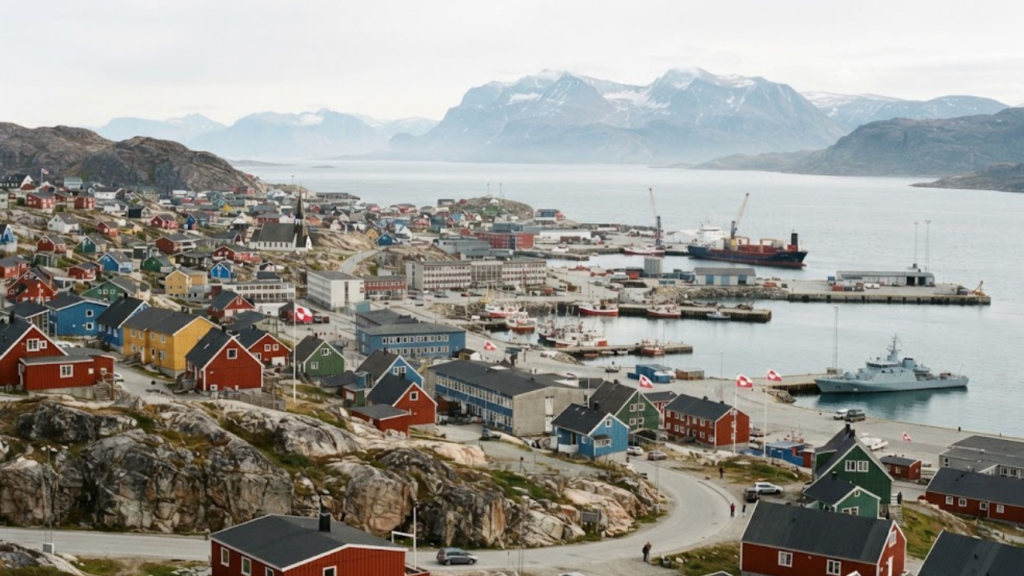
The Greenland NATO security dispute at the center of this week’s signing in New York already has two competing explanations, and neither government is calling the other one wrong. President Trump says the agreement hands Washington “permanent control” over Greenland’s security. Danish Foreign Minister Lars Løkke Rasmussen, in a Sunday interview with broadcaster TV2, described something else entirely – an arrangement where, in his words, “responsibility for security in the Arctic is not only Danish or American,” with NATO taking on much of that role instead.
Copenhagen isn’t disputing Trump’s version of the Greenland NATO security dispute. It’s simply describing the same agreement in different terms and letting the gap speak for itself
How the Greenland NATO Security Dispute Started
Nine months ago, this wasn’t diplomacy – it was a crisis. Trump spent early 2026 refusing to rule out military or economic force to bring Greenland under American control, at times describing the island as essential to US security regardless of what Copenhagen wanted. NATO allies took the threat seriously enough that Belgium, Estonia, Finland, France, Germany, Iceland, the Netherlands, Norway, Slovenia, Sweden and the UK carried out Arctic military exercises through the year, partly aimed at deterring exactly that outcome.
The political fallout reached Greenland’s own ballot box. The territory’s opposition to Trump’s threats helped fuel a landslide win for Prime Minister Jens-Frederik Nielsen’s party in last year’s election – a result widely read as Greenlanders rejecting the idea that their future was Washington’s or Copenhagen’s to decide alone.
Trump eventually stepped back from the threat of force. This week’s signing is the paperwork version of that retreat, framed publicly as partnership rather than retreat. Rasmussen arrived in New York for the signing while still declining to release the text. Erik Jensen, a Greenlandic opposition lawmaker who says he’s read the draft, gave a notably restrained reaction: he’s “not worried.” After how tense this dispute became in January, that’s a low bar – clearing it isn’t the same as endorsing what’s inside.
What the Deal Might Actually Change on the Ground
Washington already has a physical foothold in Greenland under a 1951 defense treaty – Pituffik Space Base, in the island’s northwest, remains the only American military installation there.
Whatever this week’s agreement adds to the Greenland NATO security dispute, it isn’t a first-time US presence; it’s a renegotiation of how much authority comes attached to a presence that already exists. A NATO spokesperson called the agreement a step that would “advance security, stability and cooperation” in the Arctic – the kind of statement the alliance makes whenever it wants to sound supportive without committing to specifics. What’s still unclear is whether shifting oversight toward NATO changes the terms of that 1951 pact at all, or whether this mostly reshuffles who gets to claim credit and who gets to claim restraint.
That distinction is the real story behind this Greenland NATO security dispute. If NATO’s role turns out to be mostly symbolic – a face-saving frame that lets Trump call it “control” and Denmark call it “shared” — then Tuesday resolves a political standoff without changing much on the ground. If NATO’s involvement is structural, giving the alliance genuine say over decisions that used to belong to Denmark and the US alone, that’s a real shift in how the Arctic gets governed.
It would matter well beyond this one island, shaping how Russia and China’s own Arctic ambitions – from shipping lanes opened by melting ice to interest in the region’s rare earth deposits – eventually get handled by the alliance as a whole rather than by Washington alone. Reuters reported that the agreement’s full contents remain undisclosed ahead of the signing. Whichever description turns out closer to the truth – Trump’s or Rasmussen’s — will say more about where this relationship actually stands than either government’s talking points do right now.