
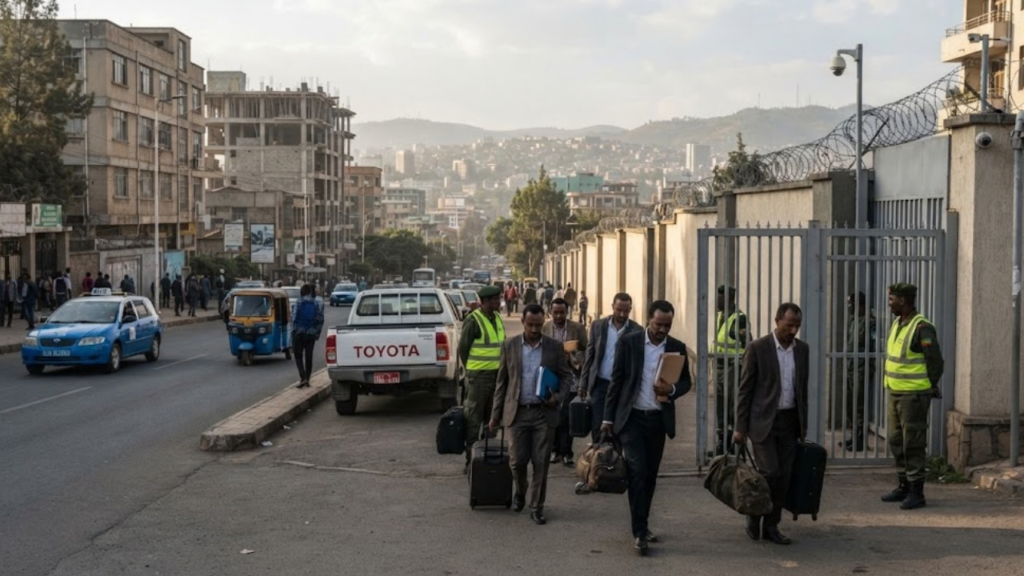
Eritrea severs diplomatic ties with Ethiopia hours after Addis Ababa ordered its embassy in Asmara closed and declared 10 Eritrean diplomats persona non grata on Thursday, October 1, the formal status that requires a diplomat to leave. Ethiopia gave them 48 hours and accused Eritrea of hostile acts. Eritrea rejected the claims and said it had no option but to respond in kind, as Ethiopian federal forces fight an armed opposition alliance in the north.
Ethiopia’s Foreign Ministry said its measures answered Eritrea’s “direct and indirect acts of hostility and belligerence.” It said the 10 diplomats, who include the chargé d’affaires and staff accredited to the African Union, took part in activities that threaten national security and breach the Vienna Convention on Diplomatic Relations. The ministry gave no details of those activities or of how the embassy would close, and said it still values ties between the two peoples, even as Eritrea severs diplomatic ties at the state level.
What Ethiopia alleges and what Eritrea answers
Addis Ababa accuses Eritrea, Sudan and Egypt of supporting the opposition alliance, led by the Tigray People’s Liberation Front (TPLF), that has fought federal troops since last week. All three countries deny it, according to Reuters. Eritrea’s Foreign Ministry called the allegations of hostile activity astounding and said it had shown restraint. No evidence for the accusations had been published in the reporting reviewed for this article.
Eritrea’s information minister, Yemane Gebremeskel, told Reuters that expelling all Eritrean diplomats effectively closes Eritrea’s embassy in Addis Ababa. Reuters also reported that Asmara has said it fears Ethiopia will try to take the Red Sea port of Assab by force, a claim Ethiopia has not been reported to have answered. Ethiopian state broadcaster EBC and two sources said Ethiopia also expelled an Egyptian diplomat.
The fighting behind the diplomatic break
The alliance, which calls itself the Ethiopian Peoples’ Forces Alliance for Survival, unites seven armed groups, including the TPLF and groups from the Amhara, Afar, Somali and Benishangul-Gumuz regions, with the stated aim of removing Prime Minister Abiy Ahmed. Federal forces are advancing in southern Tigray toward the regional capital, Mekelle, while the alliance has taken towns in Afar. Reuters reported tens of thousands of people displaced.
Overnight blasts were heard in Addis Ababa, three diplomatic sources told Reuters. A source linked to the alliance said it carried out drone strikes there, including on military headquarters, but this had not been independently verified. If confirmed, it would be the first known drone attack on the capital by anti-government forces. The TPLF describes its campaign as a defensive war against federal drone and artillery strikes.
Why Eritrea severs diplomatic ties after the 2018 reconciliation
The break reverses a reconciliation that ended two decades of hostility after the 1998-2000 border war. Abiy and Eritrean President Isaias Afwerki restored relations in 2018, embassies reopened, and Abiy won the 2019 Nobel Peace Prize. Eritrean troops later backed federal forces in the 2020-2022 Tigray war, which the African Union estimated killed about 600,000 people, before the 2022 Pretoria peace agreement ended it.
Relations soured over Ethiopia’s demand for sea access. Ethiopia has been landlocked since Eritrea became independent in 1993, and Abiy said in October 2025 that the claim was “irreversible” while insisting Ethiopia had no intention of going to war. Eritrea reads talk of Assab as a threat to its sovereignty. An analysis published by The Conversation noted that Assab lies within Eritrea’s internationally recognised territory.
What changes after Eritrea severs diplomatic ties, and what remains unknown
Ethiopia’s embassy in Asmara, reopened under the 2018 deal, is to close, and the expelled Eritrean diplomats include officials accredited to the African Union, whose headquarters is in Addis Ababa. It was not clear how Eritrea will now be represented there. The reporting reviewed did not say whether consular services or movement across the border would be affected, and no statement from the African Union or the UN had been found.
Abiy asked last year for international mediation over sea access, naming the United States, China, Russia, the African Union and the European Union. No new mediation effort had been announced when this was written. Still unresolved are the evidence behind Ethiopia’s allegations, who carried out any drone strikes in Addis Ababa, and how the embassy closures will proceed. HCN will update this story as verified facts emerge.